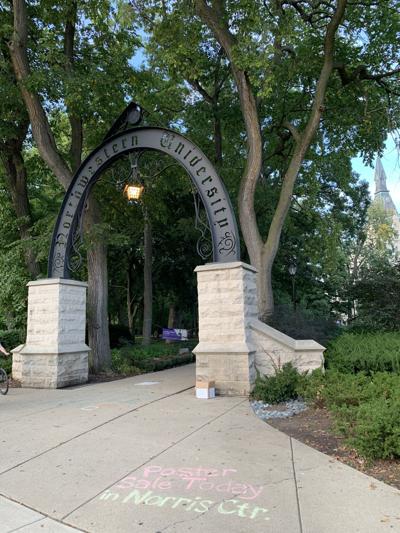


Northwestern University, Evanston, Illinois
CHICAGO — Jewish students can't sue Northwestern University for failing to throttle protests and campus-takeover "encampments" supporting Palestinian liberation, which the plaintiffs said turned the Northwestern campus into an openly antisemitic "dystopic cesspool of hate."
The firm of Much Shelist PC, of Chicago, had originally filed the suit in May 2024 in Cook County Circuit Court on behalf of three unnamed Jewish students, identified only as Jane Doe and John Doe 1 and 2. According to the complaint, John Doe 1 was an undergraduate resident student at Northwestern, while John Doe 2 and Jane Doe were graduate students living off campus in Evanston.
The complaint accused Northwestern of a “gross breach” of its contract with the students by permitting and “coddling” what they called openly antisemitic pro-Hamas protests, saying the university should pay for allowing Jewish students to be subjected to the antisemitic actions and threats that were established in and spread from an encampment in the center of the school’s lakefront campus.
Northwestern removed the case to federal court in Chicago.
In an opinion filed in March, U.S. District Judge John Blakey largely granted Northwestern’s motion to dismiss the complaint.
Blakey summarized allegations included in the most recently amended version of the complaint, drawing the origins of the incident from the Hamas network’s Oct. 7, 2023, terrorist attacks on Israel, including references to social media posts from Northwestern faculty and school programs, such as the Women’s Center and the Asian American Studies Program, as well as faculty at the school’s satellite campus in Qatar.
According to Blakey, the complaint documented several incidents of stridently antisemitic depictions, statements and actions. But those allegations alone don’t establish a violation of Title VI of the Civil Rights Act, specifically the existence of a hostile educational environment, because of pleading requirements regarding what school officials knew and when, the judge said.
“They allege a Title VI violation based upon ‘many other incidents on campus’ which contributed to the hostility they endured,” Blakey wrote. “But plaintiffs do not plead any facts about what these ‘other incidents’ involve; nor do they allege how these ‘other incidents’ were reported to Northwestern officials, or that those officials otherwise had actual knowledge of such incidents. For example, John Doe 2 alleges that he was the subject of a ‘derogatory and harassing online post.’ Yet plaintiffs do not allege anyone reported this post to Northwestern officials, or that Northwestern officials had actual knowledge of the post.”
The complaint likewise lacks specifics about Doe 3 encountering “antisemitic rhetoric, online harassment or false accusations,” Blakey wrote, or his interaction with a protestor May 1, 2024.
“Across all the alleged instances of severe, pervasive and objectively offensive conduct (that certainly deprived plaintiffs of access to educational opportunities as alleged), there is just one — the encampment — where plaintiffs allege facts to show school officials had actual knowledge. There, plaintiffs’ claims of deliberate indifference also lack sufficient factual detail, but for a different reason.”
Though the complaint alleged specifics, such as Northwestern turning off automatic sprinklers that might’ve dispersed protestors or being generous in negotiations seeking to end the encampment, Blakey said the law required the students to allege the school’s response “is not so unreasonable, under all the circumstances, as to constitute an ‘official decision’ to permit discrimination,” a phrase drawn from a 2022 U.S. Seventh Circuit Court of Appeals decision, C.S. v. Madison Metropolitan School District.
Even negligence doesn’t necessarily reach the Title VI benchmark for being unreasonable, Blakey said. He pointed to a 2025 opinion from the U.S. First Circuit Court of Appeals, StandWithUs Center for Legal Justice v. Massachusetts Institute of Technology, which also delt with a pro-Palestine campus encampment following Oct. 7.
“In rejecting the plaintiffs’ Title VI claims, the court in StandWithUs wrote that MIT ‘took steps to contain the escalating on-campus protests,’ with an ‘evolving and progressively punitive response,’ first by trying to ‘peacefully clear the encampment,’ then by using suspensions and arrests,” Blakey wrote. “As a result, the court held, MIT’s response was not ‘clearly unreasonable.’ The court added that to fault MIT for ‘a failure of clairvoyance and a perhaps too measured response’ would ‘send the unhelpful message that anything less than a faultless response’ would ‘earn no positive recognition in the eyes of the law.’ ”
Harvard ran afoul of the law, Blakey said, by allowing a camp to be undisturbed for three weeks and noting university police didn’t react to a protestor approaching and shoving a Jewish student. At Cooper Union for the Advancement of Science and Art the school president ordered officers to stand down while protestors menaced Jewish students, and Blakey said those “failures too were ‘clearly unreasonable’ and amounted to deliberate indifference.”
By contrast, the Doe allegations detail what Northwestern administrators did to end the encampment within four days, including having school police issue citations to protestors who refused orders to remove tents. That the school tried to explore “other options” than what the Does find appropriate is not improper under Title VI, Blakey said, noting the law doesn’t “mandate a specific set of increasingly punitive measures to remove hostile environments, and courts ‘must hesitate to second guess’ officials’ judgments to find the appropriate response.”
The Jewish plaintiffs also accused Northwestern of intentional Title VI discrimination, specifically through the Qatar campus and an Al-Jazeera partnership, but Blakey said their theory doesn’t “explain how Northwestern’s decision to establish a campus in Qatar demonstrates discriminatory intent on the part of Northwestern, and their arguments remain predicated upon conclusory allegations. Plaintiffs also plead no facts explaining how Northwestern is acting to ‘placate’ Qatar, and they allege no non-conclusory facts plausibly showing a connection between Northwestern’s foreign partnerships and its actions toward antisemitism on its Evanston campus.”
The Does’ evidence included picture of a poster stating “NU Qatar 4 a Free Palestine,” but that alone doesn’t show Title VI discriminatory harassment, Blakey said. Nor do allegations about Qatari faculty speaking in Evanston, absent facts about those professors engaging in discrimination, he said.
The judge likewise said social media posts alone can’t form the basis of a claim, especially without allegations the Does “even encountered the posts, or that the posts affected the programs plaintiffs were enrolled in.”
Finally, Blakey said the Does failed to allege indirect discrimination by contrasting their experience with the school’s response to white supremacist stickers on campus or formal statements following George Floyd’s murder. The plaintiffs, he wrote, “have not put forth a’ single example of a similarly situated individual’ outside their protected class that ‘received the response’ plaintiffs sought from Northwestern upon complaining of harassment.”
He then declined to decide the question of supplemental jurisdiction over a state law contract breach claim and allowed the plaintiffs 45 days to amend their complaint.