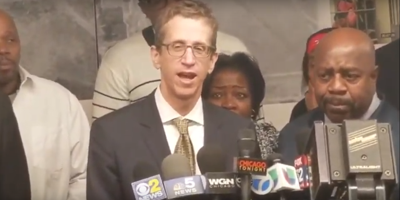


Attorney Jon Loevy, of the firm of Loevy + Loevy, of Chicago
CHICAGO — A federal judge in Chicago has tossed a defamation lawsuit in which two Loevy & Loevy attorneys sought $600 million from their former cannabis dispensary business partners.
Civil rights lawyers Jon Loevy and Michael Kanovitz also own majority interests in Illinois-based Justice Cannabis, a group of companies. They filed the complaint against Leonard and Robyn Tannanbaum, the founders and owners of Advanced Flower Capital, AFC board members Bernard Berman, Alexander Frank, Thomas Harrison, Robert Levy and Marnie Sudnow, and Dan Neville, who is CEO and minority owner of AFC Management.
U.S. District Judge Jeremy Daniel dismissed the complaint in an opinion filed Aug. 18.
According to court records, the dispute traces to several loan agreements culminating in a 2024 forbearance in which the defendants required Justice Cannabis to retain Tim Bossidy as a chief restructuring officer managing New Jersey operations without input from Justice.
Daniel said that during those negotiations, “Neville began to discuss a plan to create a multistate cannabis business with Bossidy at the helm.” Loevy and Kanovitz said despite Bossidy’s fiduciary duty to Justice, he “took direction only from the defendants and never spoke to either the plaintiffs or Justice Cannabis CEO Alexzandra Fields during his tenure in charge of New Jersey operations,” according to Daniels’ summary.
As New Jersey sales fell off by more than half, while an inventory backlog increased more than five times over, Loevy and Kanovitz claimed AFC and Bossidy refused to hire more employees, delayed payments to vendors, sold products at below-market prices to benefit AFC borrowers and kept Justice from being able to pay off loan principal.
Loevy and Kanovitz filed a federal lawsuit in New Jersey in March 2025 after the defendants refused to produce Bossidy’s emails as part of a review into whether he violated fiduciary duties. That complaint, Daniel explained, “accused the defendants of mismanagement and incompetence, causing breach of contract, interference with fiduciary duties to Justice Cannabis and conspiracy with Bossidy to cause Justice Cannabis to fail. In doing so, it alleged $200 million in damages against AFC and that the defendants made up fake defaults to foreclose on the cannabis assets as a plot to steal and appropriate the licenses.”
That led to a flurry of threatened and realized litigation and financial action on both sides, including the defendants lodging a racketeering complaint in federal court in New York, claiming Loevy and Kanovitz stole $50 million from AFC. Defendants also made media statements asserting Loevy and Kanovitz alleged “defrauded AFC to line their own pockets and prop up other business ventures.”
The court documents do not specify which "other business ventures" the defendants claimed Loevy and Kanovitz may have allegedly "propped up" with the funds.
Loevy and Kanovitz both practice law through the Loevy & Loevy firm. The firm has particularly generated headlines and many millions of dollars in fees through lawsuits aimed at the city of Chicago on behalf of people who claim they were wrongly convicted of murder after Chicago Police detectives allegedly coerced false confessions.
The firm stands at the center of a still-brewing controversy surrounding some of those court cases. In one of the cases, former Cook County State's Attorney Kim Foxx testified under oath that she and others in her office decided not to oppose efforts by those who had been freed to pursue so-called "certificates of innocence" from the courts, even though Foxx said prosecutors didn’t necessarily believe they were actually innocent of the murder charges.
The certificates of innocence have since been used by some of those people, including some represented by the Loevy firm, to back their lawsuits against the city of Chicago in pursuit of multi-million dollar settlements or judgments.
Those alleged wrongful conviction lawsuits were not referenced in the court documents in the court fight between Loevy, Kanovitz and their former cannabis dispensary business partners.
In the cannabis dispensary case, a New Jersey judge ruled Justice hadn’t violated the loan terms and barred foreclosure proceedings.
Loevy and Kanovitz then filed the defamation suit in Chicago in April 2026 based on the New York lawsuit, with damages estimated from $350 million to $600 million. But Daniel said that complaint wasn’t properly filed in Illinois.
“The sole allegation regarding the defendants’ aiming their conduct at Illinois is that statements to Law360 are targeted at the Illinois legal community, and the defendants knew, in making the statements, that they would be published in Illinois,” Daniel wrote. “But this is conclusory at best and does not provide sufficient factual matter explaining how the defendants’ statements to Law360, which is a national publication, are somehow targeted specifically at Illinois or made in Illinois, nor does it point to any other connection that the defendants established with Illinois in making the statement or ensuring that the plaintiffs’ reputational harms in Illinois would be achieved.”
Daniel noted the statements didn’t tie Loevy or Kanovitz to Illinois either personally or professionally, and while they “adequately alleged that they have suffered harm in Illinois because of the defamatory statements, the fact that the plaintiffs have suffered harm in Illinois is not enough to establish personal jurisdiction.”
He granted the motion to dismiss without prejudice, adding dismissal on jurisdictional grounds means not addressing other arguments. However, Daniel also rejected the defendants’ motion for sanctions, which they argued were appropriate because the lawyers and their representatives should’ve known they lacked standing.
“Sanctions are appropriate,” Daniel wrote in summarizing the position, “because Norton Rose Fulbright should have known that the argument for personal jurisdiction was ostensibly foreclosed by 40 years of Supreme Court case law and that the plaintiffs have attempted to reintroduce this argument after it failed in California state court.”
Daniel disagreed, saying U.S. Seventh Circuit case law has been inconsistent, while further acknowledging “colorable arguments that the defendants’ conduct was calculated and ‘expressly aimed’ at harming the plaintiffs in the community in which they have built their legal practice.”
Loevy and Kanovitz have until Sept. 8 to amend their complaint.
Jonathan Bilyk contributed to this report.