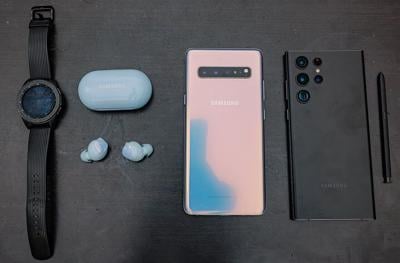


Samsung smartphones and other devices
CHICAGO — People trying to sue phone makers under Illinois' biometrics privacy law need to do more than merely accuse the companies of installing a camera and an app to process the photos on a mobile device, a federal appeals court has ruled.
On Aug. 7, a three-judge panel of the U.S. Seventh Circuit Court of Appeals sided with device making giant Samsung, which is defending itself against an attempt by trial lawyers to extract a potentially massive payout using a class action lawsuit lodged under the law known as the Illinois Biometric Information Privacy Act (BIPA).
In the ruling, the judges said they believed the plaintiffs had fallen short of establishing their case that Samsung, through the Gallery photo app that comes preinstalled on Samsung Android smartphones, had illegally scanned the faces of people whose images are captured in photos taken by the phone's camera and processed and stored in Gallery.
The judges agreed the plaintiffs had not established Samsung ever actually "possessed" the images or any kind of data that may have been generated from any face scans conducted by the Gallery app.
The decision was authored by Seventh Circuit Judge John Z. Lee. Seventh Circuit Chief Judge Michael Brennan and Judge Candace Jackson-Akiwumi concurred in the decision.
"Manufacturing a device (and installing related software) that allows a user to voluntarily take pictures of onself, friends, family, and other passersby and, in the process, create face templates that remain parked within the confines of the user's own personal device not only falls short of triggering BIPA's statutory requirements but strays too far afield from the statute's heartland," Lee wrote in the court's opinion.
The decision upheld a 2024 ruling from U.S. District Judge Lindsay C. Jenkins, who had similarly ruled that Samsung had never possessed nor retained the face scans at the heart of the case.
The lawsuit was first filed in Cook County Circuit Court in 2021 by attorneys Keith J. Keogh and others with the firm of Keogh Law Ltd., of Chicago. The lawsuit was nominally filed on behalf of a then-11-year-old Champaign resident identified only as G.T., and her "next friend," Liliana T. Hanlon.
They later were joined in the action by attorneys from the firm of Lowey Dannenberg P.C., of White Plains, New York, in a complaint filed on behalf of named plaintiffs Shimera Jones, LeRoy Jacobs, Balarie Cosby-Steele, John DeMatteo, Richard Maday, Mark Heil, Allison Thurman and Sherie Harris.
However, the plaintiffs indicated they sought to expand the action to include potentially thousands of additional plaintiffs, and perhaps more.
The lawsuit claims the Gallery app improperly scans the faces of people pictured in photos and videos stored on Samsung phones, allegedly without first securing written consent or without providing certain notices, as allegedly required under the BIPA law.
The lawsuit was similar to thousands of other class actions filed against software companies, tech vendors, employers and others under the BIPA law since 2015. Those lawsuits all generally accuse companies of alleged unauthorized scans of people's so-called unique "biometric identifiers," including fingerprints, "voice prints" and facial geometry, among others.
Just as the other lawsuits, the suit against Samsung also seeks a potentially massive payday.
Under the BIPA law, plaintiffs are allowed to demand damages of $1,000-$5,000 per violation. The Illinois Supreme Court had interpreted the BIPA law to define individual violations as each time a company's software scans someone's face, fingerprint or other biometric identifier.
When multiplied across an unknown number of scans conducted on potentially thousands of plaintiffs, potential damages could have quickly soared into the many millions or even billions of dollars.
More recently, Illinois state lawmakers took action to reform the BIPA law to explicitly define an "individual violation" as being the first such allegedly improper scan. Thus, damages could only be multiplied per alleged victim, and not per scan.
And courts have interpreted those reforms to apply to lawsuits filed before the legislation was passed, such as the lawsuit against Samsung over alleged Gallery face scans.
However, even with the changes, the potential payout could have been very large, runing potentially into the hundreds of millions of dollars.
But in Chicago federal court, Judge Jenkins powered down the lawsuit against Samsung.
While she conceded the Gallery app may scan the faces of people featured in images stored on phones using the app, Jenkins said the plaintiffs couldn't establish Samsung ever "controlled" the face scan data, within the meaning of the BIPA law defined by the courts.
While the plaintiffs appealled, the Seventh Circuit judges concluded their claims remained flawed.
"... Nowhere in the complaint do Plaintiffs allege that the facial geometry data that they captured using their devices were saved on anything but the devices themselves," Lee wrote. "Nor do Plaintiffs allege that Samsung somehow forced them to take pictures with faces or that Samsung has the ability to access, modify, or use facial geometry data in any way."
The appeals court affirmed Jenkins' decision to dismiss the case.
Samsung has been represented in the case by attorneys Mark H. Boyle, of the firm of Donohue Brown Mathewson & Smyth, of Chicago; Randall W. Edwards, Matthew D. Powers and Ashley M. Pavel, of O'Melveny & Myers, of San Francisco and Newport Beach, California.
,