
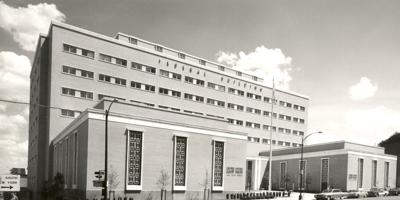


Abraham A. Ribicoff Federal Building in Hartford, Conn.
HARTFORD, Conn. – A federal judge has rejected a $3.6 million settlement for users of dry shampoo, prolonging a case started after a controversial testing lab found benzene in several products.
Judge Michael Shea on Tuesday refused to give preliminary approval to the deal with Unilever, which would have paid class-action lawyers $1.2 million. The case alleges consumers would not have paid as much for brands like Dove, Suave and TRESemme had they known about the presence of benzene, a carcinogen when exposure is in high enough amounts.
Members of a nationwide class lack standing to recover funds from the settlement, Shea wrote, because not every line tested by the Connecticut-based lab Valisure, a firm recently featured in an American Tort Reform Association Report on “junk science,” showed dangerous amounts of benzene.
“(A)bsent direct proof of contamination, the class must be defined to include only persons who purchased a particular product line found to be contaminated by third-party testing,” Shea wrote.
“Otherwise, the proposed class includes persons who lack standing.”
The firms Silver Golub & Teitell, Sauder Schelkopf and Squitieri & Fearon on May 5 filed their proposed settlement of a class action lawsuit against Unilever. Like other firms in cases over other products, they cited the findings of Valisure in their 2022 complaint. Steven Bloch of the Silver firm signed the document.
In court records, Unilever cited a September 2022 letter from Valisure’s lawyer, Marty Sipple, offering to test aerosol products for benzene for an up-front payment of $1.25 million and $250,000 a month, promising to keep results confidential.
In that court filing, Unilever suggested Valisure might have been offering to keep test results for its products out of a petition it later filed with the FDA, which has rejected Valisure's findings in two other petitions.
In motions to dismiss the case, Unilever and other defendants argued the plaintiffs lacked standing because they didn’t include specific allegations as to which products were purchased and when and where they were.
Shea took up that issue on his own after the motions were deemed moot by the proposed settlement. Though one of the named plaintiffs did establish standing, the definition of the class to receive money from the agreement was too broad, he ruled.
The class definition includes purchasers all the way back to 2014, though the testing was conducted many years after that start date. Products covered in the settlement would seemingly be non-contaminated varieties of dry shampoo, Shea wrote.
Plaintiff lawyers argued the results of the testing show the benzene contamination was widespread at the defendants’ manufacturing facilities.
“The named plaintiffs are, in other words, asking me to infer – based on product recalls, third-party testing and an FDA ‘warning letter,’ that the contamination was so widespread as to include all product lines sold under the… brands,” Shea wrote.
“But that is a stretch too far under the fact-specific standing analysis [an earlier case called Johns] requires, and I am not permitted to draw such loose inferences.”
Lawyers say about 10 million units were possibly subject to benzene contamination. The entire settlement was worth $3,625,000. Using a method to determine damages that includes a "price point" at which consumers would have preferred the products be sold, the lawyers said the settlement represents a 24% recovery compared to the best outcome possible at trial.
Those with proofs of purchase would have gotten a full refund. Those without could have recovered $3 per product, with a cap at $12 per household.
Lawyers will now have to rework the class definition and submit a new agreement to Shea.
Valisure's citizen petitions with the FDA bring lawsuits. The same day it announced a petition claiming acne medications contain benzene, Bloomberg and CNN ran stories about the “cancer-causing chemical” in benzoyl peroxide-containing acne medicine.
Companies usually settle these cases despite Valisure’s checkered history, including the fact founder David Light served time in prison for possessing a cache of illegal weapons while he was still an undergraduate at Yale.
Dozens of suits followed Valisure's testing on acne medication. But they are in jeopardy now, after the FDA tested 95 acne drugs and found only six lots with with small problems, all nearing their expiration dates.
"Even with daily use of these products for decades, the risk of a person developing cancer because of exposure to benzene found in these products is very low," the FDA wrote.
The FDA went on to warn labs like Valisure to use validated testing methods, saying Valisure's processes may result in much higher reported levels of contaminants like benzene.
"FDA has continued to raise concern that use of unvalidated testing methods by third-party laboratories can produce inaccurate results leading to consumer confusion," the FDA said.
Valisure heated acne medicines to 170 degrees Fahrenheit and found "concerningly high levels of benzene in only 18 days." Valisure said the temperature was a reasonable estimation of what might occur in a shipping container or a hot car.
It was a similar process that produced NDMA in the heartburn medicine Zantac. Valisure created an artificial stomach, heated it to 266 degrees and exposed it to a level of salt that would kill a human.
And though the FDA similarly rejected those findings, lawsuits pressed on. A federal judge in Florida dismissed about 50,000 lawsuits after finding Valisure's methods didn't fit expert witness standards, and the Delaware Supreme Court did the same to cases in that state’s courts. A California judge reached the opposite conclusion and allowed lawsuits there to proceed.