
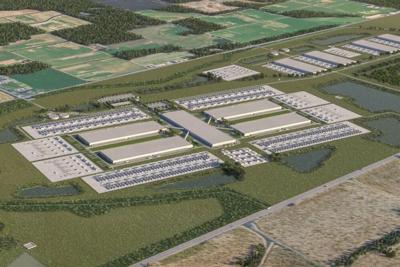



An artist’s rendering shows the layout of the data center planned for northeast Louisiana in Richland Parish.
Louisiana utility regulators have decided not to require Meta Platforms to turn over information justifying a proposal to build seven new natural gas power plants to serve a data center project in Richland Parish, despite a judge’s opinion that Meta should do so.
Melanie Verzwyvelt, an administrative law judge in the Louisiana Public Service Commission’s (LPSC’s) Administrative Hearings Division, sided with nonprofit groups last week by rejecting Meta’s motion to stop nonprofit groups from subpoenaing the company to turn over the records.
In a decision issued on Aug. 4. Verzwyvelt denied Meta’s motion to quash a move by the Alliance for Affordable Energy and the Union of Concerned Scientists for a subpoena for the production of Meta documents. But the LPSC voted 3-1 today to vacate the subpoena meaning the company will not have to disclose the data.
The dispute in question emerged after Entergy Louisiana filed an application with the LPSC for approval to add more than five gigawatts of electricity generation as well as battery storage and transmission enhancements to serve the Meta data center project.
The nonprofit groups sought the release of reports and data demonstrating the number of permanent jobs the Richland Data Center will create, the amount of electricity load the project will require, load variability over time and communications between Entergy and Meta about the development.
On its web page describing the project, Meta said the $50 billion data center would result in 1,000 new permanent jobs and 7,500 temporary construction jobs.
The New Orleans-based Alliance for Affordable Energy said potential impacts of the project on Louisiana ratepayers and the public require Meta to provide additional documented evidence about its plans.
“When a private project could raise utility bills, reshape the grid and lock ratepayers into billions of dollars and decades of new fossil-fuel infrastructure, the public deserves more than a corporation’s word,” a news release published last week by the alliance states.
"We’re disappointed that the LPSC sided with a trillion-dollar corporation’s right to secrecy over the public’s right to know the facts before billions of dollars in costs and risks are locked in," Logan Burke, executive director of the Alliance for Affordable Energy, said in a statement emailed to The Louisiana Record. "Meta shouldn’t get to decide for itself what information the commission needs to see to make a decision that is in the public interest, especially when Louisianans are the ones who will pay the price if their projections don’t hold up."
Meta has argued that responding to the subpoena request could compromise confidential or trade secret information, including proprietary data on economic modeling, workforce planning and investment projections. But Verzwyvelt pointed out in her decision that the LPSC has rules to protect confidential data.
“Meta's position is that it should not have to provide documentation substantiating load needed by the data center, and (Entergy Louisiana) has indicated that it lacks the data underlying the assertions in its testimony,” she said. “This is troubling, given that the capacity need is a threshold issue in the commission's determination regarding whether or not the application is in the public interest.”
In short, Meta’s arguments were insufficient to justify a motion to quash such a subpoena seeking the economic data underlying the data center project, according to Verzwyvelt.
“Meta's warning that it is not advisable as a matter of public policy to require customers to produce the type of data requested in the subpoena, and that doing so will have a chilling effect on new business in Louisiana, rings hollow when Meta refuses to provide any evidentiary support for its claims,” she said.
Neither Meta nor Entergy provided a comment to The Louisiana Record about the dispute.