
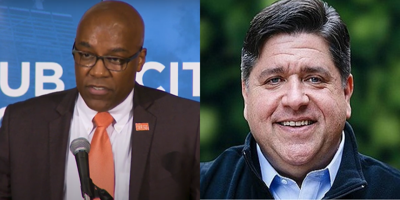



Illinois Attorney General Kwame Raoul and Gov. JB Pritzker
EAST ST. LOUIS - Illinois has no constitutional authority to empower the state's trial lawyers and social justice organizations to use state courts to sue and "harass" federal immigration agents over their efforts to enforce federal immigration law, nor to set boundaries for where immigration agents can make arrests.
Those are the claims leveled by the Justice Department in their latest lawsuit filed against Illinois Gov. JB Pritzker and Illinois Attorney General Kwame Raoul amid the continued multi-front legal fight over Illinois' sustained and varied attempts to resist federal immigration law enforcement in the state.
Already, Illinois and the Justice Department, under President Donald Trump, have clashed repeatedly in court over immigrants' rights, including in actions challenging Illinois' so-called sanctuary policies seeking to welcome and shield illegal immigrants from removal; an Illinois law threatening employers who use the federal E-Verify system to check if workers are legally authorized to work in the U.S.; and Illinois' attempts to block the Trump administration from kicking illegal immigrants off of Medicaid and other government benefits programs.
The lawsuit filed Dec. 22 in federal court in Southern Illinois takes at a new Illinois law, passed rapidly by Illinois' Democratic legislative supermajority and signed by Pritzker, which Illinois Democrats have said they intend to use to limit Immigration and Customs Enforcement (ICE) and Border Patrol agents from continuing to carry out immigration raids and other enforcement operations in Illinois.
The law specifically creates a so-called right of private action, allowing people who claim their rights were violated by immigration agents engaged in so-called "civil" immigration law enforcement to sue the agents and potentially extract big payouts and attorney fees.
The law also establishes buffer zones in state courthouses and within a 1,000-radius of the buildings, prohibiting immigration agents from making arrests there.
The law would allow plaintiffs to seek damages of $10,000 per violation against the agents they accuse of violating their rights or the law.
The law further allows plaintiffs to seek potentially much more excessive punitive damages against federal agents, which could be multiplied based on numerous factors, such as if the immigration agents wore a mask to conceal their face; failed to wear a badge and identify themselves when making the arrests; didn't wear a body camera to record the arrest; or were driving an unmarked vehicle without proper license plates.
Illinois Democrats and immigration rights activists have repeatedly complained of such tactics by immigration agents since the Trump administration launched the so-called "Operation Midway Blitz" and other immigration enforcement operations throughout 2025.
In announcing the law, Illinois State Sen. President Don Harmon, D-Oak Park, said in a story published by Capitol News Illinois that he believed the law would put agents on notice that "if you abuse your authority, there are consequences.”
"We are providing the victims of this chaotic federal assault a clear, legal path to go after their abusers and hold them accountable,” Harmon said.
In the lawsuit, the Justice Department said, rather, the state is intending to empower anti-ICE activists and trial lawyers through "the creation of a state-sanctioned private remedy that inevitably will become a vehicle to threaten and harass federal officers."
In the filing, the Justice Department also noted Harmon, in earlier comments, had all but admitted the law was likely to lose when inevitably challenged by the federal government.
They noted Harmon told his fellow lawmakers the legislation "was an 'imperfect bill' and acknowledged that Illinois lawmakers were 'playing with a stacked deck' against the Federal Government which has the 'upper hand.' Accordingly, he is 'prepared for this law to be challenged.'”
Harmon has repeatedly enacted other legislation of questionable constitutional standing previously, as well, even when fully acknowledging the legislation would be subject to vigorous and uncertain constitutional challenges in court.
After enacting Illinois' controversial ban on so-called "assault weapons," for instance, Harmon famously quipped: "See you in court."
In this instance, the Justice Department said Illinois' law all but flouts the "long-settled principles" of the Constitution's so-called Supremacy Clause, which limits the abilities of states to use state laws to countermand or limit federal law enforcement actions in their borders.
The federal action noted state lawmakers attempt to dance around those principles by attempting to limit the state's causes of action to so-called "civil" immigration enforcement actions initiating arrests and deportations against illegal immigrants, which Illinois Democrats have repeatedly insisted is distinct from "criminal" enforcement.
However, the Justice Department asserted such a distinction is a "fallacy."
Instead, they said, "the vast majority of removal cases involve a combination of administrative, civil, and criminal charges.
"... The effects of this misconception will permeate all areas of law enforcement — administrative, civil, and criminal alike — causing confusion and chaos by unjustly subjecting officers to liability for discharging their lawful duties under federal law."
The Justice Department further argued flatly the state has no authority to limit federal immigration officers from carrying out their duties in courthouses, or any other publicly accessible spaces.
Further, the Justice Department said Pritzker and Illinois Democrats are to blame for the need to make those arrests in the first place. They said Illinois' so-called sanctuary policies explicitly prohibit county sheriffs and state and local police and correctional agencies from honoring so-called detainer requests from federal immigration agents. Under such requests, federal agents ask state and local authorities to hold criminal illegal immigrants in custody until federal agents can pick them up and remove them from the country.
“Unfortunately, Illinois politicians prefer to attack law enforcement with lawsuits and punitive damages rather than support ICE’s Criminal Alien Program, which prioritizes the safe removal of dangerous criminal aliens like murderers, child rapists, and other serious offenders,” said Steven D. Weinhoeft, U.S. Attorney for the Southern District of Illinois. “Courthouse arrests are only necessary in the first place because Illinois refuses to honor federal detainers at the jails and prisons, instead preferring to release criminals back into our communities.”
The Justice Department's lawsuit seeks a court order striking down the new state law as unconstitutional.
The state of Illinois has not yet responded to the lawsuit in court.
The case is currently assigned to U.S. District Judge David Dugan.