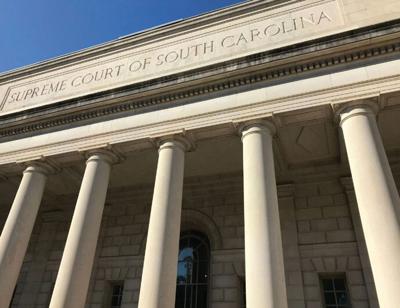



South Carolina Supreme Court
COLUMBIA, S.C. – South Carolina’s supreme court is looking to further prevent law firms from being partially owned by profit-driven non-lawyers, an increasingly controversial arrangement currently allowed in Arizona, Utah and D.C.
The court last week released a request for written comments on private equity in firms, months after the Tennessee Supreme Court did the same. Proponents of allowing non-lawyer ownership of firms say it increases access to justice for citizens in rural areas, and though it may seem beneficial for large injury firms to have access to more money, it could open the door for new competitors.
Rule 5.4 of South Carolina’s Rules of Professional Conduct prohibits fee-sharing with non-lawyers and bars them from owning or managing law firms. A lawyer’s judgment must remain independent.
“This Court is considering whether an amendment to Rule 5.4 is needed to protect the public from interference into the attorney-client relationship and to clarify and more explicitly restrict lawyers and law firms from entering into arrangements that attempt to evade Rule 5.4's prohibitions and requirements, as these arrangements threaten a lawyer's professional responsibilities, including but not limited to exercising independent professional judgment and maintaining client confidentiality,” the court wrote.
In nearby Tennessee, comments warned that money will only flow toward personal injury and mass tort cases, while rural residents promised access to justice will still struggle to find lawyers willing to work on more mundane, common matters like estate planning, divorce and landlord-tenant disputes.
“If anything, there is a tremendous risk of reducing access to justice among the most affected populations,” John Harris of Schulman, LeRoy & Bennett in Nashville wrote to the Tennessee Supreme Court. “Private-equity investment has led to widespread closures of rural hospitals in favor of consolidation in metropolitan areas.
“The same economic incentives would predict similar outcomes in the legal profession, as investors seek scale, efficiency, and higher margins, often at the expense of rural and low-profit communities. The poor would find it even more challenging to obtain cost-effective legal representation as investors chase the most profitable cases, not the least profitable ones.”
Firms with non-lawyer owners are called alternative business structures. There are more than 150 ABSs in Arizona but far less in Utah, and the idea has been outright rejected in several states, including Florida and California.
The mass tort firm Wisner Baum went to court to challenge California’s prohibition after it set up an ABS in Arizona. That entity – Eleos Law – is funded by Wisner Baum and focuses on client services and other matters while Wisner Baum litigates the cases.
Among Eleos’ workload are 9,400 cases over Zantac and 8,450 over alleged contamination of baby food. Ultimately, Wisner Baum dropped its challenge to California law in February after a federal judge refused to block it.
Last year, the South Carolina Bar’s Ethics Advisory Committee responded to a state lawyer who had a possible business arrangement to bring personal injury cases with an ABS from Arizona and asked for guidance.
“Existing South Carolina laws and rules do not permit either the practice model or fee splitting contemplated by the inquiry,” the committee wrote, noting similar conclusions in Texas, Georgia and Maryland.
“Thus, Lawyer cannot directly, or by indirection or willful blindness, do what South Carolina laws and rules do not permit regarding the practice of law in South Carolina, in South Carolina courts, in matters governed by South Carolina law.”
The committee also advised that a South Carolina lawyer may not invest in an ABS.