
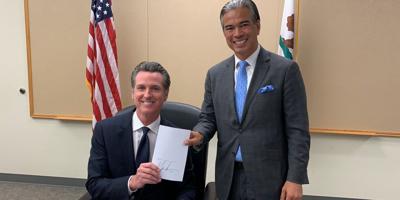



From left, California Gavin Newsom and California Attorney General Rob Bonta
SACRAMENTO — A Sacramento County judge has rejected a petition from backers of a voter identification measure that argues the attorney general’s ballot summary and title are “false, misleading and inconsistent” with the state Election Code.
Superior Court Judge Jennifer K. Rockwell denied a petition by Californians for Voter ID, Yes on 39 that called for a rewrite of Attorney General Rob Bonta’s ballot title and summary. In an Aug. 6 decision, Rockwell rejected the petitioners’ contention that Bonta had failed in his legal obligation to provide a true, impartial description of the purpose of Proposition 39, which will go before voters on Nov. 3.
“Because the certified ballot title, summary and label for Proposition 39 accurately describe the effect of the measure and reflect a reasonable exercise of the attorney general’s discretion in preparing these items under Elections Code 9051, the petition will be denied,” she said.
The plaintiffs took issue with multiple parts of Bonta’s ballot language. They called his proposed title – “Prohibits citizens from voting unless they present government-issued identification” – misleading because they “fail to give a true and impartial statement of the measure’s purpose.”
The title is not accurate because Proposition 39 would not bar the casting of a ballot, according to the petitioners. Instead, it would prohibit the counting of ballots that don’t comply with the measure’s requirement of a government-issued ID, they said. But Rockwell disagreed.
“This provision on its face requires a voter to ‘present a government-issued identification’ when casting a ballot,” she said. “A citizen who failed to present such identification would indeed be prohibited from both casting a ballot and having their ballot counted.”
The process of voting encompasses more than simply submitting a ballot, according to Rockwell. Courts have long held that “voting” includes the counting of a person’s vote, she said.
The lawsuit also alleged that Bonta’s description omitted or obscured one of the key provisions of the measure: the requirement that election officials do their due diligence to ensure that voter rolls are accurate and contain the names of U.S. citizens only.
But Rockwell noted that the summary mentions the measure’s requirement to “annually report the percentage of each county’s’ voters whose citizenship they have verified.” She also accepted Bonta’s contention that Proposition 39’s other requirements on election officials did not amount to a change in the current law.
Bonta said the court confirmed that the ballot title and summary and the ballot label describe Proposition 39’s main purpose and provisions accurately and impartially.
“My office followed the law and fulfilled its duty to provide California voters with clear, accessible and accurate information,” Bonta said in a statement emailed to the Southern California Record. “We’re pleased that the court agreed with us.”
The petitioners express disappointment at the court’s findings.
“The attorney general’s revision of the ballot title, an 11th-hour change made long after the measure qualified for the ballot, remains a politically motivated attempt to sway the election outcome and manipulate public opinion,” Yes on 39 said in a statement. “Now, by allowing additional politically motivated changes to the ballot materials, the court has further enabled efforts to distort the substance of Proposition 39 and deprive voters of the full and accurate context they deserve.”
But despite the legal defeat, Yes on 39 remained optimistic that the measure would pass in November.
“Proposition 39 is a common-sense, bipartisan measure to secure our elections and restore confidence in the democratic process,” the statement continued. “We are confident Californians will see through these efforts and judge Proposition 39 on its merits and not on biased ballot language.”