
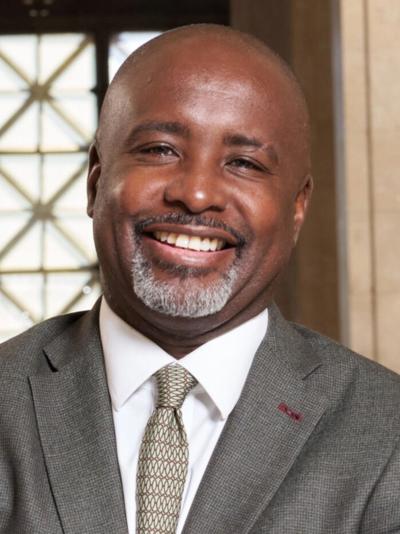


Los Angeles City Council President Marqueece Harris-Dawson
LOS ANGELES — The Los Angeles City Council must end its policy of barring speakers from using the “N-word” or “C-word” during public meetings or else face a First Amendment lawsuit, two free-speech groups have warned.
The First Amendment Coalition in San Rafael and the Washington, D.C.-based Foundation for Individual Rights and Expression (FIRE) sent a letter to the council last week, informing elected leaders that the groups represent Stacey Segarra-Bohlinger, an L.A. resident who was ejected from a meeting last year for using the word “c—,” a derogatory term for women, while criticizing the council’s recent adoption of Rule 7 to curb what it considers offensive speech.
Rule 7, which was adopted in July of 2025, prohibits speakers at City Council and committee meetings from using the “n—” — a racial slur for black people — and “c—”, or their variations, and the rule also bars speakers who use such language from attending future meetings. The policy violates both the First Amendment and California’s Brown Act because it permits government censorship when no disruptions of meetings have occurred, according to the free-speech groups.
In their cease-and-desist letter, the groups say that while Segarra-Bohlinger, a member of her neighborhood council, used the word “c—” while criticizing Rule 7, she did not exceed her allotted time, discussed an issue within the council’s jurisdiction and did not disrupt the council meeting.
“Free speech is under attack across the country,” Segarra-Bohlinger said in a prepared statement. “We can't let the City Council set such a dark precedent. While I don't condone the use of slurs or epithets to insult or dehumanize others, I strongly oppose any infringement on the right of the public to speak freely, and that includes using strong language when it feels necessary.”
Council members have said they enacted the new policy in response to complaints from the public about people using the words in question during the public comments portions of meetings.
“A government that gets away with censorship won’t stop at just two words,” FIRE’s attorney, Zach Silver, said. “It will target other speech, too – particularly criticism. The council president himself has said he wants to ban more words in the future, and you should believe him.”
The cease-and-desist letter points to federal court decisions supporting robust discourse in public places. A 1971 federal court decision rejected the conviction of a man who wore a “F– the Draft” jacket while inside a Los Angeles County courthouse,” the letter says.
Segarra-Bohlinger is demanding that the council stop threatening to remove speakers based on their choices of language, permanently repeal the word ban and rescind the rule’s provisions giving the council authority to ban offenders from future public meetings.
Council President Marqueece Harris-Dawson did not respond to a request for comment, but he previously said he hopes the council will expand the ban to include more words in the future.
“The first target of censorship is never the last,” David Loy, the First Amendment Coalition’s legal director, said. “Censorship anywhere gives aid and comfort to censorship everywhere. Now more than ever, it is essential to protect free speech against official attack from any quarter.”
The free-speech groups have given the council 30 days to repeal the rule’s provisions in order to avert the planned lawsuit.