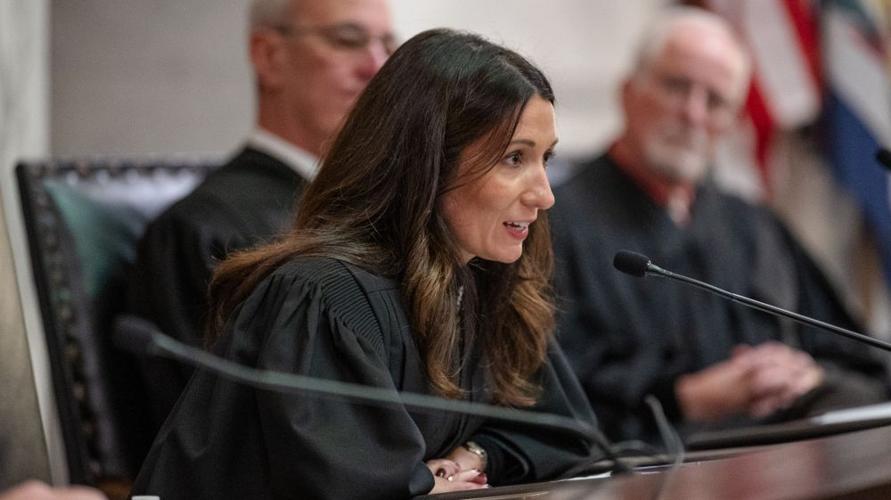





Haley Bunn began her 18-month term as Chief Justice of the West Virginia Supreme Court of Appeals on January 1, 2026.
CHARLESTON – As the second most senior justice on the bench, Haley Bunn is ready to serve as chief justice of the West Virginia Supreme Court of Appeals.
But unlike any justice before her, Bunn’s term will be 18 months as the court transitions its chief justice rotation from the calendar year to the fiscal year.
“I am honored to have been entrusted by my colleagues to serve as chief justice and lead the judicial branch over the next year and a half,” Bunn said.
Bunn, 40, was appointed to the court in 2022 by former Gov. Jim Justice, and was elected in 2024 to a 12-year term that began last January.

Bunn
“Under our unified judicial system, justices of the Supreme Court of Appeals of West Virginia not only make decisions on matters of law, but they also serve as a board of directors to administer the operations of our state’s entire judicial branch, with the chief justice functioning essentially as a chairman of the board,” Bunn said. “Aligning the service of the chief justice to the state’s July 1 to June 30 fiscal year calendar will help us better plan and work with leaders in the executive and legislative branches to secure the court’s budget and ensure efficient access to justice for all citizens.”
Bunn said the timing makes sense for a variety of reasons.
“We hope this will afford each chief justice going forward the ability to approach the administrative, budget and legislative processes with a more collaborative and deliberate approach than we were previously able given that the new chief would assume the role on January 1, just days before the start of a legislative session and the spring term of court,” she told The West Virginia Record. “We're always talking about what's best for the branch, our staff, our employees. It became very clear that it’s so hard on not just the chief, but the staff who is there to assist the chief on administrative matters to pick up on January 1 and to start initiatives at the same time as starting a term of court. And the Legislature goes in session and within usually a month, you’re going to be presenting the budget.
“We submit our detailed budget proposal in the fall, so it has prepared under one chief and then presented by another. It’s just logistically tough. Plus, this is such a busy time. January is one of the busiest months for the court anyway.”
The start of the fiscal year is July 1.
“We’re starting fresh with a new fiscal year,” Bunn said. “We’re not hearing oral argument on cases in July. You can kind of get your feet under you on the administrative side of it. So, I think it’ll be better for the people going forward who serve as chief as well as the staff who assists the chief in doing administrative tasks.”
Bunn applauded Justice Bill Wooton for “his steady leadership over the past year as chief justice as we navigated significant changes across the judiciary.” That included mandated judicial realignment that took place in January 2025 as well as Justice Beth Walker’s retirement and Justice Tim Armstead’s passing.
“Looking forward, I hope to build upon the efforts of my predecessors to modernize public access to the judicial branch and further efforts to educate citizens about the functions of West Virginia’s court system,” she said.
Bunn also said praised retired Justice John Hutchison, who was chief when she was first appointed to the bench.
“Hutch’s kindness, acceptance and steady leadership from my first day on the court onward really helped shape the way I approach both the administrative and the judging side of this job,” she said.
Bunn said the first two weeks of her tenure as chief justice have been a whirlwind.
“It’s a baptism by fire, and you’re drinking from a fire hose,” she told The Record. “There’s so much that this court does that I, as a practicing attorney, did not realize … and that I’m sure that a lot of the public doesn’t realize. So, there’s all of that we do as a body. And then there’s an extra layer on the chief.”
Bunn said Wooton has been helpful when she’s had questions about the job.
“He has been right there for advice already,” she said. “And he’s just down the hall if I need him.”
Bunn also praised the collaborative nature of the court, which includes two new justices who have been appointed since last summer. Justice Tom Ewing was appointed following Walker’s retirement, and Justice Gerald Titus was appointed following Armstead’s death.
“They (Ewing and Titus) have stepped right in and fit right in with the three of us,” Bunn said, referring to Wooton and Justice Charles Trump. “That’s really a testament to this institution. We miss Beth, and we miss Tim. But they would say, just like each one of us who are here now, it’s not about the individual.
“This is an institution full of amazing people. The new court, as we call ourselves, has done a wonderful job of setting the systems up, setting the policies up, setting the procedure to really succeed and keep the branch healthy and running, no matter who's sitting in the big chair.”
Bunn said she has been somewhat surprised by the volume of the work involved in being chief justice, such as handling recusals and disqualifications. She said there were about 600 or so such requests.
“It’s every day, and that’s part of the workflow,” she said. “But honestly, I've been so well prepped by my colleagues. Justice Walker, before she left, gave me a lot of advice on being chief, as did Justice Armstead. I’ve been able to see both of them and Justice Wooton serve as chief, and we have such an amazing staff. So it’s been a fairly easy transition.”
Bunn said she wants to use her time as chief justice to focus on an initiative she calls Hear Our Voices. It’s a project in conjunction with the National Center for State Courts.
“We hear something in the news every single day about the abuse and neglect system,” she said. “I feel very strongly that we need to always focus on kids that are involved to the extent that we can. This initiative will be including young adults or young people – some are still juveniles – in the process of making sure the court system is serving them well.
“Essentially, they’ll have lived through these experiences and will be going to the folks on the front lines, whether it be circuit judges or family court judges, and discussing what it was like to sit in that seat as a child or to be affected by a court ruling as a child. I think this will help our judges, help our staff, to make this process more stress free, more understandable just to hear the concerns of the kid who’s been there.
“I really am adamant that we here at the Supreme Court, or even on the benches out in the counties, shouldn’t be sitting in an ivory tower manor. There’s always been a focus on this from this court, and I just want to renew and double down on that focus of what we do affects people every day. We can't lose sight of that.”
Bunn said more details about the initiative will be provided when it is launched statewide in the next few months.
She also said she wants the court to focus on leveraging data to better inform the public, the other branches of government and the court system itself about the work the state court system is doing.
Bunn said she’s excited to serve as chief justice.
“It is exciting because I care so much about this branch, and I know that I have the support of my four colleagues,” she said. “It’s exciting to do these extra little extra things, extra projects. But, you know, in other ways, it’s exactly the same.
“I still pinch myself when I walk into the Capitol in the mornings. I look up to that dome, and I have to just say, ‘Wow.’” This is a heavy responsibility, and I’m so honored to be able to sit here in this seat and do what we do every day.
And it’s the same on the bench every day. It does not lose its luster, and just because I'm in the big chair doesn't make it more special. But I’m excited to be able to maybe offer something different.”
Bunn shared a story about some encounters she’s had with female students at the court’s LAWS events where the court hears cases at high schools across the state.
“A lot of times I’ll talk to young women, young girls, and I'll get comments like, ‘You wear those shoes and you are a judge? You’ve got your nails done, too.’ Stuff like that, that just happens to be me,” Bunn said. “I kind of like representing something different in the big chair. To me, everyone should be represented in a big chair. And for young women, particularly, for them to feel comfortable. You can be into fashion, for example, and still be the chief justice. You can be five-foot-nothing. …
“We were in Raleigh County at Woodrow Wilson High School, and Justice Wooton’s granddaughter was in the audience. And at lunch after the programming, his granddaughter and all her friends were like, ‘Could you believe her blue shoes? Weren't they cool? And she (Bunn) asked the first question. Can you imagine?’
“All they talked about were my shoes and such. Not that the shoes are the important thing, but just that women can do this and still be themselves.”