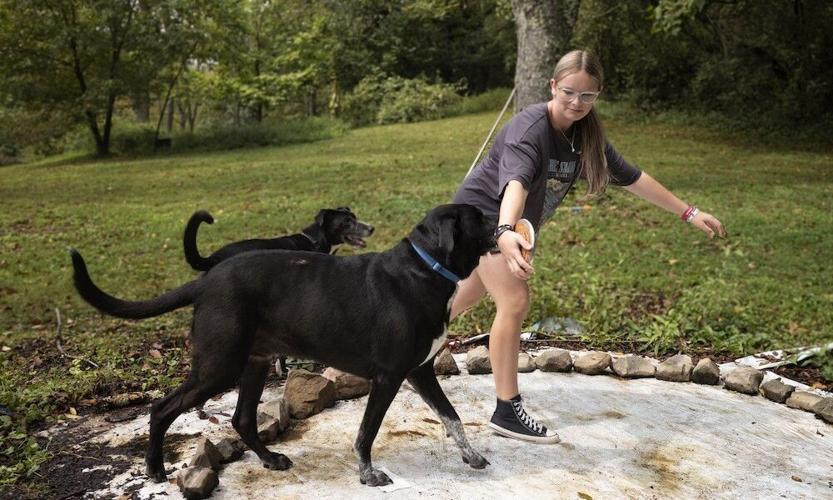




Becky Pepper-Jackson
WASHINGTON – The U.S. Supreme Court seems likely to uphold a West Virginia law banning transgender athletes from competing in girls’ sports.
The court on January 13 heard oral arguments in an appeal of a case originally filed by Becky Pepper-Jackson, a 15-year-old transgender student-athlete from Bridgeport, and her mother. The court paired it with a similar case from Idaho and heard more than three hours of arguments.
It’s the first time the nation’s highest court has taken up the issue regarding transgender athletes participating in girls’ and women’s sports.
Five of the court’s six conservative justices seemed likely to rule in favor of the state laws banning athletes assigned male at birth from competing on teams that correspond with their gender identity. West Virginia and Idaho are among the 27 states with laws that forbid such participation.
The two lawsuits before the Supreme Court say the laws violate the Constitution's guarantee of equal protection and Title IX. The states say the bans do not discriminate, saying the sex-based classifications are allowed because they are protecting athletic opportunities for women and girls.
The West Virginia case focuses on the state’s Save Women’s Sports Act, a 2021 law that recognizes the inherent physical differences between females and males.

McCuskey
“It’s a great day for the country — but especially for West Virginia — as our daughters have finally had their voices heard in front of this nation’s highest court,” state Attorney General J.B. McCuskey said following Tuesday’s arguments. “West Virginians know that allowing boys to compete against girls is unfair and dangerous, and today, we had the chance to present that argument to the justices. Their decision in this case will impact the future of women’s sports, women’s and girls’ safety on the playing field and the promises of Title IX.
“Getting to the Supreme Court to present this argument has been a monumental undertaking, years in the making. My team and I have worked tirelessly to protect equal opportunity for our daughters, mothers and female friends. I’m confident our efforts will be successful.”
Last week, McCuskey says his office is working to “protect female athletes and ensure fairness and safety in women’s and girls’ sports.”
“This case is monumental not only for West Virginia, but for our entire country,” McCuskey said. “The outcome will impact the future of women’s sports, the promises of Title IX, and the safety of our daughters.
“We are hopeful that the Supreme Court will uphold the Save Women’s Sports Act and agree with what West Virginia has been saying for years: biological sex matters in sports, and allowing males to compete against female athletes is unfair and dangerous.”
According to the AG’s office, West Virginia’s law draws the line at objective biology — a line it says “makes good sense because sex is what matters when it comes to sports. Gender identity does not.”
McCuskey’s office says both Title IX and the Equal Protection Clause make room for this. Title IX permits states to separate athletic teams based on biological sex, and the Equal Protection Clause is much the same.
The AG says the 2021 law is constitutional because it promotes fairness and safety in women’s sports.
Pepper-Jackson is a high school student-athlete who is a member of the Bridgeport High School track and field and cross-country teams. As she was preparing for middle school, the state passed the law banning transgender girls from participating in girls’ sports.
She and her mother sued, arguing the law violated the Constitution and Title IX as applied to her, especially because she has received medication from the onset of puberty and never had experienced any physiological changes associated with puberty for boys.
The lawsuit, filed in federal court, alleges that banning Becky from participating in school sports with other girls just because she is transgender is unconstitutional and violates Title IX, which prohibits sex discrimination in schools receiving federal funding.
As a result of an injunction issued by the lower courts, she has been able to participate in middle school cross-country and track and field for the past three years.
In April, 2024, the U.S. Fourth Circuit Court of Appeals held that West Virginia’s law excluding Becky from participating on girls’ teams violated Title IX and that the district court should not have dismissed her equal protection claim. Last June, the U.S. Supreme Court granted West Virginia's request to review that decision.
She is the only known transgender student-athlete seeking to compete in West Virginia.
Becky and her mother Heather Jackson are being represented by the ACLU, the ACLU of West Virginia, Lambda Legal and Cooley LLP.