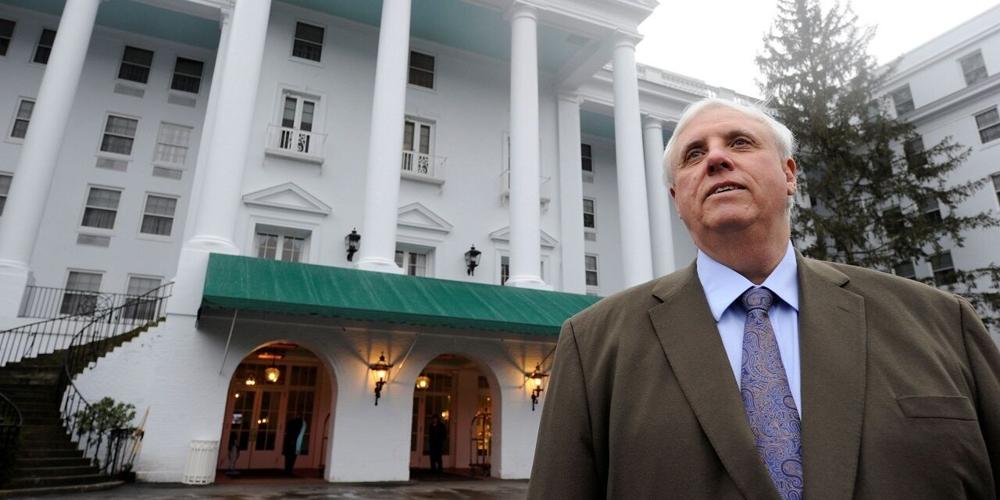





Jim Justice outside The Greenbrier
CHARLESTON – West Virginia Lottery officials say The Greenbrier’s casino legally can remain open while a change in ownership is reviewed if the resort ensures new incoming board members are shielded from day-to-day operations.
In an August 14 letter, the Lottery’s Acting Director David R. Bradley told Greenbrier attorney Steve Ruby the Lottery Commission would not have an emergency meeting on the issue, but he did say casino operations could continue with some caveats. Bradley was replying to an August 13 letter sent by Ruby.

Ruby
If a $500 million refinancing deal with Kennedy Lewis Investment Management goes through, it would acquire 51 percent control of the resort currently owned by U.S. Senator Jim Justice and his family. The new parent company would have a five-member board of managers, but three of those would belong to KLIM. State lottery rules say those three could not exercise authority over the casino while the Lottery Commission does background checks and formally approves them.
But Bradley said state law does not say the casino would have to close pending that vote.
“Still, if you provide the Lottery with a sufficient plan that appropriately walls off the holding company from ‘perform[ing] any duties or exercise[ing] any powers’ over the casino until such time as the Lottery Commission meets, then your transaction could be finalized without jeopardizing the casino license,” Bradley wrote. “You will be in compliance with the law so long as the unapproved board members of the holding company exert no authority over the operations of the casino.
“And, as a result, the casino can continue to operate prior to the final vote of the Commission.”
Bradley also said any decision to close the casino were “the sole business decision” of The Greenbrier, and that such a move “stands outside the control of the Lottery Commission.”
Bradley again expressed concerns about debt connect to the Justice family and its businesses.
“To begin, I am deeply disappointed that your letter expressed no plans for the pending Greenbrier Hotel Corporation (‘GHC’) and Kennedy Lewis transaction to resolve debts owed to the Department of Environmental Protection,” Bradley wrote, alluding to unpaid mining fines owed to West Virginia. “Your client should make greater efforts to make the citizens of West Virginia whole in this deal.”
Bradley also said having an emergency meeting on the issue isn’t possible because a possible voluntary closure by The Greenbrier doesn’t qualify as an unexpected emergency to justify bypassing public notice requirements.
The Lottery Commission is scheduled to meet August 26.
Meanwhile, the West Virginia Democratic Party has criticized Justice and his family for financial mismanagement that now threatens the jobs of 90 Greenbrier casino employees while calling on U.S. Attorney Moore Capito to explain why repeated failures by Justice businesses to pay taxes have not resulted in the kind of aggressive federal scrutiny and prosecution brought against other West Virginia business owners.
This week, the IRS filed new federal tax liens totaling more than $8 million for unpaid Greenbrier payroll taxes. The filings list unpaid balances of approximately $4.92 million for the tax period ending December 31, 2025, and $3.08 million for the period ending March 31, 2026.

WV Legislature photo
“For years, Jim Justice has operated his businesses as if paying his bills and paying his taxes were optional, and now 90 working West Virginians and their families are being asked to pay the price,” state Democratic Party Chair Mike Pushkin said. “These employees went to work, did their jobs and helped make The Greenbrier one of West Virginia's most recognizable institutions.
“They shouldn't become collateral damage because the Justice family's financial house is in chaos."
While noting previous legal and tax issues involving Justice and his companies, Pushkin said the pattern raises a basic question about equal enforcement of the law.
“If a tavern owner on Capitol Street in Charleston had done what Jim Justice and his businesses have repeatedly done, I have no doubt they'd be facing serious charges,” Pushkin said. “But when it comes to Jim Justice, the U.S. Attorney’s Office appears to look the other way.
“Working people have taxes taken out of every paycheck, and small-business owners know there are consequences if they collect taxes and don't send that money to the government. Jim Justice shouldn’t live under a different set of rules just because he’s a wealthy and powerful United States senator.”
The Democrats also listed several other businesses and business officials who have been prosecuted by the U.S. Attorney’s office for tax issues far less than the $8 million alleged against Justice.
“Let's put these numbers side by side,” Pushkin said. “Federal prosecutors in southern West Virginia have pursued business owners over unpaid employment taxes involving roughly $150,000, $394,000, $525,000 and $630,000. People have gone to federal prison. Now the IRS has filed more than $8 million in new payroll-tax liens against The Greenbrier. West Virginians deserve to know: Where is Moore Capito?
“Moore Capito’s own office bragged just months ago about collecting restitution from a Charleston businessman prosecuted for failing to pay employment taxes. So we know his office understands the seriousness of withholding taxes.
“We know federal prosecutors are willing to pursue ordinary West Virginia business owners. What West Virginians deserve to know is whether those same standards apply when the business is owned by the family of a United States senator.”
Pushkin said no one is asking Caito to “skip an investigation or ignore due process.”
“We’re asking him to apply the same standards,” Pushkin said. “Investigate it. Follow the money. Determine what happened. And if the evidence establishes that federal tax laws were willfully violated, prosecute the case just like you would if the business owner didn't have ‘United States Senator’ in front of his name.”
Pushkin also said there is a larger pattern of issues involving the Justice businesses.
“This isn’t one late payment or one business dispute,” Pushkin said. “For years we've watched the same cycle: bills aren’t paid, taxes aren’t paid, creditors go to court, liens are filed and Jim Justice asks for more time. The people who ultimately suffer aren’t billionaires and bankers. They’re workers, small businesses, vendors and communities that depend on these companies. …
“When a business withholds money from an employee’s paycheck for taxes, that money isn’t the business owner’s personal line of credit. Federal prosecutors understand that perfectly well when the defendant is a business owner in Charleston, Montgomery or Hurricane. The question is whether those same rules apply when the business belongs to the family of a politically powerful United States senator.”
The West Virginia Democratic Party called on Capito and the U.S. Attorney’s Office to explain whether Justice’s repeated tax problems have been referred for investigation and to assure West Virginians that political connections will play no role in federal tax enforcement.
“Moore Capito has a simple obligation: enforce the law equally,” Pushkin said. “His job isn’t to protect powerful politicians or powerful families. His job is to enforce federal law without fear or favor. …
“Justice isn’t just another businessman anymore. He’s a United States senator. That makes transparency and accountability more important, not less. There cannot be one justice system for politically connected millionaires and another for everybody else. And there certainly shouldn’t be one where 90 working families lose their livelihoods while the people responsible for this financial mess keep getting another chance.”