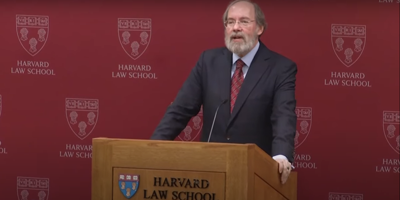


U.S. Seventh Circuit Court of Appeals Judge Frank Easterbrook
CHICAGO — A federal appeals panel has agreed with an arbitrator who sided with a labor union in forcing a hotel to reinstate an employee the hotel management had fired for displaying a knife at work.
The issue pits Unite Here Local 1 against Chicago Hotel Collection, which fired the worker after another employee said seeing the knife felt threatening. Unite Here filed a grievance but, according to court records, the hotel rejected the choice of an arbitrator.
U.S. District Judge Virginia Kendall then agreed the chosen arbitrator should hear the dispute. He ultimately ruled the infraction warranted an unpaid suspension, but not termination. The employee was to be reinstated with back pay, less 10 days, but the hotel refused. The union filed a motion to confirm the arbitrator’s ruling. U.S. District Judge April Perry, to whom the issue had been transferred, ordered the hotel to comply.
Eventually the matter landed before the U.S. Seventh Circuit Court of Appeals. Judge Frank Easterbook wrote the panel’s opinion, filed June 5; Judges Ilana Rovner and Amy St. Eve concurred.
Easterbrook said the collective bargaining agreement between the two parties lists nine people to hear disputes with the actual person to be chosen randomly. A union representative entered the names into a randomizing program, which designated Peter Meyers as the arbitrator. The hotel balked, since Meyers was already arbitrating a different dispute with the same union.
In its motion to compel arbitration, the union asked Judge Kendall to pick an arbitrator, “observing that, despite the agreement’s language, the union and the employer usually chose arbitrators by mutual agreement or by striking names from the list until only one was left,” Easterbrook wrote.
However, Kendall said the agreement clearly provided an arbitrator selection method and “did not perceive any ‘lapse’ that would justify the judicial selection of an arbitrator,” Easterbrook wrote. “The fact that union and employer often deviated from the random-selection method does not change that method or make it inadequate. … The agreement specifies a method of selection; it does not say that a person chosen for one dispute is disqualified from later disputes; and the hotel does not contend that a selection via random.org is anything other than random. (Well, it does say that the site uses a pseudorandom process, as most computer randomizers do, but humans can’t tell the difference.)”
After Meyers’ decision, Easterbook continued, the hotel opposed the reinstatement because Illinois public policy condemns workplace violence. But, the panel noted, Meyers didn’t “see any violence, and a reviewing court cannot upset an arbitrator’s factual conclusions.” Meyers reviewed security footage and, according to Easterbrook, determined “the fired worker seemed to be playing with the knife and looked at his co-worker with a ‘goofy’ expression.”
Judge Perry had a timeline of the incident, by Easterbrook’s retelling: “The fired worker took the knife out of his pocket at 0:38 seconds on the recording, smiled at the coworker at 0:41, and returned the knife to his pocket at 0:43. The hotel’s management had known for some time that the worker carried this knife and took it out every so often but had never used it to injure (or confront) another worker.”
Hotel management called police, and though the blade was an inch longer than the legal limit of 2.5 inches for pocket knives, there was no citation or criminal charge.
The panel further said the hotel’s stance on public policy about workplace violence is not relevant to “employers trying to choose the best methods of curtailing violence,” Easterbrook wrote. “We asked at argument whether the hotel would have violated any statute, regulation, or judicial doctrine if it had responded to these events exactly as the arbitrator did: suspending the knife-wielder for 10 days without pay. The answer was ‘no.’ The public policy of Illinois simply does not address how employers address actual or implicit threats of violence at work.”
Finally, the panel said “it is more than a little disappointing that counsel for the hotel ignored” a litany of U.S. Seventh Circuit opinions regarding employers’ unsuccessful attempts to “invoke ‘public policy’ as grounds for defeating arbitrators’ awards.”