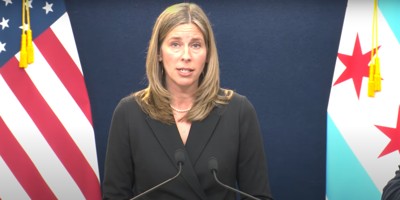



Andrea Kersten, former chief administrator of Chicago Civilian Office of Police Accountability
CHICAGO - A federal judge has tossed a lawsuit from a former top investigator for the Chicago city office responsible for investigating police misconduct claims, who had claimed he was illegally fired in retaliation for casting light on politically motivated and slanted anti-police investigations under the leadership of Andrea Kersten, the office’s former chief administrator.
U.S. District Judge Joan Lefkow issued an opinion Jan. 29 dismissing the 2024 lawsuit from Matthew Haynam.
The judge said the city wasn't prevented by any constitutional rights from being fired for criticizing Kersten and the Civilian Office of Police Accountability (COPA) because she said he was being disciplined for actions he took as a COPA employee.
Haynam had alleged the city should be held responsible for Kersten’s decision to fire him from his post as a deputy administrator at COPA, an action she allegedly took out of anger after she learned he and other investigators filed official complaints concerning “self-serving” investigations Kersten launched to push an anti-police narrative, allegedly regardless of the actual facts.
Haynam asserted Kersten improperly intervened in a March 2024 investigation after Chicago Police Department officers fatally shot Dexter Reed in Humboldt Park, making public comments she knew were “unsupported by the actual evidence adduced in the investigatory file.” These comments included assertions that officers “fabricated” a reason for initiating the traffic stop that preceded the altercation.
“Whenever there is a high-profile tragic event involving a Chicago Police Officer, Kersten pushes the increasingly popular narrative that the accused officer(s) engaged in misconduct, regardless of whether facts revealed during the course of an investigation support Kersten’s chosen conclusion,” Haynam said in his lawsuit.
Regarding Haynam’s First Amendment retaliation claim, Lefkow said protection is only extended to public employees when speaking as private citizens because the U.S. Supreme Court — in the 2006 opinion Garcetti v. Ceballos — held “when public employees make statements pursuant to their official duties, the employees are not speaking as citizens for First Amendment purposes, and the Constitution does not insulate their communications from employer discipline.”
Although she said Haynam gave only minimal details about his COPA job, what he did supply “is sufficient to determine that his speech was intimately tied to, and resulted from, his professional responsibilities.” She noted his professional duties overlapped with his legal claims aid said he only learned of the malfeasance he alleged “during the course of his duties for COPA.”
Because the speech effectively represented an employee trying to improve their work environment, Lefkow continued, he was speaking as a public employee regardless of whether his job duties explicitly required him to report any malfeasance.
“Nevertheless, Hayman attempts to argue that his speech was made as a private citizen because of the format it took,” Lefkow wrote. “He initially made his reports to two outside bodies, CCPSA and OIG, rather than internally at COPA. This argument is unavailing.”
She pointed to a 2008 U.S. Seventh Circuit Court of Appeals opinion, Tamayo v. Blagojevich, which she said established employee speech isn’t subject to First Amendment protections “even in contexts where the speech was made only to an external body with oversight responsibility.”
With that matter resolved, Lefkow said she also dismissed Haynam’s claim under the Illinois Whistleblower Act for lack of supplemental jurisdiction.
Haynam, who had sought reinstatement to his former position, with back pay and other unspecified damages, plus attorney fees, is represented by Devlin J. Schoop, of the Chicago firm Henderson Parks.