
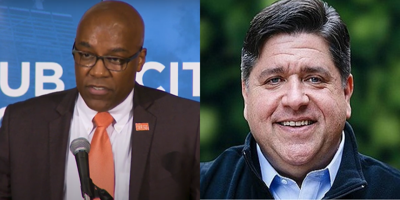



Illinois Attorney General Kwame Raoul and Gov. JB Pritzker
CHICAGO — Illinois state officials have agreed, for now, to not force Catholic hospitals and doctors to refer certain patients for medically assisted suicide, at least until the courts rule on a challenge to a new Illinois state law that would have otherwise forced all medical professionals to do so, regardless of their religious objections.
On Aug. 21, U.S. District Judge Franklin U. Valderrama entered a temporary restraining order that gives force to an agreement reached between the state and the Roman Catholic Diocese of Springfield, among other religious objectors to the requirements under Illinois' new assisted suicide law, known formally as so-called medical assistance in dying (MAiD).
The order came about 10 days after the Springfield Diocese and Springfield Catholic Bishop Thomas J. Paprocki partnered with the Lutheran Care Center, of Altamont, and a group of four Christian physicians to file a lawsuit in Chicago federal court challenging Illinois' so-called End of Life Options Act (EOLOA).
The plaintiffs are represented in the challenge by the Thomas More Society, a Chicago-based religious liberties legal advocacy organization.
According to its terms, the restraining order will remain in place until Judge Valderrama can rule on a forthcoming motion from the plaintiffs for a preliminary injunction that would block Illinois from enforcing the assisted suicide law.
That motion, in turn, will remain on hold until a federal appeals court in Chicago resolves related legal questions concerning the authority of the state to force Christian doctors and other medical professionals, as well as hospitals run by religious organizations, such as Catholic hospitals, to refer patients for abortions.
It is not known when the U.S. Seventh Circuit Court of Appeals may rule in that case, known as Schroeder v Treto. Oral arguments were heard by a Seventh Circuit panel of judges in April.
In the meantime, the state agreed to not attempt to force Catholic hospitals, in particular, to refer certain terminally ill patients for medical suicide assistance, while the case plays out.
Peter Breen, a former Illinois state lawmaker who serves as the Thomas More Society's executive vice president and head of litigation, called the restraining order "a critical first victory" for the challengers.
“Illinois’s new law forces faithful health care providers to cooperate in the state’s suicide promotion scheme, and this agreement protects our clients from this grave assault on their religious beliefs,” Breen said in a statement announcing the restraining order. “No government has the power to tell a bishop what is or isn’t moral or to require doctors to violate their oath to respect and protect human life."
One of the plaintiffs in the challenge, identified as Dr. Mary Keen Kirchoff, said she was "grateful" that the restraining order would allow her to "keep practicing medicine according to my integrity and my faith without that threat hanging over me—for now."
“This means I can go back to focusing on caring for my patients instead of wondering whether staying true to who I am is going to cost me my career,” Kirchoff said in the statement issued by the Thomas More Society.
According to court documents, Kirchoff is a devout Roman Catholic who says her religious beliefs forbid her from "cooperat(ing) with assisted suicide in any way, including by discussing its alleged 'benefits' with patients and making 'referrals' for it."
The lawsuit filed by the Springfield Diocese and their co-plaintiffs was the second challenge to the Illinois assisted suicide law.
In June, people with severe physical disabilities and a group of disability rights advocates were the first to file suit in Chicago federal court. Plaintiffs in that suit include the National Council on Independent Living; Not Dead Yet; the Institute for Patients' Rights; Progress Center for Independent Living; and Chicago Adapt; as well as medical group, the United Spinal Association.
In that challenge, the plaintiffs argue the state law must be struck down because the law will upend longstanding legal protections for people with disabilities and will create a new regime that would grant state permission for doctors, insurers and other "private actors" to pressure those with severe disabilities to die early as a cost- and labor-saving measure.
They asserted the measure will create a “duty to die” for those with disabilities.
Further, they argue the law will encourage discrimination in the state's suicide prevention efforts, by establishing a "two-track system" for suicide prevention under which suicide prevention for those with disabilities will be weighed against their quality of life considerations. Essentially, they said the system would generally seek to prevent suicide for most people, but for those with "life-threatening disabilities" it would seek instead to "facilitate their deaths."
The state of Illinois has responded to that lawsuit in court. In opposing the plaintiffs' motion for preliminary injunction, Illinois Attorney General Kwame Raoul argued the law includes safeguards to prevent the EOLOA law from being used to coerce those with disabilities to prematurely end their lives.
The EOLOA law was passed by the state's Democratic governing supermajority over Republican opposition this spring. It was signed by Democrat Gov. JB Pritzker.
The law is scheduled to take effect Sept. 12.
Supporters of the law, including Pritzker, have said the law is needed to provide people with terminal illnesses with "the option to seek medication to peacefully end their lives on their own terms in consultation with physicians."
When he signed the bill into law, Pritzker said the law would enable "patients faced with debilitating terminal illnesses to make a decision, in consultation with a doctor, that helps them avoid unnecessary pain and suffering at the end of their lives."
In their response, filed Aug. 18, the state asserted the medical assisted suicide options are only open under the law to those with terminal diagnoses of no more than six months to live. Further, they asserted, the law doesn't allow anyone other than the patient to decide whether to move forward with the assisted suicide. And, the state asserted, the law requires that the patient undergoing the assisted suicide must be capable of administering the lethal drugs themselves.
So, with those conditions in place, the state argued the plaintiffs with disabilities and their advocates do not qualify as plaintiffs capable of challenging the law on the basis they have asserted.
The disability plaintiffs have not yet filed a response to Illinois' Aug. 18 filing. And U.S. District Judge John J. Tharp Jr. has not yet ruled on the disability plaintiffs' injunction request.
In the meantime, the religious objectors lodged their own action, which challenged the law on the grounds that the state of Illinois had trampled the religious rights of hospitals and medical professionals who object to assisted suicide on the basis of religious belief or conscience.
The state has not yet responded to those claims.
The court fight over the assisted suicide law, however, is just the latest in a series of conflicts between the state and conservative Christians over attempts by the state to force medical professionals and others to go along with the preferred progressive policies of Illinois Democrats, particularly over hot button social and cultural issues like abortion, gender and, now, so-called MAiD.
A federal judge, for instance, notably struck down an Illinois state law, largely authored by Raoul, to allow the state to use the state's consumer fraud law to punish pro-life crisis pregnancy centers for spreading "misinformation" about abortion. A judge in that case called the law both “stupid” and likely unconstitutional.
And in the Schroeder v Treto case, a federal judge similarly barred the state from also forcing doctors to discuss the "benefits" of abortion with their patients.
The judge declined, however, to block the provision in an amendment to the Illinois Health Care Right of Conscience Act that would force doctors to refer women for abortion services, regardless of their religious objections. That provision is the subject of the appeal pending before the Seventh Circuit Court of Appeals.