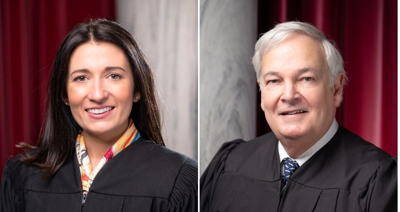



West Virginia Supreme Court photos
CHARLESTON – A Northern Panhandle attorney was confronted by West Virginia Supreme Court justices about “significant errors, inaccuracies, misquotes” and “fabricated” syllabus points.
During oral arguments in a child abuse and neglect case September 22, attorney Amanda Alexander, told the court she had drafted the opening and reply briefs in the case.
About four minutes into Alexander’s opening arguments, Justice H.L. “Kirk” Kirkpatrick interrupted her to ask whether she had written the briefs.
“I did,” Alexander replied. “And the reply brief.”
Kirkpatrick said the filings contained “some significant errors, inaccuracies, misquotes and things” and asked whether she had checked the citations.
“I thought I did, but I wrote that brief under a lot of pressure and submitted it around, I believe, 4 a.m.,” Alexander said.
Asked what legal research platform she used, Alexander said she uses Fastcase, which is provided by the Supreme Court, as well as “some other options … just Google, all the things.”
Kirkpatrick asked whether another attorney, identified during the exchange as Mr. Humberson, participated in drafting the filing. Alexander said he had not, although the two had discussed the case.
“So, this was your work?” Kirkpatrick asked.
“Yes,” Alexander replied.
Chief Justice Haley Bunn then asked directly whether Alexander had used generative AI to draft the brief.
“To completely draft it? No,” Alexander said. “I did use it to look up some case law and things like that. Which obviously, there were … I believe there were two or three missed citations.”
“In fact, syllabus points that were fabricated,” Bunn responded.
“Yeah, I wasn’t aware of that at the time,” Alexander said.
After a brief pause, Alexander asked whether the court wanted her to continue. Bunn said the decision was hers and told Alexander she had 4½ minutes remaining. Alexander then resumed arguing the case.
The exchange put a public face on a growing concern in courtrooms nationwide about using artificial intelligence tools that can produce authoritative sounding but false legal research, including nonexistent authorities, inaccurate quotations and mischaracterizations of actual cases.
West Virginia’s Office of Disciplinary Counsel addressed that risk in Legal Ethics Opinion 24-01.
While it does not bar attorneys from using AI in law practice, the ODC opinion says attorneys remain responsible for the accuracy and completeness of their work. The board cautioned lawyers to check court-specific rules and standing orders governing generative AI and any disclosure or verification requirements.
The state guidance says lawyers may use AI as a tool, but not as a replacement for their independent legal judgment. Under West Virginia’s Rules of Professional Conduct, competent representation requires the “legal knowledge, skill, thoroughness and preparation reasonably necessary for the representation.”
The ethics opinion says AI use requires human input, oversight and, when necessary, corrective action. It warns that lawyers must monitor and assess AI resources to reduce errors or bias that could compromise their work product.
“Lawyers are responsible for their work product and the legal advice they render,” the guidance states.
It specifically warns against accepting an AI system’s output at face value.
Generative AI can “hallucinate,” the guidance says, confidently presenting incorrect or misleading information as true. Lawyers should treat AI at most as a secondary source and should make final substantive decisions only after reviewing its suggested language and authorities.
The state guidance further says that AI-generated misinformation, including fake citations or misrepresentations of fact or law, can implicate an attorney’s duty of candor to the court and opposing counsel.
The state’s Rules of Professional Conduct require lawyers to provide competent representation and direct them to keep abreast of “the benefits and risks associated with relevant technology.”
Those rules also include duties involving diligence, candor toward a tribunal and supervision of nonlawyer assistance. The state AI guidance says an attorney’s failure to verify AI-generated work may implicate professional duties of competence, meritorious claims and contentions, candor to the court and truthfulness to others.
The guidance does not establish that every error involving AI constitutes an ethical violation. The Rules of Professional Conduct state that disciplinary determinations depend on the facts and circumstances existing at the time of the conduct, including its willfulness, seriousness, mitigating circumstances and prior violations.
No disciplinary action was announced during the oral argument, and the state’s Lawyer Disciplinary Board doesn’t reveal whether a complaint has been filed against an attorney until sanctions are announced.
West Virginia Supreme Court of Appeals case number 25-425