
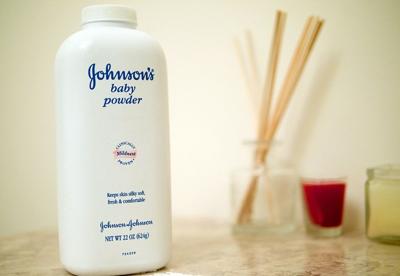


Johnson & Johnson Baby Powder no longer contains talc powder.
PLYMOUTH, MASSACHUSETTS — A Massachusetts jury rejected claims Johnson & Johnson’s talcum powder caused a woman’s fatal cancer, although the panel did decide the product should have had a warning label.
Plaintiff Stephanie Pelley sued J&J and several other companies, claiming they all contributed to her diagnosis of mesothelioma, a deadly cancer of the abdominal lining. She was represented by Dean Omar Stanley, a Dallas law firm that has taken a number of talc/mesothelioma cases against J&J to trial instead of settling.
The jury verdict adds to courtroom victories J&J has won as it aggressively fights claims it sold talcum powder contaminated with asbestos. The litigation is built on testimony by expert witnesses who say they can detect asbestos in talc. J&J says their methods are flawed and designed to confuse jurors about the scientific definition of the mineral.
Pelley’s case may have been complicated by the fact she claimed she had been exposed to asbestos her entire life from a profusion of sources including baby powder, the latex gloves she used as a nursing assistant and stray fibers carried home by her father and uncle who worked at a General Electric factory nearby. The jury answered “yes” to the question of whether Johnson’s Baby Powder should have had a warning label but “no” to whether talc in the baby powder caused her cancer.
Plaintiff lawyers revived a decades-old theory that cosmetic talc contained asbestos as the population of male workers with industrial exposure to asbestos dwindled, leaving a smaller group of potential plaintiffs including women who never worked in factories. Without industrial exposures, talc provided an explanation for the disease in a female plaintiff that a jury might believe, although mesothelioma rates in women have remained constant for more than 50 years. Jury awards for mesothelioma can run to tens of millions of dollars.
Plaintiff lawyers also claim talc causes ovarian cancer, either because it contains asbestos or due to some effect of the talc particles themselves. Johnson & Johnson also denies those claims, although it has offered $5.5 billion to try and settle those lawsuits.
“Plaintiff’s lawyers once again failed to convince a jury with false claims that collapse under the weight of the scientific evidence and their own testimony,” said Aviva Wein, J&J’s Head of Litigation, in a statement after the Pelley verdict. “Decades of scientific studies confirm that Johnson’s Baby Powder is safe, does not contain asbestos, and does not cause cancer.”
