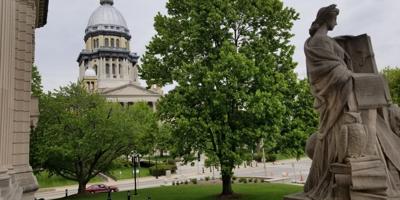


Illinois Capitol, seen from steps of Illinois Supreme Court, Springfield
CHICAGO — Illinois state lawmakers have moved to reform Illinois' property tax collection laws, which supporters say they believe will at last allow Illinois to become the last state in America to come into compliance with a Supreme Court ruling issued three years ago.
But despite the changes, Illinois counties, including Cook County, DuPage County and a collection of other suburban and downstate counties, still face potential costly liability for allegedly unconstitutionally taking hundreds of homes over unpaid property taxes, even after the Supreme Court had declared such collections unconstitutional.
And the counties are continuing to fight the claims in federal court, as they seek to either absolve themselves or pass the buck to others.
For the past four years, lawsuits have moved forward in Illinois federal courts against county governments, accusing them of unconstitutionally taking homeowners' equity when they partner with so-called "tax buyers" to seize and auction off homes over unpaid property tax debts worth a fraction of a home's actual value.
Cook County was the first to be sued in 2022. They were soon joined in court by DuPage, Lake, Kane, Will, Winnebago and Peoria, among others, who were sued separately from Cook County in 2023.
Another lawsuit was filed in southern Illinois federal court against a collection of downstate counties, including Madison and St. Clair counties.
All of the lawsuits centered on similar allegations accusing the counties of violations of the constitutional rights of property owners in how they collected unpaid property tax debt, and of all but ignoring a Supreme Court ruling in the process.
In that unanimous 2023 ruling, the Supreme Court sided with a homeowner in Hennepin County, Minnesota, whose $40,000 condominium was seized and sold by the county over $2,300 in unpaid property taxes, plus $12,700 in penalties and interest. Hennepin County then kept the surplus from the sale, in a practice dubbed by critics as "home equity theft."
In Illinois, homeowners have for decades similarly lost their homes over thousands of dollars in unpaid property taxes under the state's Property Tax Code tax sale system.
However, in the years since that ruling, Illinois' Democratic supermajority in Springfield has largely paid the ruling no heed, leaving Illinois as the only state with such a system to enact no reforms in an attempt to comply.
At the same time, the counties unsuccessfully attempted to argue in court that the Supreme Court decision should not apply in Illinois, because the counties themselves don't get anything more than the unpaid property taxes. Rather, in Illinois, it is private "tax buyers" who reap the windfall profits from tens or even hundreds of thousands of dollars in equity otherwise locked up in the homes that they may either turn around and sell or add to portfolios of rental homes for lease.
Judges rejected those arguments, saying the governments can't wash their hands of constitutional liability by partnering with private sector investors.
The matter, however, began to come to a head this year, after a Chicago federal judge first declared Cook County's "tax sales" violated the Constitution and then ruled the county should be on the hook for potentially many millions of dollars in damages to compensate hundreds of people whose homes were stripped from them through "tax sales."
Those decisions appeared to at last spur Illinois Democratic state lawmakers to act, passing legislation they claim brings the state into compliance with the minimum requirements of the Supreme Court's Hennepin County ruling.
Under the new legislation, Illinois homeowners will be given six more months to repay the delinquent property taxes. However, during that time, the counties will be allowed to add penalties and interest to the total.
Private "tax sales" will be ultimately phased out. Instead, homes would be sold through public auctions.
If the auction generates more money than the amount owed to the county for unpaid property taxes, penalties and interest, the homeowners would be allowed to petition the county for a refund of the "surplus equity."
The legislation does not address concerns about the equity homeowners may have held relative to market value of the property. Rather, the amount of "surplus equity" would be determined based on the results of the auction.
The legislation has not yet been signed by Gov. JB Pritzker.
It is unclear if the new legislation might also trigger more lawsuits challenging its constitutionality.
Lawyers representing those currently suing the Illinois counties largely declined to comment on whether they believed the reforms satisfy the constitutional requirements laid out in the Hennepin ruling. They all told The Record they were "reviewing" the new legislation.
In the meantime, however, the counties are continuing to fight the pending lawsuits in court.
In the Cook County litigation, the parties have told the judge they are not close to reaching a settlement. And the Cook County State's Attorney's office has signaled it will ask the judge to order so-called "bellwether" trials to determine how much the county may actually owe.
In the lawsuits pending against DuPage and the other northern and central Illinois counties, the counties have again filed a so-called third party complaint, seeking to either escape liability or force some of the larger private "tax buyers" to join in any liability and potential payout to people whose homes were unconstitutionally taken.
In March, U.S. District Judge Sara Ellis rejected the counties' attempts to also force the state of Illinois to shoulder some of the blame.
In both third-party actions, the counties have consistently claimed they were only acting under state law and have no legal or constitutional ability to deviate from the mandates of the property tax code set by Illinois state lawmakers.
Ellis, however, ruled the counties are on their own, because they are "political subdivisions" of the state and thus cannot sue the same state from which they were created.
In the new third-party complaint filed June 1, the counties assert they should be absolved of liability because homeowners whose properties were seized already had the option of pursuing their lost equity from their county's so-called "indemnity fund."
Ellis has not ruled on that question, to this point.
However, in the Cook County litigation, U.S. District Judge Matthew F. Kennelly specifically rejected Cook County's attempt to use the existence of its Indemnity Fund to defeat the litigation, describing such funds and the resulting petition process as constitutionally inadequate.
DuPage County and the other counties also have attempted yet again to rope in "tax buyers" to share in their potential liability. The counties assert they do not have the money sought by the plaintiffs, as they only retained the unpaid taxes and penalties. Any excess amount, they said, has been taken by the private buyers and must be gotten from them.
Ellis has not yet ruled on those claims and the third-party defendants have not yet filed a response in court.
Plaintiffs are represented in the action against DuPage and other northern and central Illinois counties by some of the same attorneys who successfully argued the Hennepin case before the U.S. Supreme Court. These include attorneys Charles R. Watkins, of Guin Stokes & Evans, of suburban Oak Park; Garrett D. Blanchfield and Roberta A. Yard, of Reinhardt Wendorf & Blanchfield, of St. Paul, Minnesota; and Vildan Teske, of Teske Law PLLC, of Minneapolis.
DuPage County is represented in the action by DuPage County State's Attorney Robert B. Berlin, and other attorneys from his office.
Other counties also have been represented by attorneys from the firm of Tressler LLP, of Chicago; and attorney Gary Scott Pyles, of Joliet.