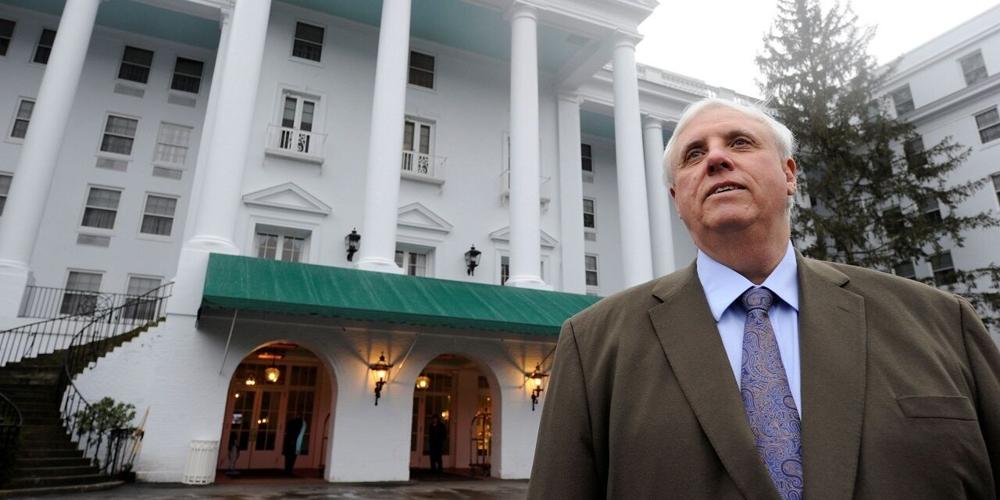





Jim Justice outside The Greenbrier
BECKLEY – Sen. Jim Justice and his family say a proposed $500 million refinancing deal for The Greenbrier resort remains on track to close by August 7, even as the federal judge overseeing a receivership fight publicly docketed an unsolicited email from a resort resident criticizing the family’s ownership and questioning their ability to service the new debt.
In a fourth status report filed July 28 in U.S. District Court for the Southern District of West Virginia, the Justice family and several Greenbrier‑related entities told Judge Frank W. Volk a joint venture financing transaction with New York‑based Kennedy Lewis Investment Management is “proceeding as expected” and that they and the lender “believe that the transaction will be completed by August 7, 2026.”

Van Scoy
A day later, Volk entered an order directing the clerk to file on the public docket an email from Sporting Club resident Douglas Van Scoy, who urged the judge to visit the resort “unannounced,” complained of deteriorating maintenance and alleged that the Justice family has harmed “many of our small business(es) in our community because of non payment of money.”
The July 28 filing responds to Volk’s July 27 order for another update on the Kennedy Lewis deal. Justice’s lawyers say the operating agreement for the proposed joint venture is in “substantively final form,” and that White Sulphur Springs Holdings – the Texas‑based Omni Hotels affiliate that bought nearly $300 million in Greenbrier debt from Carter Bank & Trust earlier this year – has provided a draft release and payoff statement.
According to the report, Justice’s team and KLIM returned comments on the payoff document “earlier today” and “intend to continue engaging in good faith” with WSSH, adding that they “do not expect any issues with reaching agreement” on the release and payoff if WSSH cooperates.
The defendants tell Volk they and Kennedy Lewis “expect to complete all aspects of the transaction within their control by August 7, 2026” and “anticipate that the transaction should close by that date,” while stressing that closing depends on timely cooperation from WSSH and approval from the West Virginia Lottery Commission, both outside their control. They say they will notify the court if either factor delays the timeline.
Justice’s lawyers acknowledge in the status report they are “still awaiting approval of the transaction from the West Virginia Lottery Commission,” calling that sign‑off “a necessary final step before the financing transaction can close.”
The Lottery Commission is reviewing how the KLIM deal – which would transfer the Greenbrier Casino Club license into a new holding company structure created with KLIM – would affect the resort’s considerable debt load and regulatory compliance. The commission’s next regularly scheduled meeting is August 26.

Volk
Volk previously granted short pauses in the case to see if the financing proposal “comes to fruition” and set a series of status‑report deadlines tied to earlier target closing dates, including a July 16 deadline.
In a July 29 order, Volk disclosed that the court had received an email from Van Scoy, who identified himself as “resident of the sporting club at the Greenbrier.” Van Scoy asked the judge to visit the resort without advance notice and wrote that “the lack of long term maintenance is fright(en)ing.”
“The Justice family has destroyed many of our small business in our community because of non payment of money,” the email states, adding, “I don’t think you will find many people here that think the continuation of Justice ownership is a good thing.”
Van Scoy is a retired financial executive entrepreneur, and prominent philanthropist closely who grew up in Bridgeport and graduated from West Virginia University. He is widely recognized for his career in investment banking and his extensive charitable donations to business education. He co-founded Pit Partners, a hospitality business that owns and operates multiple restaurants in West Virginia and South Carolina, which is where the business is based and where Van Scoy also has a home.
In the email, Van Scoy also questioned how Justice could “pay back a 500 million debt with double digit interest” if he “can’t pay current debts including taxes,” warning that “by postponing the inevitable the Greenbrier will continue to deteriorate.”
He urged Volk to “do what’s best for many of us in the Greenbrier Valley and State of West Virginia.”
Volk did not comment on the substance of the email but directed that it be placed on the public docket “as required by law,” citing the Code of Conduct for U.S. Judges, which instructs judges who receive an unauthorized ex parte communication bearing on a case’s substance to notify the parties and allow them an opportunity to respond.
WSSH, formed under Omni parent TRT Holdings, bought the Greenbrier’s remaining loan debt from Carter Bank in March and soon after sued the Justice family and resort‑related entities, asking Volk to appoint a receiver to take control of the resort’s assets, operations and finances. WSSH’s filings and an amended complaint accuse the Justice defendants of failing to pay contractors, employees and vendors and warn that without a receiver the resort could slide deeper into insolvency.
Receivership would place a neutral third party – WSSH has proposed hospitality executive Michelle Russo – in charge of day‑to‑day operations, revenue collection, debt payments and potential restructuring or sale of the resort, while barring the Justice family from further interference.
The Justice defendants oppose receivership and have argued in court papers that WSSH and TRT are using the bought‑up debt to try to “take The Greenbrier” from local ownership. They contend the KLIM deal, secured on a first‑lien basis by a pledge of Greenbrier assets and equity, would refinance the WSSH‑held debt and fund capital improvements at the resort.
Volk has largely held the receivership request in abeyance while monitoring the KLIM financing, repeatedly extending briefing and hearing deadlines – most recently to align with the Justice family’s self‑imposed August 7 closing date – and ordering periodic status reports to track whether the half‑billion‑dollar transaction will actually close.
U.S. District Court for the Southern District of West Virginia case number 5:26‑cv‑257