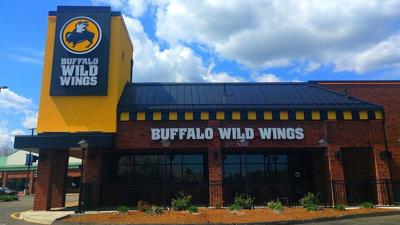


Buffalo Wild Wings
CHICAGO — Buffalo Wild Wings can't be sued for selling "boneless wings" that are actually oversized, sauced chicken nuggets, because "reasonable" customers shouldn't expect de-boned chicken wings, a federal judge has ruled.
On Feb. 17, U.S. District Judge John J. Tharp Jr. sided with the operator of the casual sports bar and grill restaurant chain amid the dispute over a claim that they have somehow duped customers by marketing their "boneless wing" menu items alongside their standard bone-in chicken wings.
“'Boneless wing' is ... clearly a fanciful name, because chickens do have wings, and those wings have bones," Tharp wrote. "As the Ohio Supreme Court recently put it, '[a] diner reading ‘boneless wings’ on a menu would no more believe that the restaurant was warranting the absence of bones in the items than believe that the items were made from chicken wings, just as a person eating ‘chicken fingers’ would know that he had not been served fingers.'
"A reasonable consumer would not think that BWW’s boneless wings were truly deboned chicken wings, reconstituted into some sort of Franken-wing."
The decision comes as the latest step — though perhaps not the last — in the nearly three-year-old attempted class action against Buffalo Wild Wings.
The case landed in Chicago federal court in 2023, when attorneys from the firm of Treehouse Law, of Los Angeles, filed suit against BWW, on behalf of named plaintiff Aimen Halim, of Chicago.
In the lawsuit, Halim accused BWW of allegedly misleading him and potentially thousands of other customers into allegedly paying more for "boneless" chicken wings by allegedly profiting off the mistaken belief that those "boneless wings" were "actually wings that were deboned," and were made entirely of meat from a chicken wing.
Rather, Halim said he sued when he learned the "boneless wings" were actually a kind of sauced chicken nugget made from chicken breast meat.
In the lawsuit, the plaintiffs asserted BWW's listing of the products on the menu, without a full description or other language indicating they were not actually deboned wings, amounted to consumer fraud and illegal deception.
In response, BWW asked the court to dismiss the lawsuit. They argued Halim's lawsuit fell short under the standard needed to prove fraud and deception.
They argued "reasonable consumers" would not have been misled by the product name, because they would have recognized the true nature of the food products they were ordering and eating.
In his latest ruling, Tharp agreed with BWW that the lawsuit may not be able to fly, at least at this point.
The judge specifically rejected the plaintiffs' attempts to argue that the term "boneless wing" is "'literally false' because the products are not wings."
Noting that the term "Buffalo wings" refers to the way a chicken wing is prepared and sauced, and not to any kind of actual buffalo meat, Tharp noted that words, and particularly marketing terms, can have "multiple meanings."
The judge noted, for instance, that BWW itself sells products it calls "cauliflower wings ... presented as an alternative to chicken wings."
"If Halim is right, reasonable consumers should think that cauliflower wings are made (at least in part) from wing meat," Tharp wrote. "They don’t, though."
Further, the judge noted the products are nothing new, as the term "boneless wings" has been used by restaurants to refer to those same kinds of products "for over two decades."
"Boneless wings are not a niche product for which a consumer would need to do extensive research to figure out the truth," Tharp wrote in the ruling.
Further, the judge noted it should stand to reason that, if "boneless wings" are truly deboned chicken wings, then BWW would charge more for them.
"Common sense tells consumers that a product made out of the same ingredients, but requiring more time and work to create, would cost more—but they do not," Tharp wrote.
These factors, the judge noted, all "support the common-sense conclusion that reasonable consumers are not deceived by the marketing of 'boneless wings.'”
The judge, however, did not completely lock the door behind the case. While noting he believed "it is difficult to imagine that Halim can provide additional facts about his experience that would demonstrate that BWW is committing a deceptive act by calling its nuggets 'boneless wings,'" Tharp still gave him until March 20 to file another version of the complaint and try again.
Halim and the potential class are represented in the case by attorneys Ruhandy Glezakos and Benjamin Heikali, of Treehouse Law.
Buffalo Wild Wings has represented in the action by attorneys Jason D. Rosenberg, Andrew G. Phillips and Alan Pryor, of Alston & Bird, of Atlanta; and Douglas A. Albritton and Matthew J. Kramer, of Actuate Law, of Chicago.