
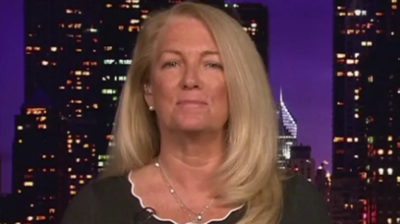


Jeanne Hedgepeth appeared on FOX News in 2021 to discuss her federal lawsuit.
WASHINGTON, D.C. — The U.S. Supreme Court will not review lower courts' decisions finding a suburban school district did not violate the constitutional rights of a Palatine High School teacher who was fired after students and community activists called for her removal in response to content she posted to her personal Facebook page opposing the Black Lives Matter movement during the riots and unrest following the death of George Floyd in 2020.
On May 18, the high court rejected the appeal petition from Jeanne Hedgepeth, turning aside her bid to revive her lawsuit against Township High School District 211.
The rejection of her petition came without dissent or comment from any Supreme Court justices.
And the rejection came despite warnings from Hedgepeth's attorneys and other legal observers that to allow the lower courts' decisions to stand would essentially give the green light to public school districts to censor and potentially fire teachers and other school staff, should they say things that might offend the political sensibiities of students, other faculty or others in the "school community" who may cause a commotion in protest of the disfavored speech.
Hedgepeth had turned to the high court earlier this year, seeking to overturn the rulings in favor of District 211 from both a Chicago federal district judge and most recently, the U.S. Seventh Circuit Court of Appeals.
District 211 is the largest public high school district in Illinois. It covers about 12,000 students at five high schools in Chicago's northwest suburbs, including Palatine, Fremd, Hoffman Estates, Schaumburg and Conant high schools.
Hedgepeth has been in court against District 211 since July 2021 when she first filed suit against the district in Chicago federal court.
Hedgepeth had worked at Palatine High School as a music teacher for 20 years.
According to the federal complaint, Hedgepeth was illegally targeted for termination for comments she posted to Facebook critical of widespread rioting, looting and other unrest in Chicago and elsewhere in the U.S. in 2020 following the death of George Floyd in Minneapolis while in the custody of police.
In those comments, among others, Hedgepeth called for rioters to be "hosed down" with liquid human waste by septic trucks.
She further posted longer comments discussing her displeasure with the use of terms like "white privilege," critical of those who characterized the U.S. as systematically racist, and questioning why discussions on race cannot include statistical information concerning the murder rate among the black population, nor the abortion rate.
The lawsuit noted all of Hedgepeth's comments were posted on her personal Facebook page, and she did not identify herself as a teacher or employee of District 211 or Palatine High School.
However, the complaint claimed Hedgepeth was immediately placed under investigation and ultimately fired by the school board, with the board citing her Facebook posts as justification.
In a separate action, Hedgepeth had also sued Tim McGowan, a Black Lives Matter activist who she blamed for launching the effort to get her fired. That lawsuit would eventually be dismissed by a Cook County Circuit Court judge.
McGowan would be elected to serve on the District 211 Board of Education from 2021-2025.
In federal court, Hedgepeth's lawsuit against District 211 also failed to gain traction.
A federal district judge found Hedgepeth's free speech rights fall short when compared against the school district's interest in minimizing disruption to the learning environment.
And that reasoning was upheld on appeal by the Seventh Circuit panel, which agreed District 211 officials did not improperly bow to the demands of activists, students and others when they fired Hedgepeth.
In the ruling, the Seventh Circuit judges said Hedgepeth, as a public school teacher, enjoyed a "unique position of trust," which should mean the First Amendment protections normally applied to individual speech may not apply to her, should her taxpayer-funded employer determine her speech has caused a community uproar and jeopardizes the school district's educational environment.
The Seventh Circuit panel said Hedgepeth "lost her job because she posted a series of vulgar, intemperate, and racially insensitive messages to a large audience" within the Palatine High School community.
Hedgepeth and her attorneys, however, assert that reasoning stands First Amendment law on its head and demonstrates a dangerous misinterpretation of Supreme Court precedent.
Hedgepeth has been represented from the beginning by attorney Paul J. Orfanedes and others with the conservative political action organization, Judicial Watch.
However, before the Supreme Court her legal team was reinforced by the addition of constitutional law attorney Paul D. Clement and others with the firm of Clement & Murphy, of Washington, D.C.
Clement is regarded as one of America's preeminent Supreme Court litigators. He has argued before the high court more than 100 times and has enjoyed a long record of considerable success.
Before the U.S. Supreme Court, Clement and his colleagues argued the lower courts' rulings essentially set up a framework for public schools and other public employers "to evade the First Amendment and enforce ideological conformity in schools and other settings" by awarding a so-called "heckler's veto" to students and others willing to disrupt the classroom environment or school board meetings to force action against a teacher or other staffer who says something politically unpopular.
In response, the school district defended the rulings, saying Hedgepeth wasn't fired only for her anti-BLM Facebook posts. Rather, they asserted those social media posts were the final straws in a mounting series of clashes and incidents between Hedgepeth and students.
They asserted Hedgepeth had been previously suspended over "profane outbursts at students," particularly following the 2016 presidential election, and the district had "specifically warned her that further incidents could result in disciplinary measures and possible termination."
The district further asserted that, even though Hedgepeth's comments on her social media posts weren't in the classroom, they said the Facebook posts should still qualify as worthy of further discipline and termination because they were visible to current and former students and other members of the Palatine High School community.
In response to the district's claims, Hedgepeth's team said the evidence clearly showed the moevement to fire Hedgepeth wasn't orchestrated by students, but by adult activists outside of the school.
"When outside agitators are handed a heckler’s veto and deemed to have equities indistinguishable from students and teachers, the district has lost the thread," Hedgepeth's lawyers wrote in a brief filed with the Supreme Court on April 28.
"Empowering hecklers to impose their own version of political orthodoxy by orchestrating complaints and then pointing to the complaints as evidence of disruption would provide a roadmap for evading the First Amendment," they said.
That view was echoed by other observers, who filed briefs in support of Hedgepeth and published public commentary attempting to warn the high court of the constitutional risks in not taking the case.
On May 11, for instance, three constitutional scholars with the libertarian Cato Institute published an op-ed urging the court to take Hedgepeth's case. Cato also filed a brief in support of Hedgepeth before the Supreme Court.
"If allowed to stand, the Seventh Circuit’s reasoning would prevent their full, uncensored civic participation by denying them robust speech rights," the Cato Institute wrote. "That is particularly dangerous in an era when the levers of government power are being increasingly used to silence and intimidate speakers."
The court, however, refused to take the case.
Neither Judicial Watch nor Clement and his firm responded to requests from The Record for comment on May 18.