
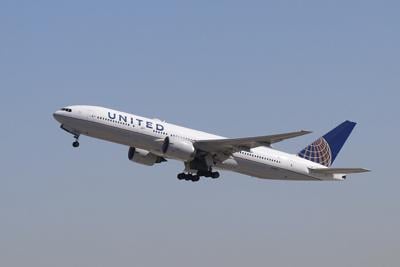



United Airlines flight shortly after liftoff
CHICAGO — A federal judge won’t let United Airlines ground a class action from a Catholic pilot who accused the carrier of religious discrimination through its Covid vaccine mandate.
Alvin Reinauer filed his Title VII complaint in 2024. According to court records he applied for a position with the Chicago-based airline that February; United agreed to interview him if he showed proof of having received a Covid vaccine. Reinauer responded with a religious accommodation request because certain vaccines were made “using fetal stem cell lines derived from an abortion” and also that “mRNA technology and cellular manipulation are morally objectionable to his faith and understanding of God,” according to his complaint.
United granted the accommodation for the interview, then offered Reinauer the job, again with the vaccine as a condition. Reinauer resubmitted the religious exemption request, which United granted. However, the airline then placed him on indefinite hold, as it wasn’t permitting unvaccinated job candidates to attend training. Reinauer alleged that while he was on hold, United was training other prospective pilots who didn’t request religious accommodations, a circumstance he said was an expressly discriminatory policy disparately impacting workers based on religion.
Although Reinauer filed his complaint in the Middle District of Florida, United moved to transfer the case to the Northern District of Illinois as well as to dismiss the complaint. The Florida court agreed to the transfer, where the parties agreed the dismissal motion was moot. U.S. District Judge Virginia Kendall granted United leave to refile its dismissal request, which it did in February 2026.
In a new opinion, Kendall denied the new dismissal motion.
Kendall first rejected United’s challenge to the complaint as time barred. While the judge noted Reinauer waited 388 days from the initial job offer to file a charge with the Equal Employment Opportunity Commission, “Reinauer unequivocally alleged an entire coercive campaign based on United’s express discriminatory policy requiring all employees to get vaccinated.”
She noted other courts have similarly framed the policy as continually subjecting workers to the coercive choice between their convictions and a paycheck. Kendall also said United improperly characterized the elements of Reinauer’s EEOC charge as identical to factual allegations in his complaint, when for her purposes the EEOC charge is only extrinsic evidence, and “the dates — including the apparent April 4, 2022, accommodation — in the EEOC charge are subject to reasonable dispute” and not all are included in the actual complaint.
“Ultimately, United’s request is an ambitious one: it asks the court to assume the truth of an extrinsic document, resolve all inferences against the non-moving party, and then dismiss the case based on facts the plaintiff never alleged,” Kendall wrote. “A motion to dismiss is not a vehicle for adjudicating contested dates or weighing outside evidence.”
Kendall further negated United’s insistence that its conditional job offer was the only discrete, relevant incident that might be grounds for a Title VII claim. She noted Reinauer ultimately got a vaccine and submitted his paperwork in late August 2022, and alleged “United immediately provided him with a training date, thus ending the period of discrimination against him,” while further alleging the airline was contemporaneously allowing passengers to fly with proof of a negative Covid test, mask wearing or quarantine in lieu of vaccine.
“United warns that if the court adopts Reinauer’s position, ‘such a rule would functionally exempt religious accommodation requests from the limitations period enacted by Congress,’ ” Kendall wrote. “United’s foreboding is unfounded. Reinauer alleged that United’s decision was in furtherance of its facially discriminatory policy. He also alleged that United’s policy was expressly aimed at individuals of faith because United doubted the sincerity of their faith — based on statements from United’s CEO.”
Kendall also refused to dismiss Reinauer’s retaliation claim, which United argued was duplicative of the discrimination allegation.
“Reinauer’s complaint clears the required threshold,” Kendall wrote. “Reinauer alleges that he faced ‘the impossible choice of either receiving the COVID-19 vaccine — at the expense of his religious beliefs — or losing his livelihood.’ Reinauer also alleged that United’s action ‘cost [him] wages on the front end of his employment’ as well as ‘valuable positions on the seniority and longevity lists that will lead to future harms in not getting certain assignments, routes, or schedules.’ No more is necessary at this stage.”
She further said some of United’s challenges, such as whether other employees were similarly situated to Reinauer, amounted to factual questions not suited for a dismissal motion. She concluded by writing that “while United heralds its indefinite, unpaid, leave during a global pandemic as not adverse, Reinauer alleged that it put him through a ‘crisis of conscience’ — and that is the allegation the court must accept.”
Reinauer is represented in the action by attorneys with the firms of Siri Glimstad LLP, of Aventura, Florida; and SL Law PLLC, of Cedar Hill, Texas.
United is represented by attorneys with the firm of Jones Day, of Chicago, New York and Minneapolis.