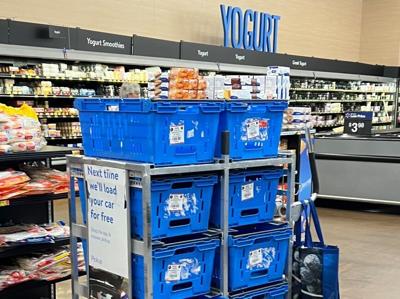



CHICAGO — Walmart and UPS have each been hit with class actions accusing them of violating Illinois laws in how they pay and verify identities of the people who work through their respective Spark and Roadie app-based delivery services.
On June 15, lawsuits were filed against the companies in Cook County Circuit Court
The lawsuits were filed by attorneys Michael Fradin, of Fradin Law, of Skokie; James L. Simon, of Simon Law Co., of Chagrin Falls, Ohio; and Jerusalm F. Beligan and Leah M. Beligan, of Beligan Law Group, of Newport Beach, California.
Each of the lawsuits level similar accusations against each company, asserting the companies were underpaying their drivers and also subjecting the drivers to alleged illegal face scans under Illinois state laws.
Both the Spark and Roadie follow business models paved by other app-based delivery services, like Instacart and DoorDash.
Spark was launched in 2018 by Walmart, giving the world's largest retailer its own app-based platform to arrange for drivers to use their own vehicles to deliver groceries and other items to Walmart customers.
Similarly, UPS acquired Roadie in 2021, integrating the crowdsourced delivery platform as a wholly-owned independent subsidiary. UPS says Roadie allows people to use their own vehicles to complete "last-mile" delivery of packages and other items shipped via UPS.
In keeping with other app-based delivery platforms, Spark and Roadie each categorize their drivers as "independent contractors," and not "employees," for the purposes of tax and wage laws.
However, in the new lawsuits, the plaintiffs assert those classifications are not allowed under Illinois wage laws, given their duties and employment conditions.
In the lawsuits, the plaintiffs assert that Spark and Roadie each fail to pass the legal tests established under Illinois wage laws, known as the "three prongs."
The lawsuits assert the drivers work under the "control and direction" of Spark and Roadie, because the services require drivers to use only their apps, set the drivers' pay, and require all drivers to "adhere to ... strict policies at all times during their work. Violations of those policies can result in discipline, according to the complaint.
Further, the lawsuits assert the work of delivering the items is not "outside the usual course" of the companies' usual business.
And they say the drivers are not "engaged in an independently established trade or business," as the drivers depend on the Spark and Roadie platforms, "cannot set their own rates, cannot subcontract, and cannot operate independently."
Further, the lawsuits accuse Spark and Roadie of allegedly illegally failing to reimburse drivers for the costs of the wireless service and other costs essential to fulfilling their job duties.
And the complaints accuse Spark and Roadie of allegedly violating Illinois' biometric privacy law by requiring drivers to upload photos of their drivers licenses and to periodically upload photos of their faces to verify their identities when performing tasks assigned through the Spark and Roadie apps.
The lawsuits assert Spark and Roadie failed to first secure consent from drivers before scanning their uploaded photos to verify their identities and did not provide them with data retention, sharing and sharing notices allegedly required by the Illinois Biometric Information Privacy Act.
The lawsuit against Spark was filed on behalf of named plaintiff David Basile, an Illinois resident who allegedly worked for Spark as a driver from November 2024 to August 2025.
The lawsuit against Roadie was filed on behalf of named plaintiff Antonio Morris, who allegedly still works for Roadie in Cook County and elsewhere in Illinois.
The lawsuits, however, seek to expand the lawsuits to include potentially thousands of others who worked as drivers for Spark and Roadie in Illinois since 2019.
The lawsuits seek potentially many millions of dollars in damages for both the wage law and BIPA law claims. Under the BIPA claims alone, for example, the lawsuits seek damages of $1,000 or $5,000 for each class member.
Neither Walmart nor UPS, nor their Spark or Roadie subsidiaries have yet responded to the lawsuits in court.