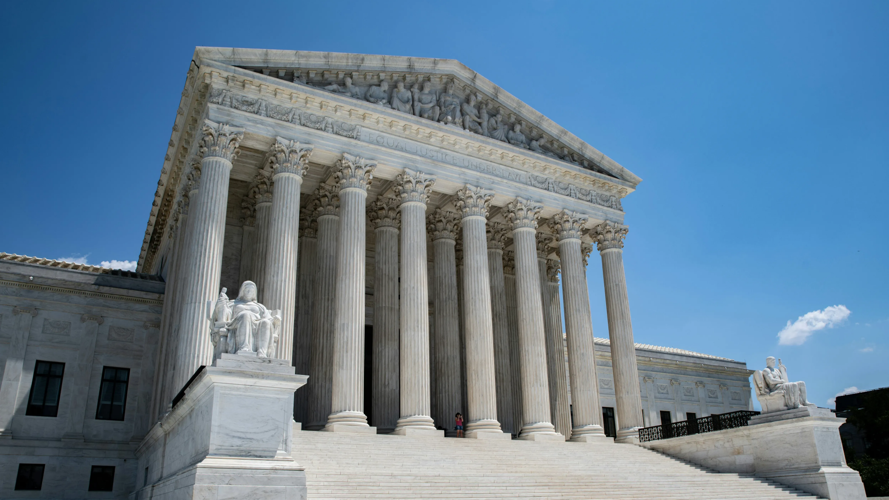





The U.S. Supreme Court stands in Washington.
WASHINGTON –The U.S. Supreme Court has rejected a former Louisiana inmate’s lawsuit against Louisiana prison officials after they shaved his dreadlocks, which he said violated his religious rights.
In a 6-3 ruling, the justices rejected the claims of Damon Landon, a devout Rastafarian, who sought to sue Louisiana Department of Corrections and Public Safety and prison officials for violations of the Religious Land Use and Institutionalized Persons Act after prison guards shaved his head.
The court voted along ideological lines, upholding a Fifth Circuit Court of Appeals decision.

Murrill
Louisiana Attorney General Liz Murrill hailed Tuesday’s ruling.
“Religious liberty is deeply important, and Louisiana has laws on the books protecting it,” Murrill said. “Ten federal courts of appeals held that the federal Religious Land Use and Institutionalized Persons Act does not allow prisoners to sue prison officials in their personal capacities for damages, and now the Supreme Court has agreed.
“We condemn the conduct as alleged in this case and have taken steps to prevent this problem from recurring, but we are grateful the court agreed with the state in this matter.”
Justice Neil Gorsuch wrote the majority opinion.
“Mr. Landor does not have a federal RLUIPA cause of action against the officers,” Gorsuch wrote. “Under the Spending Clause, Congress lacks regulatory authority to impose liability on them directly and must depend instead on consent.
And because they never agreed to answer suits like this one, Mr. Landor’s case cannot proceed against them any more than a breach of contract action might proceed against a defendant who never formed a contract.”
Justice Ketanji Brown Jackson wrote the dissent, which was joined by Justices Sonia Sotomayor and Elena Kagan. Jackson said the decision will leave prisoners who suffer violation of their religious rights “remediless.”
“Encroachments on prisoners’ statutory rights are likely to happen with fair frequency, as state-empowered prison officials will have little incentive to abide by federal law, even if it is handed to them on a piece of paper,” Jackson wrote.
Landor had his hair cut in December 2020 when he was transferred to the Raymond Laborde Correctional Center with three weeks left in his sentence. He had grown his hair for nearly 20 years. During his incarceration at two other prisons, he had been allowed to keep his hair long or under a “rastacap.”