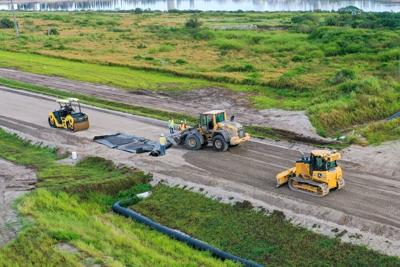


Mosaic Fertilizer won federal approval for a road-construction project that will use phosphogypsum, a radioactive byproduct in fertilizer production.
A federal appeals court has rejected an environmental group’s petition to overturn the Environmental Protection Agency’s approval of a private road project in Polk County that will be built using a radioactive byproduct of fertilizer production.
A panel of the 11th Circuit Court of Appeals turned down the request from the nonprofit Center for Biological Diversity on Aug. 12, concluding that the EPA approval of the project submitted by Mosaic Fertilizer at its New Wales mining and storage facility was in line with agency regulations and “well-supported” technical methodology.
The company processes phosphate ore into phosphoric acid used in the production of agriculture fertilizer, but a byproduct of the process is tons of phosphogypsum, which is now stored in stacks at the facility. As this solid-waste product decays, it emits radon gas, which has been linked to cancer and serious illnesses.
The company wants to use the byproduct in its private road construction project. The EPA found that risks to construction workers and nearby residents were well within acceptable levels and so low as to be “negligible,” according to the court’s decision.
“The EPA’s methodological assumptions reflect a rational attempt to model real-world exposure, and those methodological decisions fell well within the EPA’s technical discretion,” the court said.
The center and other opponents, however, have expressed concern that the company’s “pilot project” could pave the way for the radioactive byproduct to be used in road construction nationwide.
“It’s disappointing the court upheld approval of this radioactive test road, which is the next step in the fertilizer industry’s push to dispose of its toxic waste in roads nationwide,” Ragan Whitlock, a Florida-based staff attorney at the center, said in a statement emailed to The Florida Record. “Rest assured, this battle is far from over. We intend to keep fighting to protect our environment and communities from this dangerous, radioactive mining waste."
The center’s attorneys have indicated that they would continue their work, in the courtroom and in other venues, to assure the nation has strong oversight and regulations governing the use of radioactive waste.
The appeals court, however, rejected the idea that the EPA’s approval of the project would extend beyond the pilot project.
“The EPA’s review expressly and appropriately limited the scope of its decision to Mosaic’s road project, explicitly emphasizing that any future request to construct phosphogypsum roads anywhere else would require a separate application, a separate risk assessment and separate approval,” the court said.
The court found the agency’s risk assessments rational and coherent.
“The agency explained its methodology, identified the specific exposure pathways it evaluated, described its reasonable assumptions and concluded that the road project fell within acceptable risk parameters,” the court said, adding that the EPA’s action was neither arbitrary nor capricious under the terms of the federal Administrative Procedure Act.
The center pointed out that a 2005 EPA workbook bars the agency from using radium-226 samples more than one year old and that the EPA accepted samples more than three years old. But the court referred to the workbook as simply agency guidance and said it was nonbinding. Additional radium sampling was mandated before construction could begin, according to the court decision.