

West Virginia Attorney General J.B. McCuskey
CHARLESTON – A federal judge has temporarily blocked West Virginia Attorney General J.B. McCuskey from enforcing subpoenas demanding nearly a decade of records from two environmental groups.
In his 27-page memorandum opinion and order issued October 29, U.S. District Judge Joseph R. Goodwin said West Virginia Rivers Coalition and 350.org likely would prevail on their claim McCuskey’s demands violate their First Amendment right to associate.
Goodwin granted a temporary restraining order protecting the groups from the subpoenas, which sought internal communications, draft publications, scientific materials and records of their relationships with other organizations.

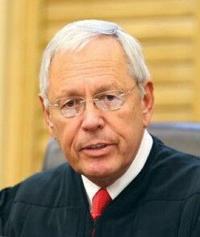
Goodwin
“What these organizations do is argue in public about what coal, oil and gas do to West Virginia’s waters and climate,” Goodwin wrote. “The state’s chief legal officer, who has publicly condemned that advocacy, now demands to know how they reached their views and who stood with them. …
“The First Amendment forbids a state from using its investigative power that way.”
The order expires at 4 p.m. November 12 unless extended. It blocks enforcement of the September 16 subpoenas, including a November 2 deadline for producing records, and prohibits McCuskey from seeking court orders compelling compliance or issuing new compulsory demands to either group for the same categories of information. A hearing on a preliminary injunction will be scheduled separately.
The ruling is not a final decision on the lawsuit. Goodwin based the temporary relief on the groups’ freedom-of-association claim, leaving their other constitutional claims unresolved.
McCuskey issued the subpoenas under the West Virginia Consumer Credit and Protection Act as part of an investigation into potentially unfair or deceptive practices. His office argued that the groups’ climate advocacy could affect the state’s energy marketplace and questioned their reliance on a climate projection scenario known as RCP8.5, according to the opinion.
In his response to the lawsuit, McCuskey defended the investigation as an effort to protect West Virginians from misleading climate claims.
“The First Amendment is not a license to lie,” his response said.
Goodwin rejected the argument that the advocacy at issue amounted to commercial speech subject to the consumer protection law. He said the record identified no cheated consumer, sale or purchase made in reliance on the groups’ statements.
“Simply, a person cannot use unfair or deceptive acts ‘in the conduct’ of trade or commerce,” Goodwin wrote. “But Plaintiffs WVRC and 350.org are not ‘in the conduct’ of trade or commerce. Their conduct—their mission—is advocacy.”
The groups filed suit October 22, alleging violations of the First, Fourth and Fourteenth amendments. The subpoenas contained 16 document demands covering records dating to January 1, 2017, and extending through the date of compliance. They sought material ranging from public statements and fundraising appeals to internal deliberations, coalition activities and relationships with renewable energy businesses.
In an October response, McCuskey withdrew demands for donor information after the lawsuit was filed. But Goodwin said that change did not eliminate the groups’ injuries because the remaining demands still reached board affiliations, coalition partners, grant recipients, agency submissions and unpublished discussions.
The next day, the environmental groups replied and asked the court to halt the AG’s investigations and subpoenas, arguing that they unlawfully target the groups’ climate advocacy in violation of the First and Fourth Amendments.
They argued West Virginia’s Consumer Credit and Protection Act regulates commercial activity, not political advocacy, and that McCuskey has shown neither a lawful basis for investigating them nor evidence that their climate statements are deceptive.
“The Attorney General’s investigation is rogue in several respects,” the groups wrote. “It is not authorized by West Virginia law; it ignores and misconstrues climate science, in an Orwellian exercise that attempts to cast the publishing of truths about the connection between fossil fuels and climate change as deception; and it construes West Virginia law to be broader than the First and Fourth Amendments allow.
“Defendant’s Orwellian exercise attempting to establish that publishing or stating the truth about the connection between fossil fuels and climate change constitutes deception ignores and misconstrues climate science and would make West Virginia a state where political ambition outweighs science and reason.”
Later, the groups reinforced that idea.
“Defendant says the injunction would place his investigation under ‘federal judicial superintendence,’” the groups wrote. “Applesauce. The relief sought prohibits defined acts in defined investigations: enforcing the September 16 subpoenas, continuing the investigations and bringing proceedings on their subjects. It supervises nothing.”
Goodwin also found a substantial mismatch between the investigation’s stated focus on RCP8.5 and the breadth of the records sought. The demands extended well beyond statements relying on that scenario, he wrote.
“Plaintiffs call this a fishing expedition,” Goodwin wrote. “In part, I agree. …
“But even on a fishing expedition, hoping to just get one bite in the vast and quiet water, a person brings a fishing pole. And in other cases, perhaps, a net. Here, AG McCuskey has abandoned both the fishing pole and the net. Instead, he has brought dynamite to the lake.”
The organizations described changes to their work that already had resulted from the subpoenas. According to the opinion, Rivers Coalition paused a community mini-grant program and publication of story maps, while 350.org altered or withheld publications and said it would undertake no new work in West Virginia. Staff members were censoring internal discussions out of concern that the attorney general would obtain them, the court said.
Goodwin found those effects supported immediate relief because lost speech and damaged organizational relationships could not be repaired by a later award of money. He also concluded that pausing enforcement posed no danger to the public and that protecting constitutional rights outweighed the state’s asserted interests on the record before him.
At Thursday’s hearing, McCuskey’s counsel offered to stipulate that the subpoenas would not be enforced while the litigation continued, according to the opinion. The parties did not reach an agreement.
Goodwin said the groups had presented substantial evidence supporting their separate retaliation claim, including McCuskey’s public criticism of environmental advocates and the gap between the investigation’s stated purpose and the subpoenas’ scope. But he reserved judgment on that claim until McCuskey could present evidence at a preliminary injunction hearing.
Goodwin emphasized that the ruling did not prevent legitimate consumer protection investigations.
“The WVCCPA gives the Attorney General power to police deception in the marketplace, and nothing in this order limits that power where it applies,” Goodwin wrote. “Nonetheless, the state consumer credit protection act cannot reach two advocacy groups who are not in the conduct of trade or commerce.”
The environmental groups are being represented by Amanda Demmerle and Derek O. Teaney of Appalachian Mountain Advocates Inc. McCuskey’s office is being represented by Zach Viglianco, the AG’ office Director of Strategic Litigation and by Ryan McCune Donovan of Hissam Forman Donovan Ritchie.
U.S. District Court for the Southern District of West Virginia case number 2:26-cv-679