
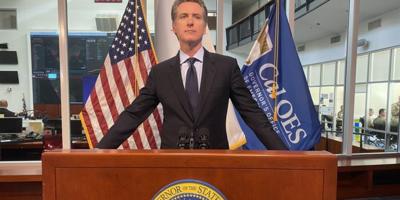



California Gov. Gavin Newsom
PASADENA — California cannot use a state law to force federal immigration officers and other agents to identify themselves using state-approved badges when enforcing federal law in the state, an appeals court has ruled.
On Oct. 14, a three-judge panel of the U.S. Ninth Circuit Court of Appeals said the doctrines of federal supremacy under the U.S. Constitution and "intergovernmental immunity" block California's Democrat-dominated state government from directly regulating the manner in which federal agents enforce federal laws in the Golden State.
And the judges said that immunity also extends to individual agents who may violate California state laws when those laws conflict with federal law or orders and directives from their superiors within the federal government.
The California law, the judges said, "regulates the performance of 'governmental action[s]' which are 'carried on by the United States itself' —not merely 'persons who [a]re acting for themselves and not for the United States.'
"Indeed, it applies only to law enforcement agencies and their officers, including federal law enforcement agencies and federal law enforcement officers.
"(The California law) thus directly regulates inherently sovereign functions. Because Congress has not authorized such legislation, it is barred by intergovernmental immunity."
The decision was authored by Ninth Circuit Judge Mark J. Bennett. Judges Jacqueline H. Nguyen and Daniel P. Collins concurred.
Bennett and Collins were appointed to the court during the first term of President Donald Trump. Nguyen was appointed by former President Joe Biden.
The decision blocks California from attempting to enforce state laws enacted by the Democrat-dominated state legislature and signed by Democratic Gov. Gavin Newsom earlier this year that seek to regulate the manner in which federal agents can enforce federal laws in California.
Known as the "No Vigilantes Act" and the "No Secret Police Act," the laws together would require federal law enforcement officers operating in California to "visibly display identification" and to keep their faces uncovered, allowing for easy identification.
The laws allow exceptions for undercover federal police operations and certain other conditions.
Federal agents who don't comply with the law could face state criminal prosecution under the laws.
While the laws purportedly apply to all federal agents in California, supporters of the laws have made no secret of their intention to target the laws specifically at federal immigration enforcement operations, including those conducted by Immigration and Customs Enforcement and Border Patrol agents.
The laws were passed as part of California Democrats' response to increased immigration law enforcement operations seeking to identify, arrest and deport illegal immigrants residing in California and elsewhere in the U.S.
The operations drew outrage and sometimes violent responses from immigrant rights' activists, Democratic politicians and residents of communities believed to harbor large numbers of illegal immigrants, asserting the increased immigration enforcement operations were immoral and illegal.
Amid other responses in California and other Democrat-dominated states throwing up roadblocks and attempting to bog down federal immigration enforcement, California Democrats took aim at practices by ICE and Border Patrol agents to decline to compel officers to wear visible badges and to cover their faces, ostensibly to protect immigration agents against public doxxing and threats or violence that may follow and be targeted against them or their families.
From the moment the laws were introduced, the Trump administration and other critics warned Newsom and California lawmakers that the laws would be challenged and likely struck down in court for unconstitutional trespass by the state on the constitutional authority of the federal government.
The Trump administration immediately challenged both laws in Los Angeles federal court.
There, U.S. District Judge Christina Bennett, an appointee of former President Bill Clinton, partially blocked the state from enforcing the face coverings ban. But Judge Christina Bennett refused to block the state from enforcing the law threatening to prosecute federal agents who don't identify themselves as the state government mandates.
On appeal, the Ninth Circuit judges said Judge Christina Bennett was wrong to allow the state to enforce that law.
While the state can prosecute agents for illegal actions they commit individually and can regulate non-law enforcement activities applicable to everyone, such as traffic laws, the state cannot attempt to use its power to regulate how federal agents enforce federal law, unless Congress authorizes them to do so, the judges said.
"... Unlike traffic laws which, for example, might require a full stop before a right turn, and which regulate conduct that any ordinary citizen could engage in, (the California law) applies exclusively to law enforcement officials and exclusively to their performance of law enforcement operations," Judge Mark Bennett wrote in the Ninth Circuit decision. "Thus, (the California law) does not just 'incidentally' sweep up the conduct of federal officers carrying out their duties."
The appellate panel reversed Judge Christina Bennett's ruling and sent the case back to her with instructions to enter an order blocking the state of California from enforcing the federal officer identification mandates.
