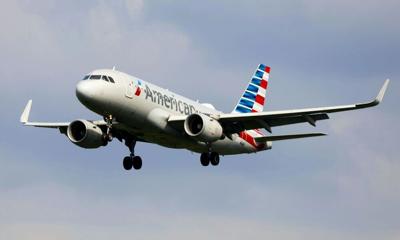


An American Airlines plane landing at Pittsburgh International Airport.
MIAMI – A Florida attorney has filed a lawsuit against American Airlines, alleging a flight crew failed to confront an intoxicated passenger who caused him injuries and instead threatened and defamed him.
Plaintiff David Cruz, a Miami-Dade County resident and attorney at Vindex Privatus PLLC, filed his lawsuit in U.S. District Court for the Southern District of Florida, Miami Division.
In his 15-page complaint, Cruz claims American, based in Fort Worth, Texas, knew the passenger – identified only by his assigned seat on the flight, “the 17A passenger” – was “visibly intoxicated” and “behaved in a belligerent manner.”
He claims the crew also knew the 17A passenger had already been involved in an altercation with another passenger seated in the exit row before the airline moved him beside Cruz.
“At the time American made that decision, American knew, or in the exercise of the high degree of care owed by a common carrier to its passengers should have known, that the 17A passenger was intoxicated, that he had already been involved in an altercation with another passenger aboard the same flight, and that he presented a foreseeable and continuing risk of harm to any passenger seated beside him,” the lawsuit states.
Cruz was a ticketed passenger aboard American Airlines Flight 2290 from Miami International Airport to Los Angeles International Airport, assigned to seat 17B, on Sept. 30, 2025.
According to his filing, he traveled on a non-revenue travel privilege, designated “D2,” derived from the employment of his mother, Flor A. Cruz, who is employed by American as a quality control inspector at the Miami hangar.
Cruz claims he spent the day performing repairs at his mother’s residence in Miami Springs, Florida, before being dropped at the terminal. He notes in his filing that he consumed no alcohol at any time before boarding his flight.
He alleges after the airline seated the 17A passenger beside him, the passenger struck him with his elbow in the left arm and ribs. He did so on three separate occasions during the flight, he claims.
The 17A passenger also threw a bottle of wine onto Cruz, saturating his clothing, his bag, and his documents, Cruz alleges.
In addition, the 17A passenger struck or knocked over a beverage that Cruz had purchased aboard the aircraft before he was able to consume it.
“Plaintiff requested assistance from American’s cabin crew on multiple separate occasions during the flight: after the first elbow strike, after the second elbow strike, and again after the bottle of wine was thrown onto him,” the complaint states.
“No member of American’s cabin crew intervened. No crew member separated the two passengers, reseated Plaintiff, restrained or warned the assailant, prepared an incident report, notified the flight deck, or took any other protective action whatsoever on Plaintiff’s behalf.”
Cruz claims he took it upon himself to begin recording audio and video, to protect himself. He states the recordings exist and “are preserved.”
Federal regulation, he notes, prohibits a certificate holder from allowing any person who appears to be intoxicated to board its aircraft, and prohibits the service of alcoholic beverages to any person who appears to be intoxicated.
After he landed, Cruz contends American’s crew “interrogated, mocked, and threatened” him and allowed the other passenger to simply walk away.
“The flight attendant repeatedly and loudly demanded to know where Plaintiff worked, accused him of lying, and insisted that he was an American Airlines employee,” his lawsuit states.
Cruz claims the attendant also threatened him with the loss of his travel privileges and misrepresented to him that law enforcement had been contacted.
Later that night, he alleges he sought medical care for bruising to his upper left arm and ribs. That same night, the Federal Bureau of Investigation contacted him and took his statement.
Members of the flight crew, in an internal review of the incident later on, claim Cruz was intoxicated during the flight.
“American’s employees published the statements with knowledge of their falsity or with reckless disregard for their truth or falsity,” the lawsuit states.
“The statements are defamatory per se. They impute to Plaintiff the commission of a criminal offense, and they impute to Plaintiff conduct, characteristics, and a condition incompatible with the proper exercise of his lawful profession as a licensed attorney, a profession in which sobriety, credibility, and fitness are essential.”
Cruz seeks compensatory damages in excess of $75,000, costs, and prejudgment interest.
His Coral Gables, Florida, law firm is representing him in the case.