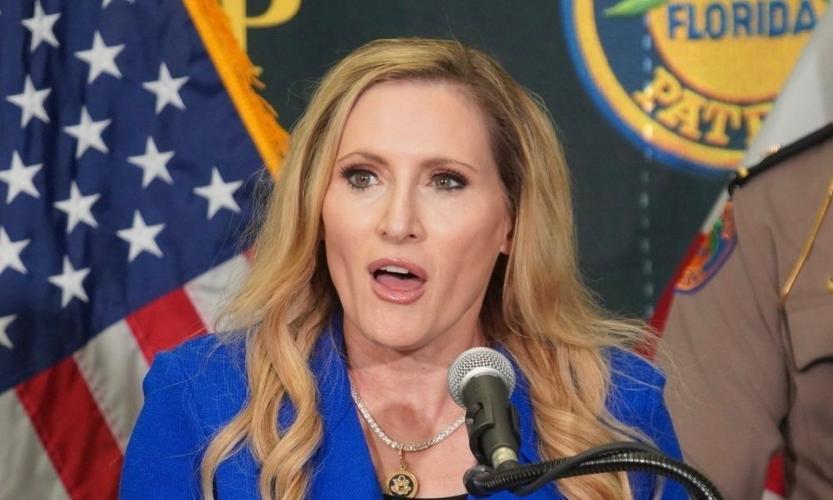






U.S. Rep. Laurel Lee (R-Florida)
WASHINGTON – A Florida Congresswoman has introduced a constitutional amendment that would establish a clear requirement that only United States citizens can vote in federal elections.
Rep. Laurel Lee, a Republican, introduced the joint resolution last month. Other sponsors include Rep. Lance Gooden (R-Texas), Rep. Mike Haridopolis (R-Florida), Rep. Julia Letlow (R-Louisiana), Rep. Wesley Hunt (R-Texas) and Rep. Russell Fry (R-South Carolina).
The joint resolution would codify in the Constitution that only U.S. citizens are eligible to vote in elections for president and vice president as well as members of Congress. It would close a longstanding constitutional gap, ensuring a uniform national standard.
“For generations, Americans have shared a clear and common understanding: voting in federal elections is a right reserved for United States citizens,” Lee said. “While current federal law reflects that consensus, the Constitution itself does not explicitly require citizenship for voting in federal elections.
“This amendment provides the clarity and permanence needed to ensure that this fundamental principle is protected.”
Rep. Jim Jordan, chairman of the House Judiciary Committee, agreed.

Jordan
“It’s simple: only Americans should vote in American elections,” Jordan (R-Ohio) said. “Congresswoman Lee’s amendment is a common-sense proposal that creates a uniform, nationwide standard that will protect federal elections permanently.”
While it commonly assumed that individuals who are not citizens of the United States cannot legally vote in federal elections, there is nothing in the U.S. Constitution that backs that conclusion up.
“To the extent U.S. citizenship has become a federal voting requirement, it is fortuitous, due only to the policy judgments of individual states,” Edward D. Greim wrote in a recent legal review about the issue. “It is not due to any valid exercise of authority by the United States Congress. That conclusion may surprise many. But if one supports the bedrock principle that it is essential to ensure that only U.S. citizens vote in federal elections, the only certain protection is a federal constitutional amendment.”
Greim, an attorney who argued the recent Louisiana redistricting case before the U.S. Supreme Court, goes on to write state “will be free under our current constitutional system to allow aliens to vote in federal elections.”
“Because the U.S. Constitution currently allows states to decide who can vote in federal elections – even including non-citizens – a constitutional amendment is necessary to ensure that only U.S. citizens vote for the Congress and for president,” Greim wrote. “Congress can pass a resolution now proposing just such an amendment. The proposal would give primary enforcement power to the states, subject to a congressional override – the same division of power that has governed the states and Congress since 1788 under the Elections Clause in Article I.
“To assure the will of the American people is fulfilled, the proposal relies upon the ‘convention’ mode of ratification, which, based on the precedent of the 21st Amendment, allows voter participation in the ratification process.”
No state currently allows non-citizens to vote for legislators. But a state law allowing non-citizens to vote for members of the state Legislature would automatically allow them to vote for members of Congress, according to Bradley A. Smith in a recent Wall Street Journal commentary.
“The only way to close that loophole is with a Constitutional amendment,” wrote Smith, a former member and chairman of the Federal Election Commission. “If proposed by two-thirds votes of both congressional chambers, this amendment would then go to the states for ratification.
“It’s the only legally effective way to ensure that only U.S. citizens vote in federal elections – and such a move would have overwhelming public support.”
Polling supports that statement.
A 2025 poll by Remington Research Group shows that 90% of those surveyed believe only U.S. citizens should be able to vote in elections for Congress and the president. And 76 percent support an amendment like the one Lee introduced.
Under current law, federal statute prohibits non-citizens from voting in federal elections. However, federal law alone is not permanent. It can be repealed, weakened or challenged, and the Constitution leaves voter qualifications primarily to the states. As a result, the current framework does not guarantee a lasting nationwide standard.
Lee’s proposed amendment does not alter state authority over state or local elections, and it doesn’t change existing constitutional protections related to voting rights, including those based on race, sex, or age. Instead, it focuses narrowly on federal elections, reinforcing the longstanding expectation that participation in choosing national leaders is reserved for U.S. citizens.

Fortenberry
“Most people think the Constitution requires that voters be citizens of this country,” Avi Fortenberry, president of Americans for Citizen Voting, told The Florida Record. “In fact, the Constitution leaves voter eligibility entirely to each state to decide.
“One state could decide that non-citizens in that state are allowed to vote in federal elections, and that decision would affect us all.”
In recent years, several states have passed constitutional amendments to ensure non-citizens don’t vote in state elections. West Virginia, for example, has an amendment on the ballot in this fall’s election.
In recent years, ACV has worked to have similar measures adopted in states. Texas voters approved a similar measure in November. And in 2024, eight states (Idaho, Iowa, Kentucky, Missouri, North Carolina, Oklahoma, South Carolina and Wisconsin) passed laws to keep non-citizens from voting.
Including Texas, 21 states now have laws ensuring only American citizens can vote in those states, and several other states are actively considering such legislation.
Legislatures in Arkansas, Kansas and South Dakota also have placed amendments on the 2026 ballot.
“Relying on statute alone leaves this principle subject to future changes that could undermine this long-standing principle,” Lee said. “This amendment ensures that no matter what happens in Washington or at the state level, federal elections will remain reserved for United States citizens.”
A 1993 law review article agreed.
“Noncitizen suffrage is a franchise issue reserved to the states by Article I of the Constitution,” Jamie Raskin wrote. “Furthermore, granting the vote to aliens does not offend the Equal Protection Clause, the Naturalization Clause or any other constitutional principle.”
Raskin is a Democratic congressman from Maryland and member of the House Judiciary Committee. He previously was a constitutional law professor at American University’s Washington College of Law.
“The idea of having foreign citizens vote in American national elections is … inherently more troubling than having them vote in local elections,” Raskin wrote in the article.