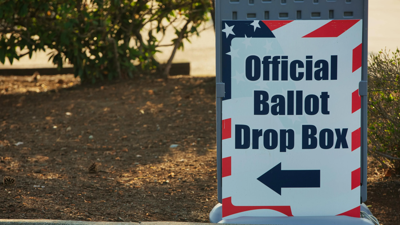



An “Official Ballot Drop Box” sign directs voters to a ballot drop location.
FORT LAUDERDALE – A federal judge has dismissed a criminal charge against a woman accused of knowingly voting as a noncitizen, saying Congress exceeded its constitutional authority by independently deciding who may vote in federal elections.
The October 1 decision by U.S. District Judge David S. Leibowitz applies only to the prosecution of Chelsea Michelle Ann Cox. It does not invalidate Florida’s prohibition on noncitizen voting, and the judge expressly declined to decide whether the federal law is unconstitutional in all circumstances.
But the ruling’s reasoning could influence constitutional challenges to federal voting restrictions, including the SAVE America Act, according to an analysis published by the Cato Institute.
In that October 2 analysis, Stephen Richer cautioned that the decision neither legalized noncitizen voting nor resolved the constitutionality of the proposed legislation.
Federal prosecutors accused Cox of knowingly voting in a federal election in Broward County October 29, 2020, while aware she was not a U.S. citizen. They charged her October 22, 2025, with one misdemeanor count that carries a maximum penalty of one year in prison, a fine or both.
Leibowitz dismissed the charge on constitutional grounds, without determining whether Cox committed the alleged offense.
“No determination of fact is needed here; one can assume that the Defendant committed every element of the crime established by Section 611, and the answer is the same,” he wrote.
The question, the judge said, was whether Congress had authority to establish the prohibition in the first place.
“Congress has no power to say who can vote or who cannot vote in federal elections – that foundational power is reserved for the States, and limits Congress,” Leibowitz wrote, noting exceptions arising from specific constitutional provisions.
The ruling draws a distinction between regulating election procedures and establishing voter qualifications.
The Constitution ties eligibility to vote for the U.S. House to the qualifications required for voters in the most numerous branch of a state Legislature. The 17th Amendment uses the same framework for Senate elections, while Article II gives states authority over the appointment of presidential electors.
Leibowitz said those provisions reserve general authority over voter qualifications to states, subject to constitutional restrictions such as prohibitions on denying voting rights because of race or sex. Congress’s power to regulate the times, places and manner of congressional elections does not confer a general power to determine who may vote, he ruled.
The federal statute crosses that boundary, according to Leibowitz, because it establishes a nationwide prohibition independent of state law. Even if a state authorized noncitizens to vote in federal elections, their participation still would be considered criminal.
“Section 611 makes it a crime for a certain class of people (non-citizens) to vote in any election where a federal office is on the ballot,” Leibowitz wrote. “To that extent, the statute dictates ‘who may vote.’”
The judge relied in part on the Supreme Court’s 2013 decision in Arizona v. Inter Tribal Council of Arizona. In that case, Justice Antonin Scalia distinguished Congress’s authority to regulate how federal elections are held from the states’ authority to determine who may vote.
Leibowitz said the 2013 decision did not directly control Cox’s case but provided important guidance on the constitutional division of authority.
Prosecutors principally relied on Oregon v. Mitchell, a fractured 1970 Supreme Court decision that upheld Congress’s lowering of the voting age to 18 for federal elections, but not state and local elections.
The government argued the decision established Congress’s authority to set voter qualifications for federal elections. Leibowitz rejected that interpretation, finding that no majority of justices endorsed the broad constitutional rationale prosecutors advanced.
He concluded that the decision supported congressional authority over voting-age qualifications, not an unrestricted power to establish other eligibility requirements.
The government also argued that Congress’s immigration and foreign affairs powers supported the prohibition as a measure against foreign interference in elections. Prosecutors maintained that states were not equipped to assess attempts by foreign countries to influence federal elections.
Leibowitz acknowledged Congress’s broad authority in those areas, as well as its power to combat election fraud. But he ruled that those general powers could not override the Constitution’s specific allocation of authority over voter qualifications.
“Foundational constitutional limits do not give way, even to capacious general provisions of enumerated congressional power,” he wrote.
The court appointed attorneys Paul D. Clement and Chadwick J. Harper to provide an independent analysis of the constitutional question. They served without compensation, and the judge credited their briefing and participation in a Sept. 15 hearing with supplying important additional arguments and legal authorities.
“We knew this was going to happen eventually,” Jack Tomczak, vice president of Americans For Citizen Voting, told Legal Newsline. “The Constitution and Supreme Court precedent are very clear that the power to determine voter eligibility in federal elections resides entirely in the states and not in Congress.
“The only way to guarantee that states won’t choose to legalize non-citizen voting in federal elections is by amending the U.S. Constitution.”
In recent years, several states have passed constitutional amendments to ensure non-citizens don’t vote in state elections. West Virginia, for example, has an amendment on the ballot in this fall’s election.
In recent years, ACV has worked to have similar measures adopted in states. Texas voters approved a similar measure in November. And in 2024, eight states (Idaho, Iowa, Kentucky, Missouri, North Carolina, Oklahoma, South Carolina and Wisconsin) passed laws to keep non-citizens from voting.
Including Texas, 21 states now have laws ensuring only American citizens can vote in those states, and several other states are actively considering such legislation.
Legislatures in Arkansas, Kansas and South Dakota also have placed amendments on the 2026 ballot.
In his Cato analysis, Richer says the ruling could sharpen debate over whether federal documentary requirements regulate registration procedures or effectively establish additional qualifications for voting.
The Senate version of the SAVE America Act would require documentary proof of citizenship for registration in federal elections, with an alternative process for citizens lacking specified documents. It also would require states to identify and remove noncitizens and impose a federal photo identification requirement for voting, Richer wrote.
Supporters have an important distinction available, he said: Requiring proof that someone meets an existing state qualification can be characterized as regulating registration procedures rather than creating a new qualification.
But the constitutional issue becomes more difficult when a citizen meets all state eligibility requirements yet lacks documents prescribed by Congress, Richer wrote.
“If federal law prevents the state from registering her, is Congress merely determining how the state verifies its voters—or has Congress effectively imposed an additional qualification on who may vote?” he asked.
The Cox ruling does not answer that question, Richer emphasized, and a single district court decision does not bind courts nationwide.
“The decision is narrow,” he wrote. “But the reasoning is anything but narrow.”
In his ruling, Leibowitz stressed that Florida remains authorized to prohibit and punish the conduct alleged against Cox. Florida law requires voters to be U.S. citizens and makes knowingly voting while unqualified a third-degree felony, the opinion states.
The judge also left unresolved whether Cox’s alleged conduct could support removal from the United States under immigration law. He noted that a separate federal statute addresses noncitizens who vote in violation of federal, state or local law, without independently establishing a federal voter qualification.
Congress might also be able to enact a different criminal law penalizing noncitizens who vote in federal elections in violation of state-established qualifications, Leibowitz wrote. Such legislation would reinforce a state’s eligibility rules rather than substitute a federal requirement, although he did not decide the constitutionality of that hypothetical law.
The court declined to consider a challenge seeking to invalidate Section 611 in all its applications, noting Congress’s broad authority over the District of Columbia could support a prohibition there.
U.S. District Court for the Southern District of Florida case number 0:25-cr-60249