
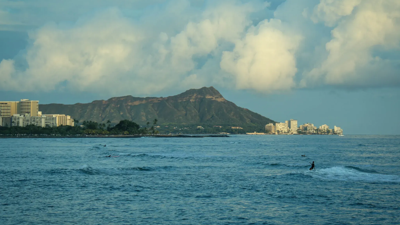



The coastline of Hawaii, April 29, 2025.
HONOLULU - As the Supreme Court prepares to hear a potentially pivotal lawsuit over climate change by Colorado municipalities this October, Hawaii seems to have its feet planted on both sides of the debate.
The Aloha State also has a lawsuit pending against major oil companies, blaming them for misleading fuel consumers – presumably including the state itself – into burning more oil than they would have had they understood global warming. At the same time, Hawaii is more reliant on fossil fuels than any other state, deriving some 90% of its total energy consumption from oil.
Hawaii is mandated to cut its fossil-fuel consumption to zero by 2045 under a 2018 law, but hasn’t gotten very far down that road. Oahu, with 70% of the state population, used oil to generate 68% of its electricity last year, down from 74% five years ago. The Hawaii Public Utilities Commission estimates Oahu is about 32% of the way toward achieving net zero, but there are signs progress will be much more difficult in the future.
Lawsuits like Hawaii Attorney General Anne Lopez’s allege consumers would have picked other options or not used as many fossil-fuel products as they did had Big Oil not concealed their harm, but numbers suggest how difficult eliminating them will be. In fact, as Massachusetts sued over the same claims, it was ignoring its own regulations on emissions from state vehicles.
Lopez hired the private firm Sher Edling for her case, filed after a legal tussle with the Trump administration after an executive order forbidding any new climate litigation as an improper attempt to regulate the international energy market. The case alleges “lies and deceit” that made Hawaii dependent on oil, and the state Supreme Court has given its blessing to similar claims by Honolulu.
Rooftop solar now accounts for 16% of the island’s electricity mix, but Hawaii has the nation’s highest level of adoption with half of households mounting solar panels on their roofs. Another 7% comes from utility-scale solar, but increasing that will run into a thicket of land-use regulations and local opposition. Oahu currently has about 2,000 acres of solar plants, but it will take as much as 30,000 acres more to replace the current capacity of 1.5 gigawatts at five to seven acres per megawatt.
The official state renewable energy plan also includes hundreds of megawatts of onshore and offshore wind, which almost certainly will have to be abandoned. Honolulu had to back off on its wind turbine plans after strong protests by local residents.
“In our view, there’s not going to be any more windmills, so the only thing left is going to be solar,” said Clint Churchill, president of the Practical Policy Institute of Hawaii, which criticizes the state’s net-zero plans as impractical and overly expensive. “To commit that amount of land that is badly needed for decades and centuries for housing is in our opinion imprudent.”
Hawaii Gov. Josh Green, a Democrat, still supports the ambitious goal of weaning the state off of oil by 2045. But he’s also supporting a $2 billion partnership with Japan’s largest utility conglomerate to shift electricity generation from oil to liquified natural gas, a plan that is opposed by diehard environmentalists.
Meanwhile the state claims it is bound by a legal settlement Gov. Green reached in 2024 with Our Children’s Trust, an Oregon nonprofit. That agreement establishes strict targets Hawaii must meet to comply with the 2022 law that mandates a 50% reduction in greenhouse gases by 2030 and total elimination by 2045. To do that, the settlement says the state must spend $40 million on electric-vehicle charging stations, convert all ground equipment at airports and harbors to zero emissions, and address “the full decarbonization of international aviation and marine transportation to the Hawaiian Islands.”
This last requirement will hit the tourism industry hard, as it would mean cutting in half visits by cruise ships that belch greenhouse gases into the air the entire time they are in port. The state also says it will mandate airlines use sustainable jet fuel made from plants and waste food oils, which cost two to three times as much as conventional aviation fuel and some critics say is made by converting forests into cropland.
Churchill believes the entire plan is due for a political reckoning like the one New York went through earlier this year. Saying the state’s climate law goals had become “costly and unattainable,” Gov. Nancy Hochul convinced legislators to push back a key 2030 deadline to cut emissions by 40% until 2040.
The Supreme Court may curtail other states’ efforts to drive down oil use – and raise revenues – by suing oil companies over global warming. It is scheduled to hear arguments in October in Boulder’s lawsuit against Suncor and major oil companies on claims the public has been harmed by hydrocarbon use.
Hawaii is still publicly committed to eliminating fossil-fueled vehicles on its roads, sharply limiting cruise ship traffic and requiring jetliners to use much more expensive fuel. At the same time, the official state plan has as a top priority not increasing energy costs for less affluent residents, especially the indigenous population. Legislators have talked about a carbon tax to redistribute income to lower-income consumers, but the proposals have gone nowhere. Hawaii has long had the nation’s most expensive electricity.
“Everybody tiptoes around the law, but the law was made by the legislature,” said Churchill.
“The only strategy in our view is to speak out.”
The stated justification for Hawaii’s net-zero plans is to protect the island chain against the effects of global warming, primarily sea level rise. Yet Hawaii’s total greenhouse gas emissions from human activities are about 15 million metric tons per year, equivalent to one mid-sized Chinese city. Its volcanoes release another three to nine million tons of CO2 a year.
Reducing the human emissions to zero will require shutting down power plants that currently supply more than half the state’s electricity and massively increasing the solar footprint on Oahu, an island with limited open land not already subject to preservation restrictions.
“There’s an inherent tension between Hawaii’s environmental goals and its decarbonization goals,” said Joe Kent, executive vice president of the Grassroot Institute of Hawaii, which promotes housing reform and economic growth policies.