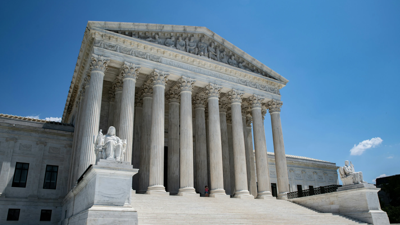


The U.S. Supreme Court stands in Washington.
WASHINGTON – In two months, U.S. Supreme Court justices will hear arguments on whether local government officials and the private lawyers they have hired can pursue lawsuits that impact the international energy market.
Cities, counties and states have filed close to 40 climate change lawsuits against companies like Chevron and Exxon across the country, despite calls from those defendants and the Trump administration that the litigation steps on the job of federal regulators. Many judges have agreed with that argument, but the supreme courts of Colorado and Hawaii have not.
The case before the U.S. Supreme Court is an appeal of the Colorado ruling in Boulder’s lawsuit, and yesterday its oral argument date was scheduled for Oct. 5. Judging by the volume of amicus briefs submitted to the court, there will be plenty of interested observers in the audience.
“Imagine a barrel of oil that is extracted from an Exxon-owned well in Texas, refined into gasoline in Texas, sold at a gas pump in Texas, and used to fuel cars in Texas,” Sen. Ted Cruz’s brief says.
“Does our Constitution allow Colorado tort law to impose liability on Exxon’s extraction of the oil? The Colorado Supreme Court answered ‘yes.’ At the request of a handful of municipal governments in Boulder, the Colorado Supreme Court ruled that Colorado courts may apply Colorado law to drilling, mining, refining, and advertising across the globe. The Colorado Supreme Court is mistaken.”
Private lawyers working on contingency fees hoping for jackpot verdicts or settlements scored contracts with local officials and crafted their complaints in a way that kept them out of federal court – a strategy already affirmed by the U.S. Supreme Court when it rejected the defendants’ arguments that they belonged there.
Instead, various state court judges have been and are currently asked to toss the cases at the motion-to-dismiss stage. The lawsuits say the public would not have purchased as many fossil-fuel products as it did had Big Oil not lied about their harms, but despite state-law claims like public nuisance and violations of consumer protection laws, some judges have decided the cases are really about regulating emissions – the job of federal officials.
Cases have been tossed in Pennsylvania, South Carolina, New York, Delaware and New Jersey. And in Maryland, multiple judges dismissed lawsuits and were affirmed by the state Supreme Court in a ruling that said climate litigation of this type “cannot be seriously contemplated.”
Several groups submitting amicus briefs disagree. The American Association for Justice – the country’s plaintiffs lawyers group – was among many that filed their stance on Monday with the U.S. Supreme Court. Air and water pollution, AAJ says, have long been matters for state regulation.
“The (Clean Air Act) is not so comprehensive as to demonstrate an implied purpose on the part of Congress to exclude state regulation of greenhouse gases altogether,” AAJ’s brief says.
“In fact, Congress provided for state regulation more stringent than EPA standards and included a savings clause preserving the right of any state or political subdivision to enforce any standard that is at least as stringent as the federal one.”
Imposing liability for the costs of addressing climate change in Colorado does not necessarily change how Big Oil must conduct itself in other jurisdictions, AAJ argued. “The fact that other states may suffer similar harms does not diminish Colorado’s or any state’s authority to provide remedies. Nor does it render such disputes inherently federal,” the brief says.
The Trump administration has issued an executive order forbidding any new cases but lost a legal battle with Hawaii Attorney General Anne Lopez last month. There is only one oil refinery in Hawaii, which currently has the second-highest average gasoline price and the highest dependence on oil for electricity despite a call to rely solely on renewable energy by 2045.
“As a result of the fossil fuel industry’s lies and deceit, the State is confronted with the real costs of protecting Hawaii’s people, natural and cultural resources, businesses, and infrastructure from hazards of climate change,” Lopez’s lawsuit says. She, like many other officials, hired the firm Sher Edling for her case.
Alabama Attorney General Steve Marshall led a group of 26 states that said Boulder is trying to “assert a power with no analogue in our Nation’s history and no place in our federalism.”
Republicans in Congress also filed a brief, complaining the Colorado Supreme Court’s ruling created a patchwork of state and local regulations for a market that is supposed to be overseen by federal authorities.
And the Trump administration said Boulder is attempting to impose new rules that would go far beyond the borders of Colorado. “If, as the Colorado Supreme Court held, those theories are consistent with federal law, then every locality in the country could sue essentially anyone in the world for contributing to global climate change,” that brief says.
That blame game has spread to citizens, too, as a Seattle lawsuit alleging the fossil-fuel industry contributed to a heat wave that killed a woman in her car in 2021 has been allowed to proceed. The woman had been on a liquid diet prior to a doctor’s appointment and the air conditioner in her car was not working.