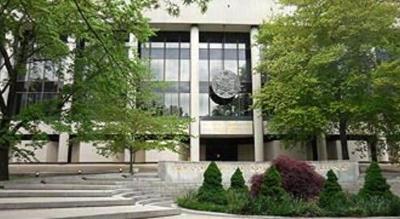


Robert C. Murphy Courts of Appeal Building in Annapolis, Md.
ANNAPOLIS, Md. – Maryland’s highest court has found that local governments that hired jackpot-seeking lawyers to sue the oil industry over climate change cannot do so.
The court yesterday affirmed the dismissals of lawsuits brought by Anne Arundel County, Annapolis and Baltimore, as the U.S. Supreme Court prepares to issue a decision in a similar case brought in Colorado.
Dozens of government officials hired private lawyers working on contingency fees to claim companies like Chevron and Exxon tricked the public into using fossil fuels. But state court judges have found the cases seek to regulate emissions standards – the job of federal regulators.
“No amount of creative pleading can masquerade the fact that the local governments are attempting to utilize state law to regulate global conduct that is purportedly causing global harm,” Maryland Supreme Court justice Brynja McDivitt Booth wrote.
“Quite simply, the notion that a local government such as Baltimore, Annapolis, or Anne Arundel County may pursue state law nuisance claims against the Defendants—seeking injunctive relief to abate injuries arising from global greenhouse effects arising from worldwide conduct—is so far afield from any area of traditional state or local responsibility that it cannot be seriously contemplated,” she added.
The U.S. Supreme Court is waiting on briefs in Boulder’s case, where the Colorado Supreme Court denied the defendants’ motion to dismiss. Hawaii’s top court also ruled Honolulu’s case could move forward.
But other judges have been critical of the plaintiffs’ approach. To stay out of federal court, where the energy industry could have mounted an even stronger defense, lawyers crafted their complaints to make claims under consumer protection laws and for public nuisance.
State judges in Pennsylvania, South Carolina, New York, Maryland, Delaware and New Jersey threw cases out as improper attempts to regulate emissions. A federal judge dismissed a case in Puerto Rico, while federal judges in New York and California had tossed cases before the U.S. Supreme Court found they had belonged in state court.
“As the Court concluded, ‘[a]lowing each of the 50 states’ ‘to impose their own preferred policy solutions for climate change’ ‘would create a plainly ‘irrational system of regulation,”’ said Ted Boutrous of Gibson, Dunn and Crutcher, who represents Chevron.
“Claims for climate-related damages under state laws are precluded by clear U.S. Supreme Court precedent.”
It remains to be seen how much stock the U.S. Supreme Court puts in the Maryland decision. Amicus briefs in Boulder’s case have poured in, urging the justices to rule on key issues persisting in the more than 30 climate lawsuits.
Alabama Attorney General Steve Marshall led a group of 26 states that said Boulder is trying to “assert a power with no analogue in our Nation’s history and no place in our federalism.”
Republicans in Congress also filed a brief, complaining the Colorado Supreme Court’s ruling created a patchwork of state and local regulations for a market that is supposed to be overseen by federal authorities.
And the Trump administration, which has issued an executive order forbidding any new cases and is battling the attorneys general of Michigan and Hawaii in court, submitted its thoughts last year, saying Boulder is attempting to impose new rules that would go far beyond the borders of Colorado.
“If, as the Colorado Supreme Court held, those theories are consistent with federal law, then every locality in the country could sue essentially anyone in the world for contributing to global climate change,” that brief says.