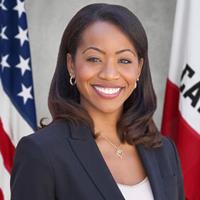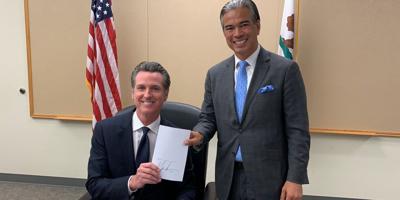



From left, California Gavin Newsom and California Attorney General Rob Bonta
LOS ANGELES — In coming days, a panel of federal judges will decide if California lawmakers violated the U.S. Constitution and federal voting rights laws when they sent to voters a rare mid-decade congressional district map to all but eviscerate Republican representation in Congress from the Golden State.
However, in coming days, it also may be seen how a new decision from the U.S. Supreme Court will alter the legal and constitutional calculus surrounding claims from challengers that California lawmakers trampled the rights of many voters when they drew the map to explicitly favor the creation of so-called "majority minority" districts, designed to ensure the election of Democratic black and Latino representatives to Congress.
On April 24, California Attorney General Rob Bonta, together with attorneys from the national Democratic Party, filed motions in Los Angeles federal court to bring an end to the lingering challenges to the California's new gerrymandered congressional map.
In the motions, Bonta, who is a Democrat, and the Democratic Party lawyers, led by the Washington, D.C.-based Elias Law Group, asserted the challenges fall short of proving the maps were racially discriminatory or unconstitutional violations of anyone's rights.
While the maps resulted in new districts that included majorities or pluralities of black or Latino voters, Bonta and his fellow Democrats said the maps should still be considered constitutional, because their primary purpose was purely to elect more Democrats, a political purpose the Supreme Court has said cannot form the basis of a challenge to legislative district maps.
Further, Bonta and the Democrats argued California state lawmakers and Gov. Gavin Newsom can't be sued, because the maps were drawn by political operatives, not by lawmakers. And they said, the maps later secured approval from a majority of California voters under the ballot measure known as Proposition 50.
That vote was held in November 2025, after Sacramento lawmakers hurriedly approved the new map and forwarded it to voters late last year.
The congressional district map had been created by California Democrats, led by Gov. Newsom, amid a special mid-decade gerrymandering initiative, in a brazen bid to increase Democratic representation in Congress.
Newsom and his fellow Democrats had asserted the move was needed to counteract efforts by Republicans in other states, and Texas, in particular, to favor the election of Republicans in 2026 and reduce the chances of a midterm Democratic takeover of the U.S. House.
Unlike those other states, California's process required Democrats to take another step: Securing approval from voters directly through a special referendum to "temporarily" amend the state constitution and allow the state legislature to draw the new maps, rather than the state's constitutionally established independent redistricting commission.
After the Prop 50 election, California Republicans challenged the law under the Fourteenth and Fifteenth amendments to the U.S. Constitution and the federal Voting Rights Act. They were later joined by the Justice Department under President Donald Trump. The lawsuits asserted the new gerrymandered maps were illegally designed to "shore up" support for Democrats from Latino voters.
While the U.S. Supreme Court has explicitly refused to strike down gerrymanders intended to increase partisan power, the court has considered challenges based on accusations district maps are drawn to favor or dilute the political power of certain racial groups.
Plaintiffs noted the man credited with drawing the maps, identified as Paul Mitchell, explicitly and publicly said he and Democrats intended to use the Prop 50 process to create more majority Latino districts.
Those statements were also echoed by Democratic state lawmakers as the maps were advanced in Sacramento.
However, a special judicial panel assigned by the U.S. Ninth Circuit Court of Appeals to consider the challenge, sided with Newsom and the Democrats. They rejected a bid for an injunction to block the state from using the district map in the 2026 elections.
In the ruling, the judicial panel essentially declared Republicans couldn't challenge the Democratic map as an illegal "racial gerrymander" unless they could somehow prove California voters had voted for the maps with the intent to discriminate in favor of Latinos or other racial groups.
The U.S. Supreme Court in February then rejected the challengers' petition on appeal. In that petition, the challengers had warned that allowing that reasoning to stand would establish a precedent allowing states to violate anti-discrimination protections by merely giving voters the chance to approve discriminatory maps.
The Supreme Court's denial meant California would be allowed to continue using the new congressional map for 2026, at least.
However, while the injunction was denied, Republicans and other challengers have not dropped their overall legal challenge, as they seek a decision on the merits of their claims that the maps are illegal racial gerrymanders.
In the meantime, after Bonta and the Democratic lawyers filed their motions to dismiss, the U.S. Supreme Court issued a new ruling that changes how courts must interpret the Voting Rights Act, and particularly the provision known as Section 2.
In the decision in the case known as Callais v Louisiana, the U.S. Supreme Court ruled that a congressional district map in Louisiana which included two districts specifically drawn to ensure black racial majorities amounted to unconstitutional racial gerrymanders.
Supporters of the map had argued the map should be allowed because it was drawn to comply with the provision known as Section 2 of the federal Voting Rights Act, and ensures black voters in Louisiana have the opportunity to elect a candidate of their choice — ostensibly, a candidate who is black.
While the decision from the court's conservative majority did not explicitly strike down Section 2 of the Voting Rights Act as unconstitutional, the court declared that explicitly using race as a criteria to draw legislative districts is unconstitutional.
Further, the court’s majority declared racial minorities do not have a right under the VRA to elect representatives who are of the same race or a preferred race. Rather, the court declared, black, Latino and other racial minority voters have the same voting rights as anyone else.
Voters who are racial minorities may be placed “in a district in which a majority generally agrees, generally disagrees, or only sometimes agrees with their voting preferences,” wrote Justice Samuel Alito, for the 6-3 majority.
“But in any event, the ‘opportunity’ of these ‘members of the electorate’ to contribute their votes to a winning cause is whatever opportunity results from the application of the State’s combination of permissible criteria. That is what our randomly selected individual voter and group of voters can expect regarding their opportunity to elect a preferred candidate.
“And under (Section 2), a minority voter is entitled to nothing less and nothing more.”
In a concurring opinion, Justice Clarence Thomas said Section 2 should have never been interpreted to designate congressional and other legislative districts as belonging to any particular races.
“This Court should never have interpreted (Section 2) of the Voting Rights Act of 1965 to effectively give racial groups ‘an entitlement to roughly proportional representation,’” Thomas wrote.
“… Blacks [we]re drawn into ‘black districts’ and given ‘black representatives’; Hispanics [we]re drawn into Hispanic districts and given ‘Hispanic representatives’; and so on,” Thomas continued. “That interpretation rendered (Section 2) ‘repugnant to any nation that strives for the ideal of a color-blind Constitution.’
“Today’s decision should largely put an end to this ‘disastrous misadventure’ in voting-rights jurisprudence.”
In dissent, Justice Elena Kagan said the decision amounted to a “gutting” of the VRA.
“If other States follow Louisiana’s lead, the minority citizens residing there will no longer have an equal opportunity to elect candidates of their choice,” Kagan wrote. “And minority representation in government institutions will sharply decline.”
The decision has already begun to ripple politically throughout the U.S. Republican-led states, primarily in the southeastern U.S., have begun moving to quickly redraw their states' congressional maps to eliminate some of the dozen Democrat-leaning districts that Republicans say states were forced to draw under the prior interpretation of Section 2, with Democrats using voters' race to secure seats in states that voted overwhelmingly Republican.
Meanwhile, Republicans noted, their voters in Democrat-led states were afforded no such luxuries, often being limited to substantially fewer congressional seats, if any, despite often accounting for 40% of a state's voter base.
In California, for instance, Republicans are currently projected to hold just three or four of the state's 52 total U.S. House seats under the new Prop 50 map, or about 6-7% of the seats. Trump, a Republican, won more than 38% of the vote in the Golden State in the 2024 presidential election.
In the lawsuit challenging California's new congressional map, challengers have not yet responded to the motions to dismiss.
However, it is likely any further arguments in the case will likely quickly center on the opinions in the Supreme Court's new Callais decision.
Attorneys from the Dhillon Law Group, one of the groups representing challengers, did not respond to questions from The Record and Legal Newsline about how the Callais decision may impact the California case.
The conservative election integrity organization, the Public Interest Legal Foundation, which is also representing a different group of challengers in the consolidated case, also did not directly respond to such questions concerning the impact of Callais.
Rather, the group responded with a statement pointing to Justice Thomas' concurrence in that case, in which Thomas said prior courts had misinterpreted Section 2 to allow for the creation of legislative districts reserved for "black" and "Hispanic" representatives.
“Justice Thomas’ words literally hit the nail on the head,” said PILF President J. Christian Adams, in a prepared statement.
“This is exactly what we are witnessing in California’s Prop 50 map redraw. Whites and Hispanics were removed from two Black Los Angeles districts, and 16 districts became 52 to 55 percent majority-minority Hispanic.”