
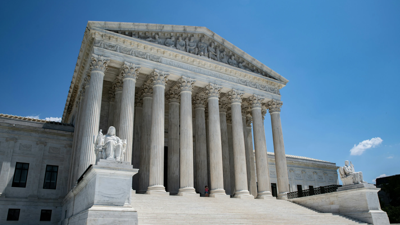



The U.S. Supreme Court stands in Washington.
WASHINGTON, D.C. — The U.S. Supreme Court has dealt another blow to the efforts by Democratic-led states, potentially including Illinois, to use state laws to fight against so-called crisis pregnancy centers and other groups involved in the political and social fight against abortion.
On April 29, the high court came down unanimously against an attempt by New Jersey state Attorney General Matthew J. Platkin to use a New Jersey state consumer fraud law to demand anti-abortion organizations turn over a list of donors and other information.
Platkin had asserted the information was needed to help the state investigate whether crisis pregnancy centers are "misleading" women about abortion in violation of New Jersey law.
The Supreme Court, however, ruled 9-0 that such subpoenas are violations of the First Amendment rights of abortion opponents to associate and speak. Forcing the turnover of such information, the court said, would result in the speech of abortion opponents being chilled, even if the state ultimately did nothing with the information.
While addressing a controversy that originated in New Jersey, the decision is likely to carry weight in other court fights elsewhere in the U.S., including Illinois, where other Democratic lawmakers and attorneys general are attempting to use similar laws to go after pro-life organizations over similar suspicions of "misinformation" or "deception."
In Illinois, for instance, Democratic lawmakers enacted a law that would force anti-abortion doctors and crisis pregnancy center operators to share with women information concerning the "benefits" of abortion.
The measure was signed into law in 2016 by former Gov. Bruce Rauner, a Republican, over the strenuous objections of other Republicans and pro-life advocates.
The law specifically placed new requirements on doctors and other pro-life medical care providers to obtain a so-called "liability shield" offered under the Health Care Right of Conscience Act.
The HCRCA law has been on the books in Illinois since the 1970s, offering legal protections to doctors and other medical professionals who refuse to perform abortions or other medical procedures they believe to be wrong.
However, in the new law, some of those protections could be removed from doctors and other medical professionals who do not agree to discuss what Democrats and other pro-abortion activists say are the "benefits" of abortion, or who refuse to refer pregnant women in their care to other medical providers who are willing to perform abortions.
A Chicago federal judge blocked the law from being enforced in 2017, as the courts agreed the challengers likely had a case that the law trampled their constitutional rights.
In the years since, the case has bounced from judge to judge, finally landing before Judge Iaian Johnston in Rockford federal court.
Johnston again blocked the law from being enforced, saying it was an obvious and unconstitutional restriction on the speech rights of abortion opponents, all but forcing them to share a state-approved message they find "morally abhorrent."
Illinois, however, has continued to defend the law in court, appealing the matter to the U.S. Seventh Circuit Court of Appeals.
The Seventh Circuit heard arguments in that appeal earlier in April.
On appeal, Raoul argued the law doesn't regulate speech. Rather, he asserted, the state should be allowed to tell doctors and crisis pregnancy centers what to say about abortion because the state is allowed to regulate health care providers' "professional conduct."
During oral arguments before the Seventh Circuit on April 10, the plaintiffs, however, said that issue was also decided by the Supreme Court contrary to Illinois' position, when the Supreme Court ruled in a case out of Colorado that states cannot use their regulatory power over health care profession to force counselors to speak with patients about gender issues only using state-approved messaging.
The Seventh Circuit has not yet ruled in the Illinois case.
However, the new New Jersey decision may give abortion opponents yet another weapon to defend themselves against efforts by states, like Illinois, to use state laws to legally pursue them.
In the New Jersey case, Raoul was among a number of Democratic state attorneys general to sign onto a brief in support of New Jersey's position and in defense of state efforts to force organizations like crisis pregnancy centers to turn over their donor information.
The Supreme Court, however, unanimously rejected that position, saying such forced disclosure violates Americans' First Amendment rights.