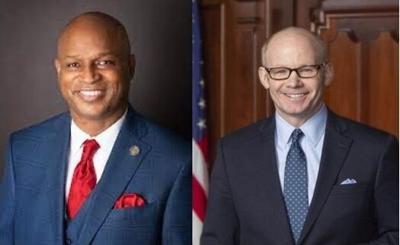



Illinois House Speaker Emanuel “Chris” Welch and State Senate President Don Harmon
SPRINGFIELD — In the wake of a U.S. Supreme Court decision explicitly declaring states cannot use race to decide how to draw legislative districts, Illinois Democrats have sidelined their attempt to amend the state constitution to explicitly require lawmakers use race to guide the drawing of legislative districts.
On April 29, Illinois State Senate President Don Harmon announced the state Senate would not vote on the proposed state constitutional amendment, meaning the measure will not advance to voters for ratification during the November election.
However, Harmon and his counterpart in the General Assembly, House Speaker Emanuel "Chris" Welch, along with Gov. JB Pritzker asserted the effort to somehow still require race be used in Illinois' redistricting process is not ended, but merely paused while they try to find a path around the Supreme Court's new ruling.
"We will dissect this decision, find a path forward and continue to protect the rights of all Illinoisans. I would ask for patience and time for our state’s top legal experts to work through this,” Harmon said.
In the decision in the case known as Callais v Louisiana, the U.S. Supreme Court ruled that a congressional district map in Louisiana which included two districts specifically drawn to ensure black racial majorities amounted to unconstitutional racial gerrymanders.
Supporters of the map had argued the map should be allowed because it was drawn to comply with the provision known as Section 2 of the federal Voting Rights Act, and ensures black voters in Louisiana have the opportunity to elect a candidate of their choice — ostensibly, a candidate who is black.
While the decision from the court's conservative majority did not explicitly strike down Section 2 of the Voting Rights Act as unconstitutional, the court declared that explicitly using race as a criteria to draw legislative districts is unconstitutional.
Further, the court’s majority declared racial minorities do not have a right under the VRA to elect representatives who are of the same race or a preferred race. Rather, the court declared, black, Latino and other racial minority voters have the same voting rights as anyone else.
Voters who are racial minorities may be placed “in a district in which a majority generally agrees, generally disagrees, or only sometimes agrees with their voting preferences,” wrote Justice Samuel Alito, for the 6-3 majority.
“But in any event, the ‘opportunity’ of these ‘members of the electorate’ to contribute their votes to a winning cause is whatever opportunity results from the application of the State’s combination of permissible criteria. That is what our randomly selected individual voter and group of voters can expect regarding their opportunity to elect a preferred candidate.
“And under (Section 2), a minority voter is entitled to nothing less and nothing more.”
In a concurring opinion, Justice Clarence Thomas said Section 2 should have never been interpreted to designate congressional and other legislative districts as belonging to any particular races.
“This Court should never have interpreted (Section 2) of the Voting Rights Act of 1965 to effectively give racial groups ‘an entitlement to roughly proportional representation,’” Thomas wrote.
“… Blacks [we]re drawn into ‘black districts’ and given ‘black representatives’; Hispanics [we]re drawn into Hispanic districts and given ‘Hispanic representatives’; and so on,” Thomas continued. “That interpretation rendered (Section 2) ‘repugnant to any nation that strives for the ideal of a color-blind Constitution.’
“Today’s decision should largely put an end to this ‘disastrous misadventure’ in voting-rights jurisprudence.”
In dissent, Justice Elena Kagan said the decision amounted to a “gutting” of the VRA.
“If other States follow Louisiana’s lead, the minority citizens residing there will no longer have an equal opportunity to elect candidates of their choice,” Kagan wrote. “And minority representation in government institutions will sharply decline.”
The decision will likely ripple politically throughout the U.S.
Republican led states, primarily in the heavily Republican southeastern states, are expected to move quickly to redraw their states' congressional maps to eliminate at least some of the dozen Democrat-leaning districts that Republicans say they were forced to draw under the prior interpretation of Section 2 of the VRA, with Democrats using voters' race to secure seats in states that voted overwhelmingly Republican.
Meanwhile, Republicans noted, their voters in Democrat-led states were afforded no such luxuries, often being limited to substantially fewer congressional seats, if any, despite often accounting for 40% of a state's voter base.
In Illinois, for instance, Republicans hold just three of the state's 17 congressional seats, despite winning more than 40% of the vote routinely, thanks to a congressional map widely considered one of the most egregious examples of gerrymandering in the U.S.
In the hours following the Callais ruling, the Florida state legislature, at the urging of Republican Gov. Ron DeSantis, moved swiftly to redraw their state's congressional map to potentially give the GOP an additional four seats from the Sunshine State.
Other southern states may follow suit.
Meanwhile, in Illinois, the state's Democratic leadership, led by Welch, began pushing a state constitutional amendment to explicitly make race a criteria when drawing legislative districts.
In spearheading the amendment, Welch said the move was necessary to use the state constitution to somehow use the state constitution to thwart the expected results of the Callais decision.
Even after the Callais decision, Welch and Pritzker expressed fury and promised the state would take action to push back on the decision, which Pritzker called "an abomination."
Before and after the Callais ruling, Welch particularly asserted state lawmakers were pushing ahead with their new amendment, saying the state would "fight back" with the measure to "protect voters from discrimination and strengthen access."
Docketed as House Joint Resolution Constitutional Amendment 28 (HJRCA 28), the measure would amend the Illinois state constitution to add new race-based criteria to the rules that must be considered by lawmakers and their designated mapmakers when drawing new representative districts every 10 years.
Currently, the Illinois state constitution only requires districts meet three criteria: That the districts be equal in population; that they be contiguous; and that they be "compact."
However, under HJRCA 28, the rules would be revised to require districts to be drawn to "ensure that no citizen is denied an equal opportunity to participate in the political process and to elect representatives of his or her choice on account of race" and "to create, where practical, racial coalition or influence Districts."
"Racial coalition or influence districts" are congressional or state legislative districts in which a certain racial minority may not necessarily make up a majority of the population in the district, but still are present in sufficient numbers to elect a representative of their particular race, should voters of that particular race decide to do so.
HJRCA 28 was introduced by Welch, a powerful Illinois Democrat whose district includes portions of Chicago’s western Cook County suburbs. The measure, which Welch has dubbed the measure the "Illinois Voting Rights Amendment,” passed the state House, quickly amassing support of many other powerful progressive state lawmakers, who have joined their name as co-sponsors of the proposed amendment.
Welch, who is black, has said such a measure is needed to enshrine in the state constitution racial districting considerations that had been formally considered by courts to be required under the VRA.
For decades, Illinois Democrats, in particular, have used Section 2 to justify the state's controversial congressional and state legislative district maps. They have argued that the bizarre shapes of Illinois' legislative districts are the result of the need to abide by Section 2's language prohibiting drawing federal or state districts which “results in a denial or abridgement of the right of any citizen of the United States to vote on account of race or color.”
That provision has been interpreted by courts to also protect racial minorities, but primarily black and Latino Americans, against so-called "vote dilution," or state congressional and legislative districts drawn in a way to dilute the ability of black, Latino and other racial minorities to elect a non-white representative of their choice.
The Callais decision, however, upended that reasoning, finding Section 2 had been improperly interpreted by prior courts to all but guarantee black, Latino and other racial minorities a right to so-called proportional representation in Congress and state legislatures.
Even before the ruling, constitutional law experts and court observers warned Illinois Democrats' attempt to enshrine race-based criteria into districting would face a very uncertain constitutional future, at best.
Chris Keiser, an attorney with the nonprofit constitutional legal advocacy organization, the Pacific Legal Foundation, said states like Illinois have long relied on Section 2 as a "safe harbor" to sidestep the otherwise understood general prohibition on "racial gerrymandering."
So Keiser said it was likely Illinois' current redistricting process already was unconstitutional.
But he said Illinois cannot use a state constitutional amendment to require such race-based districting in the future.
That view was backed by Jason Mazzone, a professor specializing in constitutional law at the University of Illinois at Urbana-Champaign College of Law.
"State constitutions cannot authorize or require state governments to do something that the federal constitution (or any other federal law) forbids," Mazzone said.