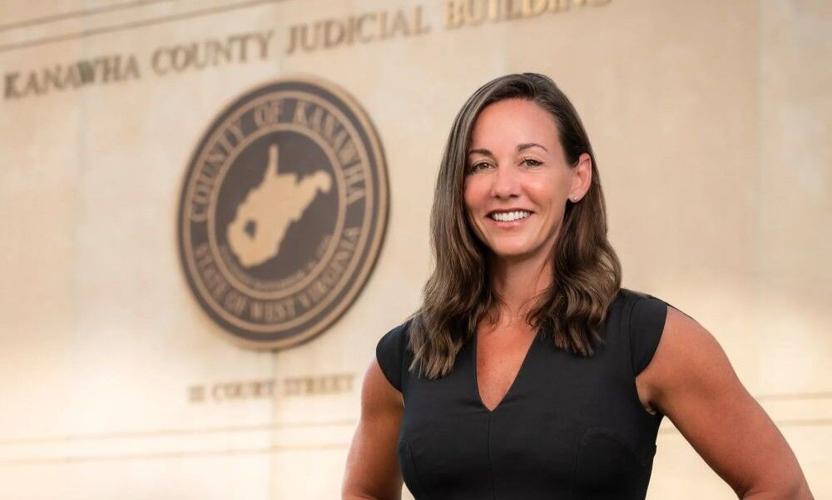



Kanawha Circuit Judge Maryclaire Akers
CHARLESTON – A member of the state Judicial Hearing Board agrees with the majority’s recommendation that ethics charges against a Kanawha County judge be dismissed, but she disagrees with how it got to that conclusion.

Stonestreet
In a concurring opinion, Kanawha Family Court Judge Brittany Ranson Stonestreet agrees disciplinary charges against Kanawha Circuit Judge Maryclaire Akers must be dismissed, but Stonestreet sharply criticizes portions of the JHB’s recommended decision as factually and legally unsound.
“Several findings of fact and conclusions of law contained in the recommended decision either extend beyond the evidentiary record, misconstrue testimony or rest on inferences that are not properly supported,” Stonestreet wrote in her concurring opinion. “Because I believe clarity to the record is essential for the guidance of the bench, I write separately to identify the principal areas of disagreement.”
In the 35-page recommended decision signed by JHB Chairman Michael D. Lorensen and filed June 5 with the state Supreme Court, the JHB said it found no clear and convincing evidence Akers violated any of the five judicial conduct rules cited in a formal ethics charge tied to her March 2025 appearance on MetroNews’ “Talkline” program.
In her concurrence, Stonestreet first faults the majority for relying on a January 2026 West Virginia Watch article that never was admitted into evidence.
“The article was not authenticated, and Akers was never given an opportunity to respond, yet the majority ‘quotes the article as though it were an evidentiary submission’ and uses it to infer why Akers later ‘stepp(ed) back’ from a monitoring agreement,” she wrote, calling such reliance “improper” while noting the article attributes child-welfare problems to systemic conditions and “not to Judge Akers or any breakdown of the monitoring process.”
The only evidence on Akers’ reason for stepping back, according to Stonestreet, is Akers’ uncontradicted testimony that “the pending ethics charges – not the media interview, or any complaints from stakeholders (of which there were none) – chilled her ability to continue any collaborative work.”
Stonestreet says no party sought further action regarding monitoring, and “DoHS filed no motion. The monitor requested no relief. No stakeholder expressed concern.”
Second, Stonestreet rejects the majority’s description of the agreed monitoring order as having a “coercive element.”
“Not a single witness testified to coercion or undue pressure,” Stonestreet writes, adding no stakeholder – including DoHS, guardians ad litem, the prosecutor’s office or the Supreme Court’s Division of Children’s Services – raised any concern that the agreement was anything but voluntary.
Stonestreet says the statement of charges against Akers labels the document an agreement, and the parties stipulated DoHS consented after consulting counsel and did not perceive any bias or impropriety.
Third, Stonestreet says the majority “mischaracterizes” Akers’ MetroNews interview and uses the transcript as proof.
When asked about future case decisions, Akers declined to discuss that.
“I can’t talk about what my decisions will be,” Akers told “Talkline” hosts Dave Wilson and T.J. Meadows. “I can’t even really talk about most of what my decisions are in any specific case.”
Stonestreet says Akers’ reference to the “polar star” best-interest standard was just a restatement of a basic principle of state law, not a preview of rulings.
Stonestreet also defends Akers’ comments about the statistical link between abuse and neglect and later juvenile or criminal involvement, calling them “autobiographical, educational” statements about “well-documented, tragic reality,” not bias. Stonestreet also notes that when pressed to criticize the Legislature or governor, Akers refused.
“Actually, I can’t answer that,” Akers said on “Talkline.” “I’m not allowed to answer.”
Stonestreet also notes that former DoHS Secretary Alex Mayer “testified unequivocally” that neither he nor any DoHS employee believed Akers’ conduct created even an appearance of bias, and no one sought recusal.
Stonestreet devotes a major portion of her concurrence to the proper interpretation of Rule 2.10(A) on judicial public comment, warning that the Judicial Investigation Commission’s Advisory Opinion 2023‑23 “unconditionally (and incorrectly) states” that a judge cannot go on media when the topic involves a pending or impending case.
Rule 2.10(A), Stonestreet writes, does not impose a flat ban but a two-prong test: a pending/impending matter plus a statement that “might reasonably be expected to affect the outcome or impair the fairness” of that matter. By treating the advisory opinion as an absolute prohibition, she says the majority “overlooks the second prong” and risks chilling “entirely permissible, educational public communication by the judiciary.”
Stonestreet also calls it irrelevant, for ethics purposes, whether Akers’ February 2025 order was correctly styled as an “Administrative Order” or even legally sound. Mislabeling or legal error “absent improper motive or intent to prejudice a party, does not constitute judicial misconduct,” she writes, citing Casto and King.
Stonestreet argues the majority’s narrow view of “Administrative Order” is inconsistent with Rule 3a(a) of the child abuse and neglect rules, which expressly contemplates administrative orders directing DoHS to act. Any dispute over the order’s authority is “an appellate question, not an ethical one,” and does not affect the Rule 2.10(A) analysis.
On transparency, Stonestreet defends Akers’ decision to hold a public hearing with a Teams link, noting that 153 people accessed the hearing and that Akers ordered a transcript. Those steps, she writes, “reflect a commendable effort to promote openness and accessibility” in a child-welfare system where individual cases are otherwise sealed.
“Transparency is not an enemy of judicial integrity; it strengthens it,” Stonestreet wrote, adding that in a child-welfare crisis, a public proceeding helps ensure the judiciary remains “a beacon of stable, impartial and open justice.”
Finally, applying Rule 2.10(A), Stonestreet agrees the monitoring matter was technically pending but concludes, along with the majority, there is no clear and convincing evidence the second prong is satisfied.
She says Akers’ comments repeated information already public, the parties stipulated she made no remarks on credibility or legal positions, DoHS perceived no bias and no one sought recusal.
“Judge Akers’ interview could not, and did not, affect the outcome or impair the fairness of any matter,” Stonestreet wrote. “I therefore respectfully concur[s] in the result only.”
West Virginia Supreme Court of Appeals case number 26-259 (West Virginia Judicial Investigation Commission complaint 25-2025 and West Virginia Supreme Court of Appeals case number 25-483)