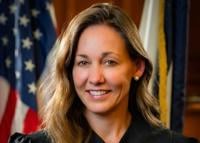


Kanawha Circuit Judge Maryclaire Akers
CHARLESTON – A Kanawha County judge did not violate the state’s judicial ethics code when she went discussed West Virginia’s foster care crisis on a statewide radio program, the Judicial Hearing Board has concluded.
In its 35-page recommended decision filed June 5 with the state Supreme Court, the JHB said it found no clear and convincing evidence Kanawha Circuit Judge Maryclaire Akers violated any of the five judicial conduct rules cited in a formal ethics charge tied to her March 2025 appearance on MetroNews’ “Talkline” program.
The JHB decision comes after a March 19 evidentiary hearing and an April 13 brief from Special Judicial Disciplinary Counsel Rachael Cippoletti recommending the case be dismissed outright. The board notes Akers never has been disciplined as a lawyer or as a judge, adding the “salient facts in this matter are not in dispute” because the parties entered extensive factual stipulations.
The ethics case grew out of Akers’ response to reports that children in the custody of the Department of Human Services were being housed in hotels and at an unlicensed 4‑H facility in Kanawha County, including a child who attempted suicide while staying in a hotel. After learning of the suicide attempt and other critical incidents, Akers contacted the Supreme Court’s Division of Children’s Services to ask about the propriety of placing children in hotels and other unlicensed sites.
On Februrary 24, 2025, she entered what she labeled an “Administrative Order” requiring then-DHS Cabinet Secretary Alex Mayer and Kanawha County Assistant Prosecutor Mandy Pellegrin to appear in her courtroom to discuss how juveniles in state custody were being placed in hotels and 4‑H camps. She later entered a second order resetting the hearing for February 28 at Mayer’s request and directed a Microsoft Teams link be made available to anyone who wanted to observe remotely.
About 150 remote observers watched that public hearing where Akers heard testimony from Mayer and then‑Deputy Commissioner for Policy and Programs Lorie Bragg about the use of unlicensed placements and about critical‑incident notification procedures used by Child Protective Services.
After a recess, DHS agreed to the appointment of a monitor and to an “improvement period” designed to reduce and eventually eliminate the use of unlicensed facilities for children in its custody.
That same day, Akers entered an agreed order establishing a one‑year improvement period for DHS and appointing Supreme Court Division of Children’s Services Director Cindy Largent‑Hill as a court‑appointed monitor to report back to the judge.
Akers made no public statements about the proceeding before the February 28 hearing and agreed order, according to the stipulated facts.
On March 2, 2025, MetroNews’ T.J. Meadows invited her to appear on the March 3 edition of “Talkline” to explain the hearing and the order. During the interview, she discussed the foster care system, the use of hotels and the 4‑H camp and the purpose of the monitor and improvement period.
Judicial Disciplinary Counsel opened a complaint March 24, 2025, and the Judicial Investigation Commission later voted to issue a public admonishment, finding probable cause that she had violated several ethics provisions based on the interview.
Akers objected to the admonishment, prompting the JIC in July 2025 to authorize a formal Statement of Charges that added alleged violations of Rule 2.2, which addresses impartiality and fairness. The case then proceeded to the JHB for a full hearing.
In its recommendation, the JHB says Akers’ orders arose from specific abuse‑and‑neglect‑type cases over which she and other Kanawha County judges were exercising jurisdiction, not from a free‑standing administrative investigation. It concludes that the so‑called “administrative orders” functioned as judicial show‑cause orders, leading to a hearing with sworn testimony, findings of fact, conclusions of law and an improvement period enforced through a court‑appointed monitor.
At the same time, the decision is critical of the breadth of those orders, saying they went beyond “simple information‑gathering” and, because they were not requested by a party and imposed an improvement period on a state agency, raised separation‑of‑powers and jurisdictional concerns.
The JHB notes Akers was not charged with entering an order without jurisdiction, but says that context informs how her conduct on the radio should be viewed.
Applying the clear‑and‑convincing evidence standard, the board ultimately finds there is insufficient proof Akers violated the rules of judicial conduct. It likewise analyzes the rules governing public statements on pending or impending matters and extrajudicial activities and concludes the record does not support a violation at the level needed to impose discipline.
The JHB recommendation now goes to the state Supreme Court, which has the final say in judicial discipline matters. The justices can accept, reject or modify the board’s findings and recommendation.
Last month, Akers asked the state Supreme Court to step in and force the dismissal of the judicial ethics charges. In her May 8 petition, she notes the JHB already had said it found no clear and convincing evidence of misconduct.
Akers is being represented by Thomas C. Ryan of K&L Gates in Pittsburgh.
West Virginia Supreme Court of Appeals case number 26-259 (West Virginia Judicial Investigation Commission complaint 25-2025 and West Virginia Supreme Court of Appeals case number 25-483)