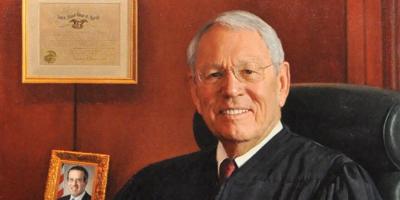


U.S. District Judge Joseph R. Goodwin
Every lawyer in America will tell you he's an officer of the court. Ask him what that means, and he'll say something like, “Well, it means I owe a duty to the court as well as to my client.” Which sounds like an answer and isn't one. He doesn't know. Almost none of us do.
I want to tell you the most important thing about that title. Lawyers are the one set of institutional officers in this country whose office the political branches cannot take away.
The Supreme Court laid the cornerstone of that principle 160 years ago, and the courts have built on it ever since. Almost nobody remembers. It's also precisely why lawyers are free to defend the courts, and the time when the courts need defending may be closer than we like to think.
The history is very important here.
Go back 700 years to England, where our profession was born. If you had business in the king's courts, you showed up yourself. Nobody else could stand in for you unless the king allowed it.
When the king did permit, the man who stood in your place was called an attorney, from an old French word meaning turned toward. Turned toward your business, by permission of the court. He wasn't selling a service. He was part of the court's own machinery for doing justice.
In 1292, the king told his judges to choose a set number of attorneys to serve the courts, and from then on the judges decided who got to be one. They examined him, swore him in and wrote his name on the court's roll. If he seriously misbehaved, they struck it off.
He had real obligations to his clients. But his oath didn't go to them. He swore to the court, to do no falsehood, to delay no man's cause for lucre or malice. Everything else he owed anybody was built on top of that promise.
The bar, by the way, was a real piece of wood. Two of them, actually.
One stood in the dining halls of the Inns of Court, where young men trained by arguing mock cases after dinner, and a railing separated the students from the senior members who ran the place. When the seniors decided a student was ready, they called him forward to that railing to argue. Called to the bar.
The other railing stood in the courts at Westminster, where counsel stood to plead and prisoners were brought. The prisoner at the bar. The case at bar.
The rail in an American courtroom, the one dividing the well from the gallery, descends from both, which is why crossing it uninvited still feels like trespass, and why lawyers cross it as of right.
The furniture has been telling the story the whole time. A lawyer's standing was never his own creation. It was conferred by an institution, at a threshold, in front of witnesses.
America merged England's two kinds of lawyer into one. The American attorney at law inherited the barrister's place at the rail and the attorney's office in court. That inheritance lives today.
When a court disbars a lawyer, it needs no statute. The power is inherent in the court's control over its own officers. That's thirteenth-century principles, still operating.
Then, just after the Civil War, the United States Supreme Court answered the question of what kind of office it is. Congress had passed a law requiring a loyalty oath to practice in the federal courts, aimed at keeping former Confederates out. Augustus Garland, an Arkansas lawyer who had served in the Confederate government, challenged it. The Court struck the law down.
Justice Stephen Johnson Field wrote that an attorney is an officer of the court, but not an officer of the United States. The office isn't a grant of political power, held at the government's pleasure. Once conferred, it can be taken away only by the court itself, through the court's own process. Congress cannot revoke it. No president can.
And that's how it works to this day. Congress doesn't license a lawyer and can't unlicense one. Admission to every federal court, mine included, is by the court's own rule, and disbarment by the court's own process.
West Virginia is cleaner still. Our Supreme Court of Appeals has long held that the power to regulate the practice of law is inherent in the court and belongs to it exclusively. The Legislature doesn't license lawyers in this state and couldn't unlicense one.
Consider what that means. Every other officer in American public life holds his position at somebody's political mercy. Cabinet secretaries serve at the president's pleasure. Agency heads can be removed, defunded, reorganized out of existence. Even judges, protected as we are, can be impeached, and our courts can be restructured by Congress.
The lawyer alone holds an office that the political branches neither granted nor can take away. A lawyer's commission runs from the courts, and only the courts can call it back.
A lawyer is, structurally, the one officer in the system who can stand up for the judiciary without asking anyone's permission.
That never has mattered more than it's starting to matter now.
Americans have been losing faith in one institution after another for decades. The courts, however, still stand as one of the few structures the public hasn't wholly abandoned.
Not because judges are better people, but because courts still do, every day and in public, the thing they claim to do. A person walks in with a dispute and walks out with a decision, reached by rules he can watch being applied.
But a court's power is a strange and delicate thing. A court order has no army behind it. It works because the people expect it will be obeyed. The losing party complies and appeals. He doesn't defy.
That expectation is the entire force of law. But it's important to remember that someone has to maintain it from generation to generation.
Judges can't do it. I've been on the bench for over thirty years, and I can tell you the office comes with a muzzle. I can't call a press conference to defend my own order. The moment I argued for my ruling in public, I'd destroy the impartiality that gives the ruling its claim to obedience. The judge speaks through the opinion and then must fall silent.
So who speaks? Who explains to the public why an unpopular decision still binds? Who stands up when court orders start being treated as suggestions?
The officers of the court do. That's what officers of an institution are for. There are well over a million lawyers in this country holding commissions from the courts, and the Garland case means their freedom to speak is secure.
The political branches never gave lawyers their office and cannot take it away. A lawyer who defends the courts risks clients, maybe, and comfort, certainly. He does not risk his commission.
The Constitution, as the Court came to understand the office in 1867, built a corps of a million independent officers around the one branch that cannot defend itself. Most of them have no idea.
The canons don't tell them. The rules describe the lawyer as an officer of the legal system with special responsibility for the quality of justice, but they were written to police individual misconduct. They assume the courts are safe and the only threat is a bad lawyer. Nobody drafted them for a time when the courts themselves need defending.
Other countries have shown what it looks like when the officers remember.
In 2007, when Pakistan's president sacked the chief justice, it was the lawyers who filled the streets, in their black suits, and the country understood the message precisely because of who was sending it. These weren't partisans. They were officers of the courts saying the courts were being broken.
In 2023, when Israel's government moved to strip its supreme court of much of its power, hundreds of thousands of Israelis marched week after week, with lawyers and jurists at the front.
Ordinary protest gets dismissed as politics. Officers defending their institution, which protects the rule of law, is a different kind of statement. The public can tell the difference.
I don't predict that American lawyers will be called to take to the streets, but I no longer assume they won't. And whether the profession could answer depends on whether lawyers still understand themselves as holding an office at all.
A bar of hired specialists has no standing to rally anybody. Why would the public listen to vendors defending their marketplace? A bar of officers has the only standing there is. You can't summon people to defend an office they never knew they held.
I got told, though nobody used words. When I raised my hand in 1970, a practicing lawyer who knew me stood up in open court, attested to my worthiness, and moved my admission before a judge who would see my face for years to come.
Nobody explained the office to me that day. The ceremony carried what the explanation would have said, and I've spent fifty years finding out what I'd been handed. Most lawyers now get neither the ceremony nor the explanation.
So this is me telling you what you hold. If you're a lawyer, you hold a commission that runs from the courts and from nowhere else, older than the republic, beyond the reach of any Congress or president. It makes you free in a way almost no one else in public life is free.
And it wasn't given for your benefit. It was given so the machinery of justice would have people bound to it, people with the standing to speak for it when it cannot speak for itself.
The defense doesn't wait for a crisis, and it mostly won't look like a march. It looks like explaining to your neighbors why a ruling they hate still binds. It looks like correcting the person at dinner who says courts are just politics in robes. It looks like saying out loud, with your name attached, that an order of a court must be obeyed, whoever it aggravates, because the alternative is a country where the strongest party wins every dispute.
Small acts of maintenance, performed by a million officers of the court, attorneys at law, generation after generation. That's what has kept court orders working since 1292, and nothing else will.
Every lawyer since then has received the same office. Most were never told what it was for. Now you've been told.
Goodwin is a United States District Judge for the Southern District of West Virginia.