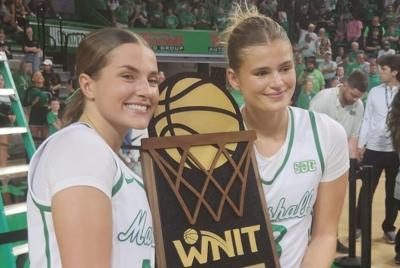


West Virginia natives Peyton Ilderton (left) and Meredith Maier helped Marshall’s women’s basketball team win the Women’s NIT earlier this year.
HUNTINGTON — A federal judge has denied a preliminary injunction sought by 14 former Marshall University and Ohio University athletes who want to compete during the 2026-27 season under the NCAA’s new “5-for-5” eligibility framework.
U.S. District Judge Robert C. Chambers denied the athletes’ motion September 2 following a hearing, saying a memorandum opinion explaining the ruling will follow.
The plaintiffs – Marshall football players Dewain “Boogie” Trotter and Demarcus Lacey, baseball player Bryce Blevins, soccer players Bailey Fisher and Ryan Holmes, tennis players Johanna Strom and Ksenia Mamontova, women’s basketball players Peyton Ilderton, Meredith Maier and Blessing King, softball player Paige Simpson and cross-country runner Hannah Wyler, along with Ohio University track and cross-country athletes Allie Martin and Leila Bouseddra – filed the federal action in August. They contend the NCAA improperly excluded athletes in the high school class of 2022 from the revised eligibility system.
The dispute follows a June NCAA decision to adopt an age-based Division I eligibility model. Under the new model, athletes generally receive a five-year period to compete, beginning either after the academic year following their 19th birthday or upon full-time college enrollment, whichever comes first. But the NCAA said athletes who used their final season of eligibility under the old rules during 2025-26 would receive no additional eligibility.
An August 21 opinion by the 10th U.S. Circuit Court of Appeals stayed a nationwide preliminary injunction in Wisne v. NCAA, a Colorado case that had allowed Class of 2022 athletes a fifth season. The stay restored the NCAA’s rules for athletes not covered by separate state-court orders and blocks, for now, the nationwide relief that had allowed qualifying athletes to compete in 2026-27 while the antitrust case proceeds.
The 10th Circuit stay means student-athletes affected by the new rule are ineligible to play for now, but they still can practice.
In an August 31 response to the local filing, the NCAA had urged Chambers to reject the requested injunction, arguing the athletes had completed the four seasons allowed under the rules governing their college careers and were asking the court to apply the 2026-27 system retroactively.
For decades, the NCAA’s Five-Year Rule allowed Division I athletes to play four seasons within a five-year period, while permitting certain waivers in defined circumstances, according to the NCAA’s court filing. The NCAA said its new policy eliminates most waivers and allows unrestricted competition during the new five-year eligibility window, subject to other eligibility rules.
The NCAA argued that changing the rules for athletes who already exhausted their eligibility would disrupt roster construction, playing time and revenue-sharing plans already made by schools and athletes for the coming academic year.
“Roster spots, playing time, and revenue sharing payments are all fixed,” the NCAA wrote. “They are zero-sum.”
The NCAA said retroactive eligibility would alter decisions made by incoming students and transfers who selected schools based partly on expected roster openings and playing opportunities.
The NCAA also said the plaintiffs did not meet the evidentiary burden necessary to support their antitrust claim. It cited the U.S. Court of Appeals for the Fourth Circuit’s decision in Robinson v. NCAA, which requires evidence defining the relevant market and showing a substantial anticompetitive effect before a court enjoins an NCAA eligibility rule.
It further argued that the plaintiffs’ West Virginia contract, consumer-protection and name, image and likeness claims failed as a matter of law. In particular, the NCAA said student-athletes were not third-party beneficiaries entitled to enforce the NCAA Division I Manual under West Virginia law and were not consumers who purchased goods or services from the NCAA under the West Virginia Consumer Credit and Protection Act.
In their September 1 reply, the athletes maintained that they are not seeking special treatment or an expansion of roster limits. Instead, they argued they should receive the same fifth-season opportunity that the NCAA is extending to athletes in the graduating classes immediately before and after them.
They argued the NCAA’s new rule effectively gives later classes five full seasons without a traditional redshirt while leaving the 2022 high school graduating class bound to the old four-season limit.
“Plaintiffs do not seek to expand roster limits generally or to displace any athlete who currently holds a roster spot,” their lawyers wrote. “They seek only parity with every other current class of Division I athletes to whom the NCAA has already extended a fifth season of competition.”
The athletes also disputed the NCAA’s assertion that they failed to show irreparable harm. Their eligibility determines whether they can compete, secure a roster position and pursue revenue-sharing and NIL compensation during the 2026-27 season, they said.
“Once rosters are set and other athletes have filled the available spots,” the athletes wrote, the lost opportunity cannot be recovered through a later damages award.
Their filing argued that the NCAA’s bylaws and constitution create enforceable obligations for which the athletes are third-party beneficiaries, particularly because eligibility affects their ability to receive scholarship, licensing, endorsement and other compensation. They also contended their claims are not based on a free-standing breach of the implied covenant of good faith and fair dealing, but rather on an alleged breach of contract evaluated through that covenant.
The federal case expanded an earlier state court challenge filed by Marshall athletes in Cabell County after the NCAA announced its eligibility overhaul. In that earlier complaint, athletes alleged that the NCAA’s exclusion of the 2022 graduating class violated the covenant of good faith and fair dealing and the West Virginia Consumer Credit and Protection Act.
The federal complaint added two Ohio University athletes and claims under West Virginia and Ohio NIL laws.
The NCAA told the court that more than 200 student-athletes had brought more than 100 lawsuits over eligibility rules during the preceding year and a half. It said appellate courts in Ohio, Tennessee and the 10th Circuit had stayed injunctions involving the five-for-five rule.
The NCAA adopted the “5-for-5” model in June, replacing its longtime framework that generally gave athletes five calendar years to play four seasons. Under the new system, Division I athletes receive five seasons of competition over five years, with the eligibility clock beginning upon full-time enrollment or at the start of the academic year after an athlete’s 19th birthday, whichever comes first. The new approach largely eliminates traditional voluntary and medical redshirt opportunities.
The rule was structured to apply prospectively, leaving out athletes who began college competition in 2022-23 and exhausted four seasons under the prior rules at the conclusion of 2025-26. Those athletes – many of whom graduated from high school in 2022 – contend the NCAA arbitrarily denied them a fifth season that other cohorts will receive, along with potential NIL and educational opportunities.
The case remains pending before Chambers. The September 2 order resolves only the request for preliminary relief.
The plaintiffs are being represented by Steve New and Emilee B. Wooldridge of Stephen New & Associates in Beckley and by Dusty Gwinn of Akers Gwinn in Charleston. The NCAA is being represented locally by Benjamin L. Bailey, Christopher D. Smith and Hannah Katherine Petros of Bailey Glasser.
U.S. District Court for the Southern District of West Virginia case number 3:26-cv-523