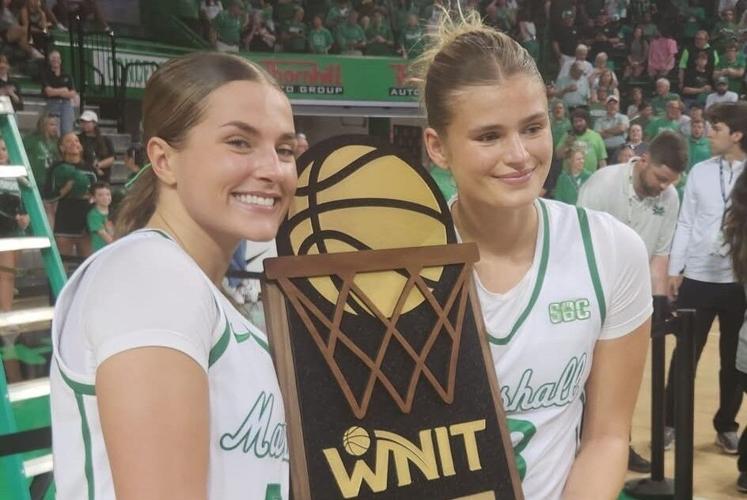


West Virginia natives Peyton Ilderton (left) and Meredith Maier helped Marshall’s women’s basketball team win the Women’s NIT earlier this year.
HUNTINGTON — A dozen Marshall University athletes and two Ohio University athletes have filed a federal lawsuit seeking immediate permission to compete during the 2026-27 season, expanding a previous challenge to the NCAA’s new five-seasons-in-five-years eligibility framework.
The complaint, filed August 24 in U.S. District Court for the Southern District of West Virginia, alleges the NCAA unlawfully excluded athletes who graduated high school in 2022 from the new “5-for-5” rule while allowing later graduating classes five full seasons of competition without a redshirt. The plaintiffs also seek protection for schools and coaches from NCAA penalties if they rely on a court order allowing the athletes to play.

New
“If the NCAA had been smart about this, they would have told student-athletes who are high school juniors right now who will be graduating in 2028 that moving forward, this rule will be adopted July 1, 2028,” attorney Steve New told The West Virginia Record. “But to try to do it in this haphazard manner and try to apply it retroactively to the Class of 2022 and those kids who played four years straight through … well, that’s why you’ve got litigation all over the country. Congratulations, NCAA. Here we are. You’re in litigation probably in 50 states.
“Just admit you screwed up, move forward and fix it. If this is the rule you want to have, great. But make it from July 1, 2028, forward. That gives these kids and universities time to adjust to the new reality.”
The filing follows an August 21 opinion by the 10th U.S. Circuit Court of Appeals on Aug. 21 stayed a nationwide preliminary injunction in Wisne v. NCAA, a Colorado case that had allowed Class of 2022 athletes a fifth season. The stay restored the NCAA’s rules for athletes not covered by separate state-court orders and blocks, for now, the nationwide relief that had allowed qualifying athletes to compete in 2026-27 while the antitrust case proceeds.
The 10th Circuit stay means student-athletes affected by the new rule are ineligible to play for now, but they still can practice.
In the case filed Monday in Huntington, the plaintiffs are Marshall football players Dewain “Boogie” Trotter and Demarcus Lacey; baseball player Bryce Blevins; soccer players Bailey Fisher and Ryan Holmes; tennis players Johanna Strom and Ksenia Mamontova; women’s basketball players Peyton Ilderton, Meredith Maier and Blessing King; softball player Paige Simpson; and cross-country runner Hannah Wyler. Ohio University track and cross-country athletes Allie Martin and Leila Bouseddra also joined the case.
All allege they graduated high school in 2022, enrolled in college in 2022 – including three Marshall athletes who enrolled early in spring 2022 – and used four seasons of competition without redshirting. They say they have roster opportunities for 2026-27 that depend on a favorable eligibility ruling.
The plaintiffs assert a Sherman Act claim, alleging that enforcement of NCAA Bylaw 12.6 unlawfully restrains competition in sport-specific Division I labor markets. They also bring claims under West Virginia law for breach of the implied covenant of good faith and fair dealing, consumer-protection violations, promissory estoppel and tortious interference.
The complaint adds claims under West Virginia and Ohio NIL statutes. The athletes argue that being declared ineligible prevents them from receiving institution-funded revenue-sharing payments and third-party name, image and likeness compensation tied to active Division I participation.
The new case follows a July 6 state court lawsuit brought by the 12 Marshall athletes in Cabell Circuit Court, also filed by New and his legal team. That complaint similarly challenged the NCAA’s decision to exclude the Class of 2022 from the new eligibility model, arguing that the athletes competed against older players who received COVID-era eligibility extensions and may have received five or six seasons.
In the Cabell County case, the Marshall plaintiffs alleged the NCAA had given former professional basketball players an opportunity to return to college competition without deducting their professional seasons from NCAA eligibility, while denying the Marshall athletes a fifth college season.
The federal complaint seeks relief from transfer-portal deadlines and from restrictions based on professional contracts signed after athletes reasonably believed their college eligibility had expired, provided those contracts are ended and compensation beyond reasonable expenses is repaid.
The athletes request a temporary restraining order, followed by preliminary and permanent injunctions barring the NCAA from using Bylaw 12.6 or another bylaw to stop them from playing in 2026-27 because they already competed in four seasons.
They also ask the court to bar the NCAA from enforcing its Rule of Restitution against them, their schools, coaches or others who facilitate their practice, recruitment, transfer, athletic aid, NIL activity or competition under a court order. That NCAA rule can authorize penalties when an athlete competes under a judicial order that is later reversed.
The lawsuit specifically asks the court to declare that Fisher, Holmes and Wyler – 2022 high school graduates who enrolled at Marshall in spring 2022 but first competed during the 2022-23 academic year – are entitled to the same treatment as fall 2022 enrollees.
The plaintiffs say a lost Division I season cannot be remedied later with money damages because it also eliminates immediate athletic, revenue-sharing and NIL opportunities. They say the NCAA can accommodate them through the House settlement’s designated-student-athlete methodology without displacing other athletes from roster limits.
The plaintiffs are being represented by New and Emilee B. Wooldridge of Stephen New & Associates in Beckley and by Dusty Gwinn of Akers Gwinn in Charleston. The case has been assigned to U.S. District Judge Robert C. “Chuck” Chambers.
The NCAA adopted the “5-for-5” model in June, replacing its longtime framework that generally gave athletes five calendar years to play four seasons. Under the new system, Division I athletes receive five seasons of competition over five years, with the eligibility clock beginning upon full-time enrollment or at the start of the academic year after an athlete’s 19th birthday, whichever comes first. The new approach largely eliminates traditional voluntary and medical redshirt opportunities.
The rule was structured to apply prospectively, leaving out athletes who began college competition in 2022-23 and exhausted four seasons under the prior rules at the conclusion of 2025-26. Those athletes – many of whom graduated from high school in 2022 – contend the NCAA arbitrarily denied them a fifth season that other cohorts will receive, along with potential NIL and educational opportunities.
U.S. District Court for the Southern District of West Virginia case number 3:26-cv-523