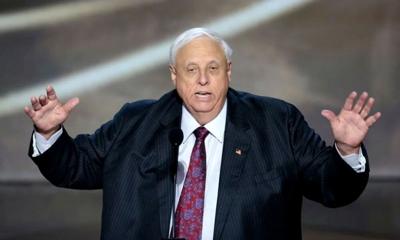



Sen. Jim Justice (R-W.Va.)
CINCINNATI — A federal appeals court has upheld a $25.2 million judgment against U.S. Sen. Jim Justice, ruling he must personally cover unpaid collateral and overdue bond premiums owed by coal companies owned by him and his family.
The 6th U.S. Circuit Court of Appeals rejected Justice’s arguments that his liability for overdue premiums was capped at about $3.5 million and that the repayment agreement should have ended in October 2021. The unanimous October 9 decision affirmed a judgment of $25,179,709.24, plus interest, in favor of Lexon Insurance Co. The interest could push the total to nearly $30 million.
“The companies’ unfortunate financial predicament provides no basis to rewrite the contract to help them,” Judge Eric Murphy wrote for the panel, which also included Judges Jane Stranch and John Bush.
The ruling adds to a lengthy record of debt disputes involving Justice and his family’s businesses. Justice, a former two-term West Virginia governor who entered the Senate in 2025, owns dozens of businesses, including coal, agricultural operations and an interest in The Greenbrier resort.
The Lexon case concerns Justice’s personal promises to pay if the companies failed to meet their obligations to the bond provider — not a direct award of reclamation costs or environmental penalties.
Lexon issued surety bonds backing the companies’ obligations to mining regulators, including requirements to restore mined land. The companies began obtaining the bonds in 2010, exposing Lexon to regulatory obligations that consistently exceeded $100 million, according to the opinion. To protect itself, Lexon required annual premium payments and collateral.
Unlike conventional insurance coverage, the surety bonds could not simply be canceled when the companies stopped paying premiums. They remained in force until the regulator released them or the companies fulfilled their obligations, the court said.
The companies began missing premium payments around 2016 as their financial condition deteriorated. In March 2018, Lexon agreed to release $5 million in collateral so the companies could pay certain debts, including reclamation expenses that would reduce obligations backed by the insurer.
In exchange, the companies promised to replace the collateral within six months and pay $3 million in overdue premiums within two months. Justice personally guaranteed those obligations.
By early 2019, the companies had not replaced any of the collateral and still owed $1.025 million in premiums under that agreement. Lexon and the companies signed a revised agreement in February 2019 requiring $20 million in collateral and monthly payments toward overdue premiums. Justice signed another personal guarantee.
The revised agreement listed an initial premium debt of $3,538,400.75. But it also provided that additional premiums would be added to the debt once they became at least 60 days overdue.
Although Lexon later agreed to modify the payment schedule, the companies ultimately provided only $5.75 million of the required collateral. They made no collateral payments after December 2019 and stopped making premium payments in March 2021, the court said.
Lexon demanded payment from Justice in July 2023. His guarantee required him to pay within three business days of receiving a written demand, but he did not, prompting the insurer to sue.
The U.S. District Court for the Middle District of Tennessee found Justice liable. After a two-day trial on damages, it awarded Lexon $14.25 million in unpaid collateral and $10,929,709.24 in overdue premiums, plus interest.
Justice argued on appeal that the agreement’s defined term, “total indebtedness,” referred only to the initial $3.5 million premium debt. The companies had paid $4.21 million in premiums beginning in February 2019, exceeding that initial figure.
But the appeals court concluded the debt was a changing amount that incorporated additional overdue premiums. Reading the initial figure as a permanent ceiling would make the provision adding new debt meaningless, Murphy wrote.
Justice’s guarantee reinforced that interpretation, describing monthly payments continuing until the debt, “including any new premiums becoming due during the term” of the revised agreement, was paid in full.
The panel also rejected Justice’s argument that a separate limitation in his guarantee capped his premium liability at the initial figure. The guarantee expressly stated a $20 million limit for collateral but referred to premium liability through the agreement’s definition of indebtedness rather than a fixed dollar amount.
Finally, Justice argued that October 1, 2021 — the extended deadline for providing collateral — was a reasonable end date for the agreement. The court ruled that the collateral deadline did not govern repayment of overdue premiums. The agreement required monthly payments “until the Total Indebtedness is paid in full,” so its term continued at least until that occurred.
Justice contended that the companies’ inability to repay could make the agreement last indefinitely. The panel said financial hardship did not permit it to change the bargain.
“At day’s end, we may not consider whether it was ‘wise or unwise, reasonable or unreasonable, usual or unusual’ for the Companies to sign the Amended Agreement or for Senator Justice to sign the guaranty,” Murphy wrote, quoting a West Virginia court decision. “Rather, we must interpret those contracts as written.”