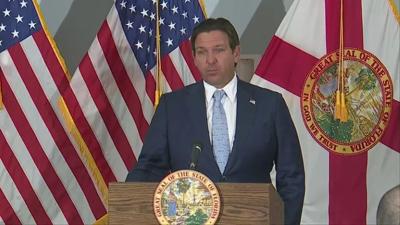



Florida Gov. Ron DeSantis
TALLAHASSEE – Hours after the U.S. Supreme Court issued a ruling regarding redistricting efforts in Louisiana, the Florida Legislature passed a new congressional map that could lead to Republicans picking up four more seats.
Gov. Ron DeSantis gave lawmakers the new map Monday, a day before a special session began to address the change. Then, the Supreme Court issued its ruling in Louisiana v. Callais that effectively stripped away what was left of Section 2 of the Voting Rights Act of 1965, making it more difficult to challenge maps that dilute minority voting power.
The ruling gave states such as Florida the invitation to be much more aggressive in drawing partisan and racially skewed districts.
During discussion of the Florida map Wednesday, lawmakers were seen reading the Supreme Court decision during debate. The state Senate took a brief break to allow review, but the House
The state Senate voted 21-17 for the map that could give Republicans four more seats in Congress. If that holds, the GOP would have 24 of Florida’s 28 seats in the House of Representatives.
DeSantis is expected to sign the map into law, and Florida Democrats already have said they’ll fight it in court. But DeSantis has appointed six of the seven justices on the Florida Supreme Court.
Before this afternoon’s Florida legislative vote, DeSantis posted on social media saying the Supreme Court ruling “invalidates the below provisions of the Florida Constitution requiring the use of race in redistricting.”
“Districts shall not be drawn with the intent or result of denying or abridging the equal opportunity of racial or language minorities to participate in the political process or to diminish their ability to elect representatives of their choice,” DeSantis quoted the ruling.
After the Supreme Court ruling, DeSantis’ general counsel David Axelman sent a copy of it to legislative leaders with a letter saying the Supreme Court ruling against the Louisiana map helps his case against racial requirements for redistricting in Florida’s own constitution, as determined by its Fair Districts Amendments.
“Much like Louisiana’s ‘intentional compliance with the court's demands constituted an express acknowledgement that race played a role in the drawing of district lines,’ Florida’s intentional compliance with the FDA would constitute such an acknowledgement and therefore would require Florida ‘to satisfy the extraordinary onerous standard of proving that its use of race was narrowly tailored to further a compelling governmental interest,” Axelman wrote. “Florida cannot do so.
“We therefore continue to urge you to enact the proposed congressional map transmitted therewith.”