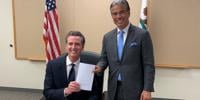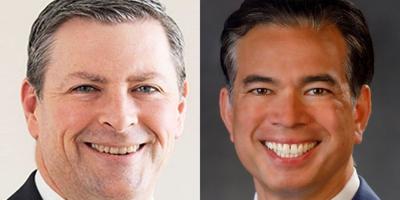



From left: Thomas More Society Executive Vice President Peter Breen and California Attorney General Rob Bonta
SAN DIEGO — The state of California must pay $4.5 million to compensate the lawyers who secured court orders blocking the state and California school districts from enforcing policies that the U.S. Supreme Court agreed trample the rights of parents by all but requiring teachers and other school staff to keep parents in the dark should their children begin identifying as transgender at school.
On March 30, U.S. District Judge Roger Benitez ordered the state to pay the millions in attorney fees to the legal team who represented parents and school teachers who challenged the law.
In the decision, Benitez noted the total amount the state must pay amounts to virtually all of the fees requested by the plaintiffs. But in the ruling, the judge said the state has no one to blame for the lopsided fee award but the state officials whose pattern of "litigation intransigence" ran up the plaintiffs' costs in fending off the state's repeated, unsuccessful bids to kill off the lawsuit and preserve the likely unconstitutional policies.
"In short, if Plaintiffs’ counsel spent time on the case that would normally be considered unnecessary, it was time most likely required to overcome the defendants’ litigation strategy of resisting at all junctures," Benitez wrote.
Benitez's ruling came less than a month since the U.S Supreme Court took the unusual step of stepping into the relatively young court fight and delivering a resounding win for the parents suing the state and the Escondido Union School District.
In the 6-3 ruling, the Supreme Court declared the state of California is almost certain to lose on the question of of whether its educational policies related to student gender information violate parents' religious freedom rights and their rights to so-called "substantive due process."
The Supreme Court majority said it believed allowing the case to play out in the lower courts, potentially with years of hearings, arguments, motions and appeals, would result in the state being allowed to enforce a policy that the majority would almost certainly eventually strike down as obviously unconstitutional, needlessly harming families in the process.
"... Under long-established precedent, parents—not the State—have primary authority with respect to 'the upbringing and education of children,'” the Supreme Court majority wrote.
"The right protected by these precedents includes the right not to be shut out of participation in decisions regarding their children’s mental health."
The Supreme Court ruling overturned a ruling from the U.S. Ninth Circuit Court of Appeals, which had, in turn, blocked an injunction issued by Judge Benitez from stopping the state and school districts from enforcing the law and policies.
The Supreme Court ruling means Benitez's injunction remains in effect, at least as applied to parents' rights to know about their children's gender status at school.
Those policies have been the subject of a legal challenge in San Diego federal court since 2023, when when two Escondido Union School District public school teachers filed suit challenging California state law and school district policies requiring them to withhold from parents information about their children's gender presentation.
In their lawsuit, the plaintiffs noted California law and school policies "forced teachers to aid in a student's 'social transition' by using any pronouns or a gender-specific name requested by the student during school, while reverting to biological pronouns and legal names when speaking with parents in order to actively hide information about their child's gender identity from them."
If asked by parents directly, they said teachers are required to respond vaguely, mislead or outright lie to parents.
In the years since, parents of San Diego County school children have joined the lawsuit, as well, saying the state law and school policies also violate their constitutional rights to know.
Some parents in the action indicated, for instance, that school officials deceiving parents about their child's gender confusion and about the role school teachers and staff played in helping the child "transition," until the moment the child attempted suicide.
The parents and teachers said the state law and school policies endanger children by intentionally cutting parents off from medically essential information about their children, but also thumb their nose at parents' and teachers' constitutional rights.
In response, the state defended the policies, saying they were based on students' privacy rights. They asserted they were needed to protect transgender children against potential abuse at home and bullying at school and elsewhere.
Benitez, however, sided almost completely with the parents and teachers. In his late December ruling, the judge blasted California officials for repeatedly asserting the guarantees of privacy rights for students under California's state constitution and state law outweighs the rights of parents under the U.S. Constitution to know medically, psychologically and religiously significant information about their children, as well as the parents’ rights to direct the religious upbringing of their children.
The judge issued a statewide permanent injunction against the state of California and any public school districts that would seek to continue the policies.
The state appealed Benitez's ruling to the Ninth Circuit, where a three-judge panel said they believed Benitez's ruling went too far and was not "narrowly tailored" enough to address the potential "harm" that the ruling could inflict on the state of California by blocking California's ruling Democratic supermajority from imposing its preferred state laws and policies.
The Supreme Court, however, threw out the Ninth Circuit's holding, as it applied to the conflict between parental right and the state's constitutional authority, ruling the parental rights should prevail.
The high court majority further slammed what they called the Ninth Circuit's misinterpretation of a recent Supreme Court ruling upholding parents' rights to direct the religious upbringing of their children.
However, despite the Supreme Court victory, Benitez noted in his new ruling that California Attorney General Rob Bonta is continuing to attempt to oppose and whittle down the reach of the Supreme Court's decision in the case, even though the state is basing those attempts on "the thinnest of arguments."
Attorneys for the challengers hailed Benitez's new ruling, saying in a statement that the decision "sends an unmistakable message to state governments and school districts across the country."
The challengers were represented in the case by attorneys with the firm of LiMandri and Jonna and with religious liberties advocacy organization, The Thomas More Society.
"If you trample the constitutional rights of parents, you will pay for it — literally,” said Peter Breen, the Thomas More Society's executive vice president and head of litigation. “California threw everything it had at this case. It lost at summary judgment, lost at the Supreme Court, and now Californians will foot the bill for their government officials’ refusal to respect the fundamental rights of families.”
Attorney Paul M. Jonna, of LiMandri and Jonna, added: “The writing was on the wall in September 2023, when Judge Benitez issued a ground-breaking Preliminary Injunction with the controlling legal analysis. Rational government actors would have abandoned these dangerous policies then and there.
"Instead, California officials doubled down, wasted taxpayer resources, and left them holding the bag for this $4.5 million fee award. The State Defendants should be held fully accountable both for their reprehensible and dangerous policies, and also for their decision to fight this losing battle in the first place. Fortunately for the nation, their intransigence backfired and provided a great blessing: a U.S. Supreme Court order undoing gender secrecy policies for the country.”