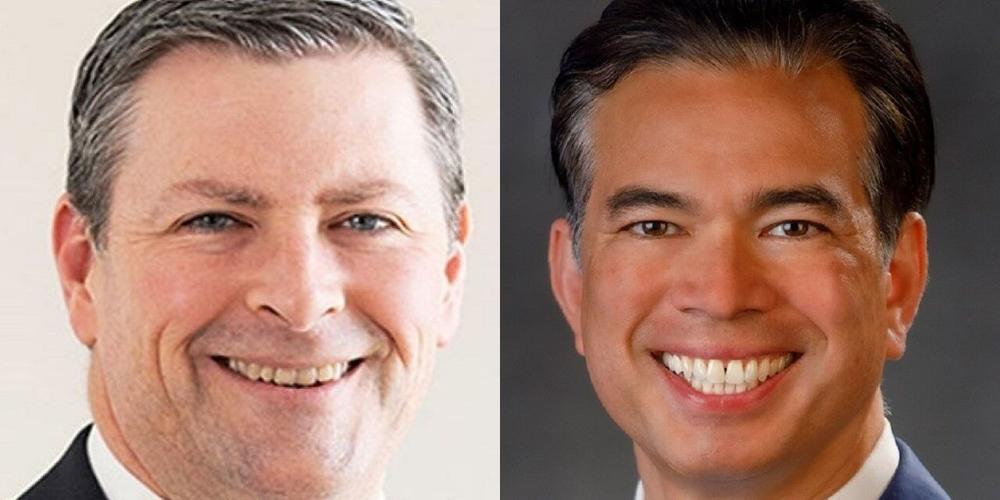



From left: Thomas More Society Executive Vice President Peter Breen and California Attorney General Rob Bonta
SAN DIEGO - Saying the state of California has trampled parents' constitutional rights to raise their children, a federal judge has blocked state education officials from enforcing a state law intentionally designed to force public school districts, teachers and other staff to keep parents in the dark about their children's gender identity.
In the Dec. 22 ruling, U.S. District Judge Roger Benitez explicitly declared public schools cannot withhold from parents or otherwise mislead parents about their students' gender expression or status at school. He said any state law or local policies that interfere with parents' right to know violates their rights under the Fourteenth Amendment and First Amendment of the U.S. Constitution.
The judge also ruled the state can't prevent teachers and school staff from telling parents about their children's gender expressions or status, without similarly violating the teachers' and staff members' First Amendment rights.
In the ruling, Benitez blasted California's ruling party for repeatedly asserting the guarantees of privacy rights for students under California's state constitution and state law outweighs the rights of parents under the U.S. Constitution to know medically, psychologically and religiously significant information about their children and the parents’ rights to direct the religious upbringing of their children.
"The state bases its legal position on a derogation of the parents’ federal constitutional right to care for and raise their children and an unwarranted aggrandizing of a student’s state-created right to privacy. California’s education policymakers may be experts on primary and secondary education but they would not receive top grades as students of Constitutional Law," Benitez wrote.
The judge also repeatedly faulted state officials for crafting laws, policies and regulations which begin at the presumption that parents do not have the best interests of their children at heart - essentially, presuming parents who learn that their children may be questioning their gender will respond with abuse and harm, and so are justified in misleading, stonewalling or outright lying to parents about their children.
The judge specifically directed the state to include a statement in their educator training materials explicitly telling public school districts and teachers that parents have "a federal constitutional right to be informed if their public school student child expresses gender incongruence" and teachers have "a federal constitutional right to accurately inform the parent or guardian of their student when the student expresses gender incongruence," regardless of California state law "to the contrary."
"The parent plaintiff class in this case do not ask schools for 'assistance' in caring for their child. Instead, they ask schools to not erect barriers and to simply permit accurate communications about the well-being of their children," Benitez wrote.
"They want an end, to use the words of the Supreme Court, of 'substantial interference' from the state public school system."
The state has indicated it will appeal Benitez's ruling to the U.S. Ninth Circuit Court of Appeals. It has also asked Judge Benitez to put his ruling on hold pending appeal.
Benitez has not yet ruled on that request. If the judge denies the request, California Attorney General Rob Bonta said his office will seek emergency action from the appeals court, saying the ruling will otherwise "create chaos and confusion among students, parents, teachers, and staff at California’s public schools."
The ruling comes as the latest step in a case that has stood at the heart of the raging legal and constitutional debate over where to draw the lines between parents' constitutional rights to direct the upbringing of their children and make health care decisions for their children and the authority of the state to protect the so-called "privacy rights" of children, particularly when their children may question their gender or expressly identify as a gender different from their biological sex.
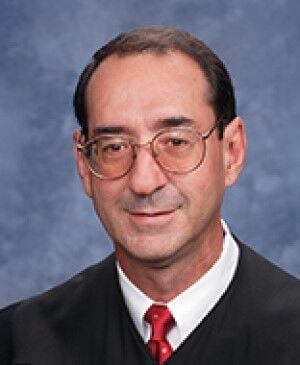
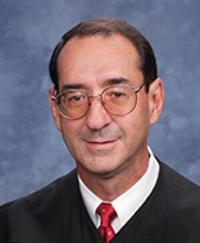
U.S. District Judge Roger T. Benitez
A number of other lawsuits and legal challenges have been filed elsewhere, including in cases in which Bonta prosecuted California school districts which attempted to enact policies requiring teachers to share such information with parents.
The case before Judge Benitez landed in San Diego federal court in 2023, when two Escondido Union School District public school teachers filed suit challenging California state law and school district policies requiring them to withhold from parents information about their children's gender presentation.
In their lawsuit, the plaintiffs noted California law and school policies "forced teachers to aid in a student's 'social transition' by using any pronouns or a gender-specific name requested by the student during school, while reverting to biological pronouns and legal names when speaking with parents in order to actively hide information about their child's gender identity from them."
If asked by parents directly, they said teachers are required to respond vaguely, mislead or outright lie to parents.
In the years since, parents of San Diego County school children have joined the lawsuit, as well, saying the state law and school policies also violate their constitutional rights to know.
Some parents in the action indicated, for instance, that school officials deceiving parents about their child's gender confusion and about the role school teachers and staff played in helping the child "transition," until the moment the child attempted suicide.
The parents and teachers said the state law and school policies endanger children by intentionally cutting parents off from medically essential information about their children, but also thumb their nose at parents' and teachers' constitutional rights.
In response, the state defended the policies, saying they were based on students' privacy rights. They asserted they were needed to protect transgender children against potential abuse at home and bullying at school and elsewhere.
Judge Benitez, however, scoffed at such assertions, saying they began with incorrect presumptions and ended at incorrect conclusions.
The judge said testimony from medical experts provided abundant proof that cutting parents out of the process and deceiving them about their children's gender presentation only produces worse outcomes.
The judge said this is true even if parents "disagree" with a student's gender expression. The judge explicitly found that "disagreement is not abuse."
"As for whether gender incongruence is an unhealthy medical condition in need of treatment, or, whether social transitioning at school is medical treatment, does not matter," Benitez wrote.
"Under the Fourteenth Amendment, parents have a substantive due process right to know of and explore whether their own child’s gender incongruence is a medical or psychological condition and whether and what kind of treatment or approach is in their child’s best interest.
"The State Defendants’ experts say that a child’s gender identity is innate. There is no evidence presented to back up that assertion. But even if there is a question, it is best answered by parents taking the child to a mental health provider to explore the question, instead of leaving a child to answer the question on his or her own."
And the judge said the schools must further respect the religious beliefs of parents and cannot use that a basis to withhold essential information about their children from them.
Citing the U.S. Supreme Court’s 2025 decision in Mahmoud v Taylor, the judge said: “… Government cannot be excused based on its desire to welcome and protect transgender students from those who believe gender is fixed. A public school, ‘cannot purport to rescue one group of students from stigma and isolation by stigmatizing and isolating another. A classroom environment that is welcoming to all students is something to be commended, but such an environment cannot be achieved through hostility toward the religious beliefs of students and their parents.’”
The judge noted religious parents have the right to find alternative ways of educating their children, including private school or homeschooling.
But the judge said such options are significantly more limited for many families, particularly those in lower income communities.
For those parents, the judge said, the state law and school policies leave them facing “an unlawful choice along the lines of ‘lose your faith and keep your child in public school, or keep your faith but lose public schooling.’”
The judge further rejected the state’s attempt to argue accommodating the religious rights of parents and teachers would be too cumbersome, given the current realities in California’s public schools.
“… This is a problem of the State Defendants’ own making. It is not a defense justifying broad-based trenching on individual rights. When the State drops an elephant in the middle of its classrooms, it is not a defense to say that the elephants are too heavy to move,” Benitez wrote.
The plaintiffs were represented by attorneys from the Thomas More Society, a Chicago-based non-profit constitutional advocacy legal organization specializing in religious freedom claims; and the firm of LiMandri & Jonna, of Rancho Santa Fe, California.

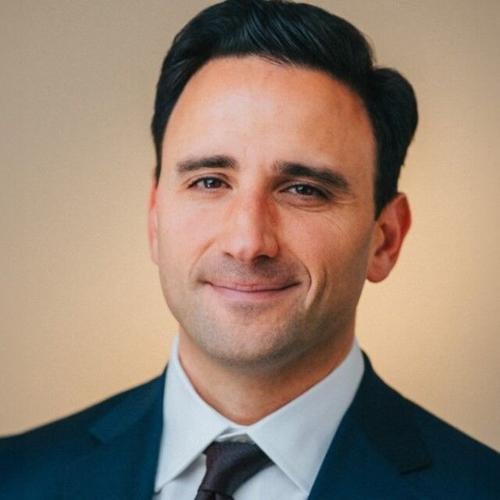
Paul M. Jonna
Following the ruling, the plaintiffs and the attorneys for the teachers and parents praised the judge's sweeping decision and reasoning.
“Today’s incredible victory finally, and permanently, ends California’s dangerous and unconstitutional regime of gender secrecy policies in schools,” said Paul M. Jonna, of LiMandri & Jonna. “The Court’s comprehensive ruling - granting summary judgment on all claims - protects all California parents, students, and teachers, and it restores sanity and common sense. With this decisive ruling from Judge Benitez, all state and local school officials that mandate gender secrecy policies should cease all enforcement or face severe legal consequences.”
The plaintiffs' lawyers also applauded Benitez for seeing through what they described as attempts by the state to even deceive the judge about the state's continuing enforcement of the policies at the heart of the case.
In their release following the ruling, they asserted Bonta and the state "misled the court by claiming these policies were no longer enforced, only to be caught red-handed enforcing them in mandatory teacher training" as recently as mid-November.
“The State knew this was a losing legal battle and tried to pull out every lawyer’s trick in the book to avoid responsibility,” said attorney Jeffrey M. Trissell, of LiMandri & Jonna. “The Court saw right through this blatant gamesmanship. It’s an absurdity that California elected officials went out of their way to deceive parents and punish honest and faithful educators who dared to challenge their twisted political agenda.”
Thomas More Society Executive Vice President Peter Breen added: “This case exposed a troubling pattern of agenda-driven adults injecting political ideology into schools, undermining trust between educators and parents, and ultimately harming children.
"Most reasonable people agree: schools should be about teaching the basics—reading, writing, arithmetic — not confusing students about gender identity. This ruling restores focus to real education and honoring the centuries-long belief that parents alone have the right to direct their child’s moral and religious upbringing, as reaffirmed by the Supreme Court this year,” Breen said.
In the ruling, the judge noted the decision does not address a California state law, known as AB 1955, which specifically prohibits school districts from forcing teachers to tell parents whenever their child may ask to be identified as a gender different from their biological sex.
That law is the subject of separate litigation, which remains pending.