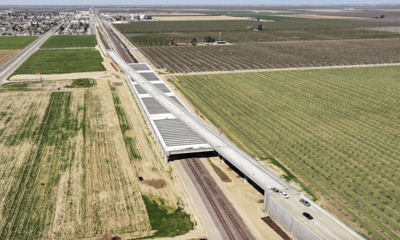


The Wasco Viaduct in Kern County is one of the major infrastructure components completed thus far on California’s Central Valley high speed rail line course. In all, just 60 miles of that 171 mile segment has been completed between Merced and Bakersfield, with costs ballooning from initial estimates of $30 billion, with a completion date of 2020, to more than $106 billion as of early 2026, with an estimated completion date now pushed back to 2033.
LOS ANGELES — New state legislation would weaken oversight of California’s high-speed rail megaproject and could allow the project’s inspector general to withhold embarrassing financial information from the public, a former Los Angeles city controller has warned.
In a recent opinion piece, former Controller Laura Chick said Assembly Bill 1608, authored by Rep. Lori Wilson (D-Suisun City), could lead to a “brazen and deeply troubling” retreat from transparency concerning the California High-Speed Rail Authority. The bill was filed one day before the authority moved to settle ongoing litigation about the transit project by approving a $537.3 million change order, according to Chick.
“The timing has raised serious concerns among lawmakers that the bill is designed to shield embarrassing or damaging information related to cost overruns, hundreds of prior change orders and more than $1 billion paid to a single contractor from public scrutiny,” the opinion piece states.
But the authority maintains it is committed to transparency.
“The authority operates with a level of transparency that is unmatched for megaprojects of this scale,” an authority spokesperson told the Southern California Record in an email. “Our budgets, schedules, risks, progress and more are regularly disclosed publicly and reviewed by the Board of Directors, state Legislature, the administration, federal partners and independent oversight bodies.”
The authority stressed that its actions take place “in full public view,” and that it is committed to that standard.
“Regarding the legislation in question, that was proposed by and impacts only the independent Office of Inspector General, which is separate and distinct from the authority,” the spokesperson said. “The authority is, and will continue to be, subject to all relevant state transparency requirements.”
The state legislative counsel’s analysis of AB 1608 indicates that the measure would revamp the inspector general’s role so that the IG could withhold audit reports if the reports contain certain information that could harm the project.
“The bill would prohibit the inspector general from making that report publicly available if it determines that the report would describe or otherwise reveal weaknesses that could be exploited by individuals attempting to harm the interests of the state or inappropriately benefit from the project,” the legislative counsel’s digest of AB 1608 says.
Chick’s opinion piece noted that the state’s high-speed rail project, which aims to connect population centers in the Bay Area, Central Valley and Southern California, has faced cost overruns, delays and litigation.
“State auditor reports and countless investigative journalism stories have repeatedly documented systemic dysfunction in what is now a multibillion-dollar undertaking,” Chick said. “The appropriate response to this history is more oversight, not less.”
In 2024, Republican U.S. senators on the Senate Committee on Commerce, Science and Transportation said the project was initially billed as costing $33 billion, with a completion date in 2020. But the estimated cost soared to nearly $130 billion, with the authority offering no firm date for its completion, the senators said.
Last year, the Trump administration terminated about $4 billion in unspent federal funding for the project. And an additional $175 million in funding for projects related to high-speed rail in the state were subsequently withdrawn by the Federal Railroad Administration.