
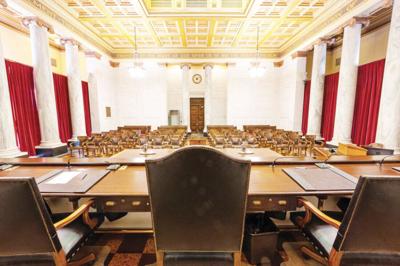



CHARLESTON – The state Supreme Court has dismissed an appeal by the Logan County Board of Education in a student sexual abuse lawsuit, saying it lacks jurisdiction because the circuit court never actually decided the board’s immunity or statute of limitations defenses.
In a May 15 memorandum decision, the justices unanimously dismissed the school board’s appeal in a 2022 civil case filed by former Logan High School student Elizabeth Vestal who says she was sexually harassed and assaulted by LHS band director Brandon Willard in the early 2000s.
Vestal alleges Willard began sexually harassing her when she was a sophomore in 2003 and that his conduct escalated to repeated sexual assaults on school property, at band camp and on trips through the summer of 2005, all while she was under his care and control as a student.
Vestal sued the board and Willard, claiming the board is liable for negligence, including failing to protect her, supervise its employee and act on warning signs.
Logan Circuit Judge Kelly Codispoti later denied several motions to dismiss filed by the board as untimely, refusing to reach the board’s arguments about governmental immunity, the constitutionality of West Virginia’s expanded childhood sexual abuse “savings statute” or whether the claims were time‑barred.
The board then appealed, asking the Supreme Court either to order the claims dismissed outright under the Governmental Tort Claims and Insurance Reform Act or to issue a writ of prohibition stopping the case from going forward.
In Friday’s unsigned decision, the justices say their jurisdiction generally is limited to final judgments, with a narrow exception that allows immediate appeals when a circuit court denies a motion to dismiss based on statutory immunity under the Tort Claims Act. They say that exception does not apply in this case because the Logan County order “presents no adverse ruling predicated upon statutory immunity.”
Instead, Codispoti concluded that only the board’s first pre‑answer motion—raising improper venue—was timely, and it denied three later Rule 12 motions solely because they were filed without leave of court and in violation of consolidation rules, not because of any determination about immunity or limitations.
The court also rejected the school board’s claim that the circuit court’s failure to reach the immunity question amounted to an “effective denial” of protection.
“Absent an order reflecting a denial of the board’s motions predicated on the statutory immunity conferred by the Act, we lack jurisdiction to grant relief,” the court wrote.
The justices also declined the board’s request to convert the appeal into a prohibition proceeding aimed at blocking enforcement of the February 6 order and reviving its statute of limitations defense.
The memorandum notes that the circuit court has never ruled on whether Vestal’s claims are time‑barred, and that the Supreme Court typically will not convert an appeal into an extraordinary writ without a suitable trial‑court order containing findings and conclusions on the issues presented.
In a concurring opinion, Justice Bill Wooton emphasized what he called a straightforward but often‑overlooked procedural rule: a defendant gets one pre‑answer Rule 12 motion, and only one.
He detailed the board’s series of filings – an initial motion to dismiss or transfer for improper venue on October 24, 2022, followed by a punitive damages motion, an amended motion to dismiss raising immunity, statute of limitations, constitutional and other defenses and then a renewed venue motion.
“The board in this case did precisely what Rule 12(g) prohibits: it filed piecemeal motions under Rule 12 seriatim, four separate motions one after another,” Wooton wrote. He said the board effectively waived those defenses at the pre‑answer stage and must now raise them, if at all, through other procedural vehicles such as summary judgment by failing to include immunity and statute‑of‑limitations arguments in its first Rule 12 motion.
The Supreme Court’s decision means Vestal’s lawsuit returns to Logan Circuit Court for discovery and further proceedings, with no appellate ruling yet on whether the board is immune, whether it can be sued for negligent hiring and supervision under the Tort Claims Act, or whether the Legislature constitutionally revived her claims by extending the statute of limitations for childhood sexual abuse.
Those substantive issues – highlighted during April’s oral arguments – will have to be developed in the trial court before any future appeal.
Vestal, who turned 18 in 2004, filed suit nearly two decades after the alleged abuse, relying on amendments passed in 2016 and 2020 that expanded the time for survivors to bring civil claims against both perpetrators and institutions that aided, abetted or concealed abuse. Her attorney, Josh Miller of Toriseva Law in Wheeling, argued that the extensions reflect a strong public policy choice to protect victims who may not be able to come forward until much later in life, and they say courts in other states have upheld similar revival provisions.
The school board maintains that the old two‑year limitations period expired long ago and that it, as a political subdivision, can only be sued for negligence within the bounds of the Tort Claims Act, not as a direct “perpetrator” or for aiding or concealing abuse. It also has argued that applying the newer statute retroactively violates its substantive due process rights, a contention Vestal’s lawyers dispute under U.S. Supreme Court precedent.
West Virginia Supreme Court of Appeals case number 24-163 (Logan Circuit Court case number 23-C-10)