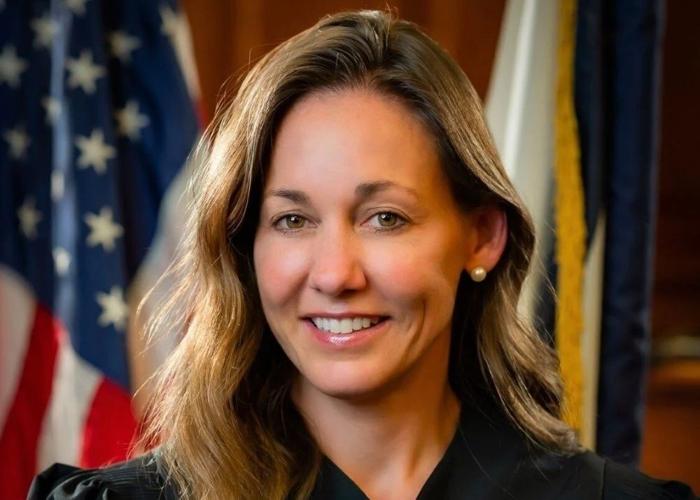




Kanawha Circuit Judge Maryclaire Akers
CHARLESTON – The state Judicial Hearing Board has refused to throw out ethics charges against Kanawha Circuit Judge Maryclaire Akers, even after the special prosecutor handling the case told the board the evidence does not meet the “clear and convincing” standard and recommended the case be dismissed.

Lorensen
In a May 4 order, Judicial Hearing Board Chairman Judge Michael Lorensen denied Akers’ April 30 motion to dismiss, saying the board lacks authority to terminate a judicial disciplinary case based solely on Special Judicial Disciplinary Counsel’s recommendation and that the ultimate decision on discipline rests with the state Supreme Court of Appeals.
The case stems from a 2025 Judicial Investigation Commission complaint over comments Akers made in a statewide radio interview about foster care and child abuse and neglect cases, for which the JIC first issued an admonishment that Akers formally challenged.
After taking over the case in late 2025, Special Judicial Disciplinary Counsel Rachael Cipoletti and Lauren Knight conducted discovery, including depositions of Akers, Judicial Disciplinary Counsel Terri Tarr and Akers’ witnesses, before a March 19 evidentiary hearing before the board.
In an April 13 brief, Cipoletti told the board that “after an investigation and a fair presentation of all the evidence, the evidence fails to meet the burden of clear and convincing evidence on the charges as alleged against Judge Akers” and explicitly “recommends this matter be dismissed and that the parties bear the costs of their own litigation.”
Akers filed an April 21 response agreeing the charges should be dropped and asking the board to award her attorney fees under Rule 4.13 of the Rules of Judicial Disciplinary Procedure, which allows a judge who is “exonerated for any reason” to recover reasonable fees from the state if the fee schedule was pre‑approved.
Her counsel, Thomas Ryan of K&L Gates in Pittsburgh, followed up with the April 30 motion to dismiss, arguing that once Cipoletti seeks dismissal and the respondent consents, the board must grant it so long as the request is made in good faith.
In his six‑page order, Lorensen said Akers’ motion “fails for three reasons.”
First, he said a key 2024 state Supreme Court ruling applies when “the state seeks a dismissal and the defendant consents.” But in this case, Cipoletti only recommends dismissal and does not seek, or even recommend, an award of fees and costs, which Akers separately requests.
Lorensen’s order also says the Supreme Court of Appeals is the “final arbiter of judicial discipline,” not Cipoletti or the Judicial Hearing Board, meaning neither a prosecutor’s recommendation nor even a joint stipulation of dismissal could bind the court.
Lorensen’s order emphasizes that even admissions or stipulations by a judge and disciplinary counsel about facts or rule violations do not bind the court, which must independently determine whether misconduct occurred and what, if any, sanction is appropriate.
“Accordingly, even a stipulation of dismissal by Special Judicial Disciplinary Counsel and the Respondent would not be binding on the Judicial Hearing Board or, ultimately, the Supreme Court of Appeals,” the order states.
The denial keeps the ethics case alive for now, despite Cipoletti’s conclusion that the record does not support the charges and its recommendation that the matter be dismissed.
The JHB had previously ordered the parties to file post‑hearing briefs by May 4. With the new order, the deadline for any additional briefing has been extended to May 11.
The board also must now prepare a written recommended decision to send to the Supreme Court of Appeals including findings of fact, conclusions of law and proposed discipline, which could include a recommendation that there is no clear and convincing evidence of any violation.
On the separate question of fees, a draft proposed order attached to Akers’ filings would have recognized that she submitted a fee request in July 2025 that was approved by then‑Court Administrator Joe Hoover and would have allowed her to pursue reimbursement, but the board’s latest order expressly leaves any ultimate disposition to the Supreme Court.
West Virginia Judicial Investigation Commission complaint 25-2025 (West Virginia Supreme Court of Appeals case number 25-483)