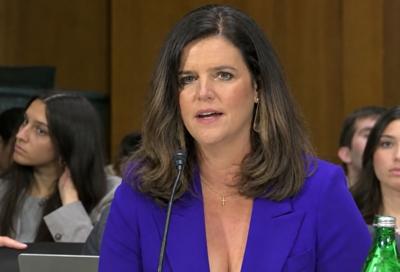


Lindsay Owens of Groundwork Collaborative
WASHINGTON – A progressive advocacy group led by a former adviser to Sen. Elizabeth Warren has been circulating a blueprint for congressional investigations of corporate America. But parts of its case remain unwritten.
Under the heading “How Eli Lilly Makes Health Care More Expensive,” the 181-page Groundwork Collaborative dossier offers only “TK,” an editorial placeholder for material still to come. The entry nevertheless includes a breakdown of the drugmaker’s political contributions and lobbying expenditures. Elsewhere, a proposed hearing’s goals include the incomplete sentence: “A hearing on how private equity firms TK mobile home residents.”
The document has drawn criticism from Washington insiders who questioned its quality and suggested it showed signs of artificial intelligence-generated writing. One former congressional staffer, speaking anonymously to the New York Post, called it “AI slop for headlines.”
Groundwork denies AI wrote the dossier. Senior vice president Alex Jacquez told the Post staff members used AI during research but spent hundreds of hours preparing the document over six months. He described it as a “living document” intended to help congressional committees, not a finished publication for public consumption, and said corrected versions were being circulated.
The controversy offers a window into an organization seeking to turn its arguments about corporate power and high prices into congressional action. It also exposes the political calculations behind its proposed investigations – and puts renewed scrutiny on the research methods and institutional backing of a group led by Lindsay Owens, a former senior economic policy adviser to Warren (D-Massachusetts).
Founded in 2018, Groundwork describes itself as “part communications shop, part think tank, and part issue advocacy organization.” Its mission includes changing economic policy and public narratives, building public power and breaking up concentrations of private power.
The dossier carries that mission into detailed recommendations for lawmakers, identifying companies to investigate, questions to ask and witnesses to call. One proposed surveillance-pricing hearing lists Owens herself among its potential witnesses.
Corporate allegations and political calculations
The document opens with the heading “Politically Corrupt Corporate Targets.” Its introduction says Groundwork has begun gathering research on companies that could become “high-value oversight targets” under a potential Democratic congressional majority.
The criteria include what companies or executives have given President Donald Trump, what benefits they have received and whether they have engaged in “bad or abusive actions.” Initial targets include Apple, Amazon, Oracle, Tesla and SpaceX, along with private prison operator GEO Group and other businesses.
The document pairs corporate conduct with political donations and administration decisions, presenting the connections as avenues for investigation. In some passages, it explicitly weighs a subject’s usefulness to Democrats.
In a section discussing an egg-industry enforcement case, the authors write: “Trump’s DOJ ultimately brought this case to light, so it may not be as useful for Democrats to champion this as other corporations.”
A separate entry on FedEx acknowledges federal prosecutors dismissed criminal charges against the company in 2016, then describes the matter as “a strong allegation.” The passage flags a dismissed prosecution for possible congressional scrutiny without explaining what evidentiary weight it should carry.
Other sections are plainly unfinished. Entries on tenant-screening companies and an apartment landlord contain “Political considerations” fields filled with “TK.” The Eli Lilly entry also leaves its “Additional Considerations” incomplete.
The Post reported an AI-detection review supplied to the newspaper flagged numerous sections. Jacquez countered that Groundwork’s own review classified the document as 97% human-written. Those competing assessments do not independently resolve authorship.
Groundwork has defended the project as help for Democrats preparing an oversight agenda focused on affordability and corporate conduct.
“We are fully in service of getting the Democratic caucus in the House and the Senate everything they need to deliver what people said that they wanted on Tuesday — which is relief from crushing high prices and a stop to the corruption that enables this ripoff,” Jacquez told the Post.
Congressional enthusiasm is not uniform.
Semafor reported a Democratic aide described the dossier as “one of many” emails lawmakers receive. Rep. Jamie Raskin (D-Maryland) told the outlet he had not seen it and rejected selecting corporations for investigations in a “vendetta-like fashion.”
“We’re not taking people or corporations that we want to pursue in a vendetta-like fashion: That’s Donald Trump land,” Raskin said. His remarks addressed an approach to oversight, not the merits of the dossier’s individual allegations.
An established relationship with Warren
Owens’ ties to progressive lawmakers long predate the document.
An economic sociologist with a Stanford doctorate in sociology, she served as a senior economic policy adviser to Warren and as deputy chief of staff and legislative director to Reps. Keith Ellison and Pramila Jayapal. All three endorsed her appointment to lead Groundwork in 2021.
Owens is also the author of “Gouged: The End of a Fair Price – and What That Means for Your Wallet,” a book examining corporate pricing practices that has been criticized for mistaking objectionable pricing practices for the underlying causes of high costs.
“Lindsay worked every day on my team to unrig our economy and make sure it worked for all families, not just the wealthy and well-connected,” Warren said in Groundwork’s hiring announcement. Owens said then she wanted to “advance a progressive economic worldview.”
The Post, citing earlier reporting by The Washington Sun, reported Warren was among Democrats who reviewed the unfinished Groundwork dossier.
The relationship was visible again at the November 10 Popular Mandate conference in Washington. The event announcement identified Owens as president and CEO of Groundwork Action, a separately named advocacy entity, and quoted her describing the gathering as a place to turn voter demands into a governing plan.
“Popular Mandate is where we turn that demand into a plan, with a roadmap for leaders across the country to deliver,” Owens said in the announcement.
Warren’s prepared remarks called for Democrats to send Trump legislation banning price gouging and “AI surveillance pricing.” She also urged congressional accountability for corporate conduct.
Foundation backing through a fiscal sponsor
Groundwork has operated as a fiscally sponsored project of New Venture Fund, an arrangement identified in lobbying-disclosure records and by InfluenceWatch, a project of the conservative Capital Research Center that tracks advocacy organizations and their funding.
New Venture Fund describes fiscal sponsorship as a way to give projects operational expertise and support without requiring their leaders to build those functions independently. It presents the model as an efficient, cost-effective way to advance philanthropic work.
One documented source of Groundwork’s support is the William and Flora Hewlett Foundation. Hewlett’s 2020 tax return lists a $100,000 grant to New Venture Fund “for support of the Groundwork Collaborative.” Its 2021 return lists another $100,000 grant for the same purpose.
InfluenceWatch portrays the sponsorship as part of a broader liberal “dark money” network.
A disputed account of inflation
Groundwork’s economic research has faced criticism separate from the unfinished dossier.
A January 2024 report said corporate profits “drove 53 percent of inflation” during the second and third quarters of 2023. Ryan Bourne, an economist at the libertarian Cato Institute, argued the analysis treated an accounting breakdown as a causal explanation.
Strong demand can raise both prices and profits while wages adjust more slowly, Bourne argued. Under that explanation, higher profits are partly a result of the conditions producing inflation rather than an independent cause.
He also challenged Groundwork’s comparison of consumer prices with a producer price index, noting the producer measure tracks prices businesses receive rather than simply the input costs they pay. Drawing on calculations by New York University economist Chris Conlon, Bourne argued the estimated contribution from profits changed sharply when a longer period was examined.
PolitiFact later examined Groundwork’s research while checking a corporate-pricing claim by then-Sen. Bob Casey (D-Pennsylvania). Most economists it interviewed identified rising production and labor costs as inflation’s primary drivers, while allowing that corporate profit-taking could contribute.
Owens has advocated forceful government responses to corporate conduct. After the Federal Trade Commission acted against former Pioneer Natural Resources CEO Scott Sheffield over an alleged price-fixing conspiracy, she called for Congress to tax oil companies’ windfall profits and issue refunds to Americans. She also urged criminal prosecution of Sheffield.
The oversight dossier seeks to its advocacy into congressional investigations. It recommends information requests, hearings and potential legislation, while evaluating corporate targets partly through their political ties and usefulness to Democrats.
Whether lawmakers adopt those recommendations remains to be seen. The version circulated outside the organization offers an expansive investigative agenda but an unevenly completed foundation: In the Eli Lilly entry, political contributions are itemized, while the explanation of how the company makes health care more expensive remains “TK.”