
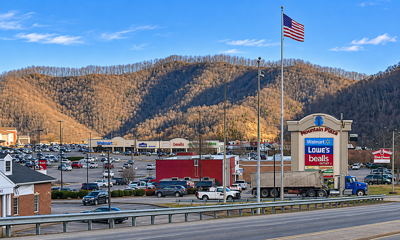



Fountain Place shopping center in Logan
CHARLESTON – The state Intermediate Court of Appeals has upheld the dismissal of a shopping center developer’s lawsuit seeking continued payments from the City of Logan under a decades-old agreement that promised the developer 57% of business and occupation tax revenue collected at the property.
In its November 6 opinion, the ICA ruled that state law shielded the city from the debts of its dissolved development authority and that years of payments did not require Logan to keep paying. The court sent the case back to Logan Circuit Court Judge Joshua Butcher for further proceedings, including resolution of the city’s pending counterclaims against Fountain Place LLC.
“The fact that the city continued to pay 57% of the B&O taxes collected from the subject property after the Development Authority was dissolved did not require the City to continue making such payments after it realized its error,” Judge Ryan White wrote for the court.
The dispute stems from a 1997 development agreement among the city, the City of Logan Development Authority and Monterra, Fountain Place’s predecessor. Monterra was developing a shopping center on land then outside city limits. In exchange for its agreement not to oppose annexation, the city and authority promised payments equal to 57% of annual business and occupation taxes collected from businesses operating at the shopping center.
The agreement ran for 20 years and gave the developer the option to extend it for another decade. It also exempted Monterra and its successors from business and occupation taxes related to construction, rental and leasing activities at the property, according to the opinion.
Monterra declared bankruptcy in 1999 after incurring substantial development costs, including excavation expenses. A federal bankruptcy court assigned its rights under the agreement to Fountain Place, which completed the shopping center.
The development authority dissolved around 2013, though the opinion said the record did not establish exactly how or why. Logan continued paying Fountain Place directly. The company exercised its renewal option in 2016, extending the agreement through July 22, 2027. The city did not object and continued payments through May 2021, when it concluded it had no legal obligation to keep paying.
Fountain Place sued in August 2023 for breach of contract and a declaratory judgment. Butcher dismissed the lawsuit in July 2025.
In affirming that decision, the appeals court relied on state statutes that separate a development authority’s debts from those of the municipality that created it. One statute limits creditors to recovery against the authority and its property. Another transfers an authority’s assets to its sponsoring government upon dissolution but does not transfer its liabilities.
“If the Legislature had intended liabilities, as well as assets, to go to municipalities and counties when a development authority dissolved, it could have drafted the statute to say so,” White wrote.
The ICA also rejected Fountain Place’s argument that the city’s continued payments prevented it from later denying responsibility. That argument relied on equitable estoppel, a legal doctrine that can prevent a party from taking a position inconsistent with its earlier conduct.
The court said estoppel could not compel a municipality to exercise powers it lacked. It also concluded that Logan acted in a governmental, rather than commercial, capacity when it used annexation, taxation, zoning and public funding to encourage the development. The city did not own or operate the shopping center or collect rent from it, the opinion noted.
The ICA did not decide whether the agreement violated the state constitution’s limits on municipal debt, an issue the circuit court had cited in dismissing the case. It said the statutory and estoppel questions were sufficient to resolve the appeal.
Attorneys for the city were pleased with the opinion.
“Obviously, we and the City of Logan are thrilled the ICA upheld the very-well reasoned ruling from Logan County,” Karen McElhinny told The West Virginia Record. “It’s a good decision for the taxpayers of the City of logan. I have to give all of the credit to (attorney) Paul Ellis. His expertise in municipal law is amazing. The fact that he identified this issue, and we prevailed through multiple layers of court is a testament to his legal prowess.”
Ellis also praised the ICA opinion.
“This has been going on for a while,” he told The Record. “We’re very pleased with the ruling. It’s very well-reasoned, and it’s accurate. The city had paid these folks for a long period of time, and it turns out they shouldn’t have been.”
Fountain Place was represented by Kent J. George, Jonathan C. Stanley and Mary G. Williams of Robinson & McElwee in Charleston. The defendants were represented by McElhinny and Austin J. Longnecker of Shuman McCuskey Slicer in Charleston, by Ellis of Ellis Law Offices in Charleston (Logan and development authority) and by Joseph A. Ford and Wesley A. Shumway of Spilman Thomas & Battle in Charleston (Fountain Place Realty and Namdar DG Realty).
West Virginia Attorney General J.B. McCuskey’s office filed an amicus brief in the case in support of the Logan respondents.
West Virginia Intermediate Court of Appeals case number 25-ICA-334 (Logan Circuit Court case number 23-C-106)
